I once spent three months manually updating a spreadsheet that a $15/month tool could have automated in seconds. I told myself I was being ‘lean.’ I was being an idiot. Here is everything I have learned about the difference between the two.
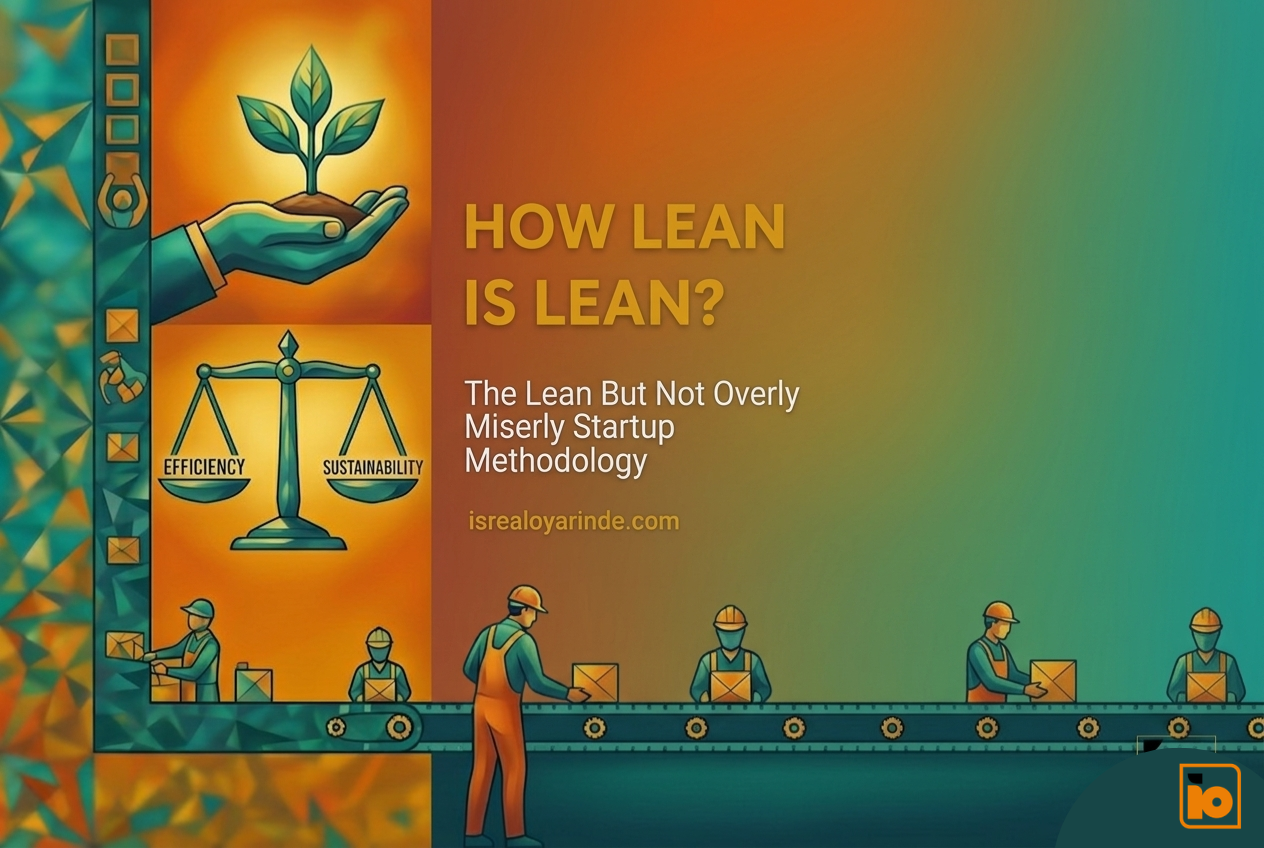
As a business owner, there is a fine balance between being lean and being miserly. Starting out in business, some of my decisions were wasteful, and now, I try to be efficient and judicious with resources.
However, being efficient and lean does not mean “starving your business.” It does not mean refusing to experiment or trying to extract as much value as possible without loosening up a growth constraint.
We hear stories of Jeff Bezos using a door as a desk, or Nigerians soaking garri for years while building their hustle, and we internalize a dangerous lesson, which is not the main point they are trying to pass across by the way, that suffering is a KPI. It is not. Suffering is a bug, not a feature.
The difference between being lean and being Miserly is that one optimizes for speed of learning and the other optimizes for an inevitable death.
What “Lean” Actually Means (Thank You, Eric Ries)
Let us start with what lean actually means because the word has been abused more than “disruptive” at a Lagos tech meetup. Eric Ries published The Lean Startup in 2011, and the core idea is deceptively simple: minimize waste by building only what customers actually want, using a Build-Measure-Learn feedback loop.
You build a Minimum Viable Product (MVP), measure how customers respond, learn from the data, and iterate. The goal is validated learning, not validated suffering.
Ries was influenced by Toyota’s lean manufacturing, where waste (“muda”) is anything that does not add value for the customer. Notice that Toyota did not say “use the cheapest steel” or “skip quality control to save money.” They said eliminate unnecessary steps. That is a critical distinction.
Y Combinator’s data on thousands of startups tells an interesting story. According to their analysis, the number one reason startups die is not running out of money — it is building something nobody wants.
The second biggest killer is running out of cash, but often because the founders spent money on the wrong things (fancy offices, premature hiring, vanity marketing) rather than on validating their core hypothesis. Paul Graham famously said startups do not die from starvation; they die from indigestion. Spend on learning. Cut everything else.
The Penny Wise, Pound Foolish Trap
True Lean Methodology is about minimizing waste, not minimizing spending. Building something nobody wants is the ultimate waste. Using capital to find out what customers actually want faster? That is lean.
It is easy to confuse the two, and experience is the best teacher, but even seasoned founders still get it wrong. Here is a simple example: say you refuse to pay for a $20/month software subscription (roughly ₦30,000) that would automate a 5-hour task, choosing instead to do it manually to “save money.”
If you value your time as a CEO at even ₦5,000 per hour — which is extremely low — that 5-hour task costs the company ₦25,000 every single time you do it. The software costs ₦30,000 for the whole month. By being “miserly,” you are actually burning equity and executive bandwidth on administrative chaff.
Your job as a business owner is to know what problem you solve and what outcome you create. Everything else is overhead. And overhead should be automated, delegated, or eliminated.
Now, there are legitimate reasons to be careful with spending. If paying for the tool will adversely affect your runway, then spending some extra time to handle a task manually so you can redirect resources into where you are seeing more traction is worth it.
Also, not all tools really optimize your process. One thing I do every year is audit and eliminate pricey tools and find better deals to avoid tool bloat. Some Nigerian SaaS tools worth knowing about:
- Paystack (payment processing) — 1.5% + ₦100 per transaction. The gold standard for Nigerian startups. Cheaper than building your own payment system, and infinitely more reliable.
- Mono / Okra (open banking APIs) — Starting at about $50/month for basic plans. If you need bank verification or account linking, building this yourself would cost you months and a compliance headache.
- Termii / Sendchamp (messaging/notifications) — SMS from about ₦4/unit. Cheaper than losing customers because they never got their OTP.
- BudPay / Flutterwave (multi-currency) — Essential if you are doing cross-border payments. The cost of not having this is losing international customers entirely.
- Notion / Google Workspace — Free to $12/month per user. The cost of NOT having documentation and collaboration tools is knowledge silos and chaos.
The Cost of Cheap Talent
If you are starting out, I think you are better off with people who have intermediate expertise, for want of a better phrase. When you are pre-revenue, shelling out for top talent that does not have structure to excel will only cause you to waste resources because they will charge top rates.
However, once you have traction, two things must happen: first, make sure the people who started with you grow as the company grows; and second, stop trying to hire the cheapest possible staff.
For example, a senior developer will obviously charge more. In Nigeria, a solid mid-level full-stack developer charges between ₦500,000 to ₦1,500,000 monthly. A junior might cost ₦150,000 to ₦300,000.
That looks like savings until you realize the junior will delay your time to market by three to six months and create technical debt that will crash your software on launch day.
When you optimize solely for cost extraction rather than value creation, your product feels “enshittified” from Day One. I have been there. It cost me a year on a relevant product launch.
The cost of fixing bad code, re-hiring after firing the incompetent cheap hires, and the reputational damage of a buggy launch is always higher than the cost of hiring right the first time.
Y Combinator’s Sam Altman (before he went off to run OpenAI) used to say that you should spend the first 25% of your budget on getting the best possible first three to five hires. Because those people set the culture, the code quality, and the operational DNA of your company. Cheap out on them and you are building on sand.
Infrastructure Is Not a Luxury
We have obvious, if unique, infrastructure challenges in Nigeria. Investing in tools to make your work smooth is not optional —it is essential. My two best purchases work-wise are my fully off-grid solar and inverter system and my Starlink.
My biggest issues used to be electricity and internet connectivity: network failing and electricity going off during meetings with clients. Since I optimized for those two, even though the upfront cost was significant, my productivity has increased dramatically.
I do not like working if there is no light or working in heat, and solving those problems has massively improved my work rate. You cannot run a “lean” remote startup by refusing to buy an inverter or a reliable internet connection. It is operational suicide.
Government incompetence is a feature of the Nigerian landscape, and a fixed cost you must factor in.
Let us talk real numbers on connectivity in Nigeria (2025/2026 prices):
- Starlink: Hardware kit around ₦440,000 (one-time), monthly subscription about ₦38,000 for residential. Speeds of 50-200 Mbps depending on congestion in your area. The most reliable option for remote work, hands down.
- Fiber (MainOne, ipNX, Spectranet fiber): Monthly plans from ₦20,000 to ₦100,000+ depending on speed. Great speeds when it works, but installation can take weeks and availability is limited to certain areas in Lagos, Abuja, and Port Harcourt.
- 5G (MTN, Airtel): Routers from ₦80,000 to ₦150,000, data plans from ₦15,000/month. Coverage is expanding but still patchy outside major cities.
- 4G MiFi (the Nigerian default): Cheap hardware (₦15,000-₦30,000) but unreliable speeds and data caps that will have you rationing bandwidth like NEPA rations electricity.
If your customer support agent cannot answer calls because “NEPA took light,” you are losing the Lifetime Value (LTV) of customers. If a competitor has a better offer and is reliable, the switching costs become negligible. Your customer will move. Lean means spending money to remove friction so you can move faster.
If your “savings” create friction, you are doing it wrong.
The Trust Premium
Nigeria is a low-trust country, and an aspirational one too. Looking cheap is expensive. It is also the reason why people will take you more seriously if you step out of a gate in a clean car.
It is ironic that we want the best value, so you need to justify your cost, while also making yourself, your brand, and your services look premium. This extends to the investment space. Investors pay 3-5x more on due diligence in Nigeria because of the lack of reliable data. Fraud and trust deficits are structural forces.
If you try to be lean by skipping audits, skipping background checks, or using a free email address like gmail.com instead of @yourcompany.com, you are signaling risk. Clients will haggle harder, investors will doubt your numbers, and partners will ask for 100% upfront payment because you look like a flight risk.
There is a reason the Big Four accounting firms charge what they charge in Lagos. A PwC or KPMG stamp on your financials is not just an audit —it is a trust signal. For smaller startups, you may not need a “Big Four” auditor, but you do need a proper domain email, a clean website, registered business (CAC), and professional-looking proposals. These are not vanity, they are trust infrastructure.
When to Be Miserly vs. When to Be Lean
So how do you balance it? It depends on where you are and where your business is going. But here is a practical framework:
Be Miserly On Vanity
- Do not rent a Lekki Phase 1 office to impress people who will not buy your product. A co-working space or your living room will do just fine until revenue says otherwise.
- Do not print branded swag (T-shirts, hoodies, water bottles) before you have paying customers. Nobody cares about your logo yet.
- Do not hire a “Head of Strategy and Business Development” when you have not sold one unit. That is you. You are the head of strategy. Go sell something.
- Do not buy a company car. Use Bolt or Uber. If the ride is tax-deductible, even better.
- Do not sponsor events or conferences to “build brand awareness” before you have product-market fit. Build awareness by having a product people actually talk about.
Spend Smart On Validation and Systems
- Spend on paid ads to test if people actually click your offer: A ₦50,000 Meta Ads experiment can save you ₦5,000,000 in building the wrong product.
- Spend on a good lawyer: You need to sort your co-founder agreement (or any agreement really) properly. The cost of a co-founder dispute without a signed agreement is the entire company.
- Spend on data and analytics: You cannot size your market by guessing. Track who buys what, when, and why.
- Spend on security: Implement No-Trust systems early —background checks, inventory tracking, access controls. These are cheaper than theft and reputational damage.
- Spend on infrastructure: power, internet, and the tools your team needs to do their jobs without friction.
The Bottom Line: Velocity Is the Goal
Movement is the only defence. Money in a startup is fuel. If you refuse to put fuel in the car because you want to “save money,” you are sitting in a parked vehicle watching your competitors drive past.
The lean startup methodology was never about suffering. It was about intelligence —spending every naira where it creates the most learning, the most validation, and the most progress. Being miserly is spending nothing and learning nothing. Being wasteful is spending everything and learning nothing. Being lean is spending deliberately and learning everything (or at least enough to make sense).
Do not starve your business in the name of cost-saving. Feed it strategically. Cut the fat, but never cut the muscle. Your startup is not a diet, it is a machine. And machines need fuel, maintenance, and the occasional upgrade.
As the Yoruba say, “Ẹni tó bá fara mọ́ iṣẹ́, iṣẹ́ á fara mọ́ ọn.” Whoever commits to the work, the work commits to them. Commit your resources wisely, and the returns will commit to you.