April 23, 2026

11 minute

Isreal Oyarinde

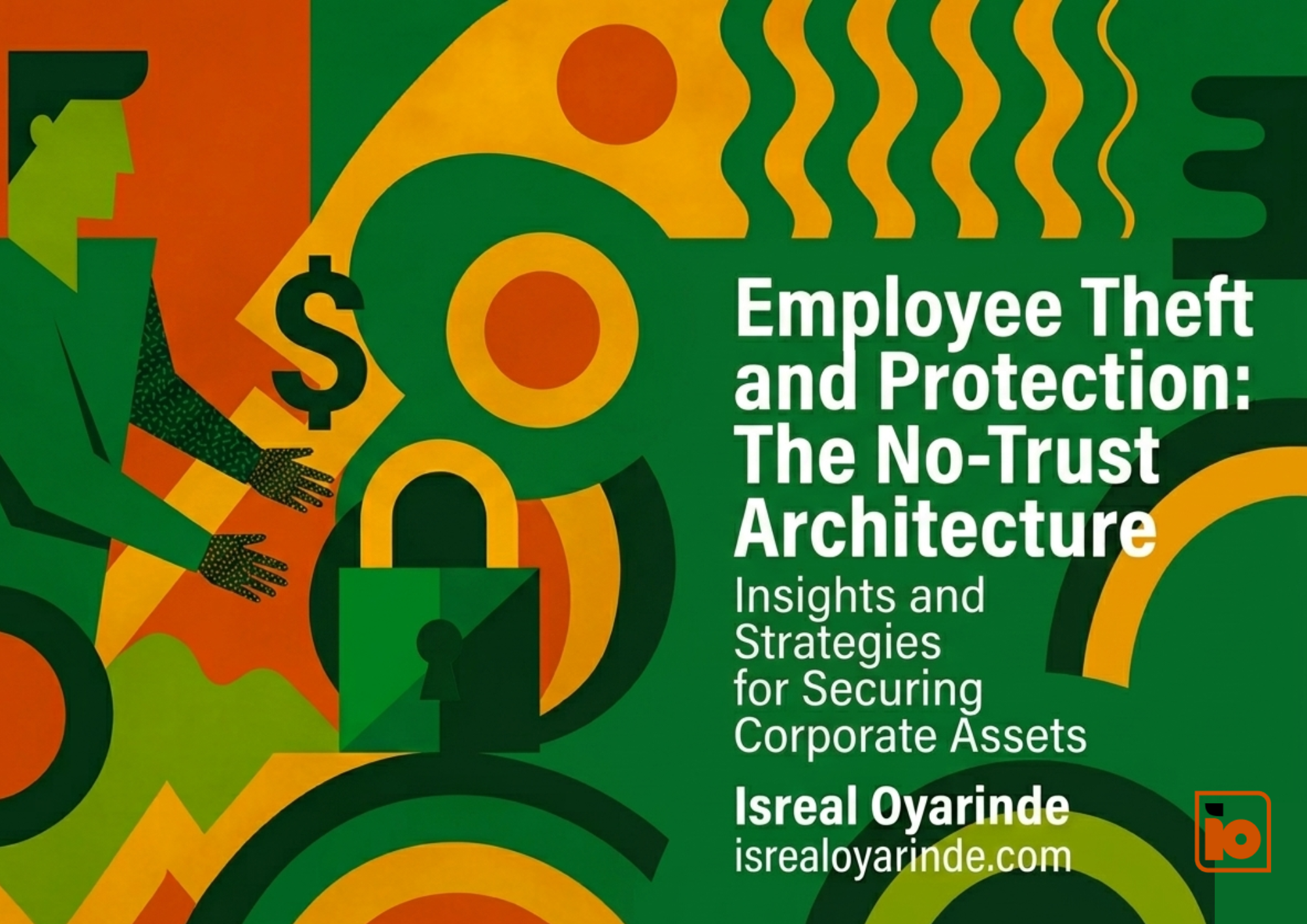
Employee Theft and Protection: The No-Trust Architecture

Table of Contents

The Day I Caught My Own Cashier

I remember the exact moment I knew something was wrong. It was a Thursday evening in 2019, and I was going through the day’s sales records at one of our retail outlets in Lagos. The numbers looked fine on paper. Actually, they looked a little too fine. Every transaction was perfectly rounded. No kobo balances, no odd figures. Just clean, whole numbers. And if you have ever sold anything in Nigeria, you know that is not how reality works. Reality is messy. Reality has N3,475 and N11,250 and change that nobody wants to carry. But this ledger? This ledger was fiction.

I stayed back that night and told the team I had a meeting. Then I sat in the back office and tried to make sense of the accounting. What I discovered made my stomach turn. My cashier, a young man I had trained, personally vouched for, and even given a salary advance just two months earlier had developed a system. He would ring up items at a lower price, pocket the difference, and at the end of the day, adjust the books. He had been doing it for at least three months. The total? Over N800,000. That is not petty theft. That is a second salary.

Although, I felt really betrayed, I did not shout. I did not fight. I sat with the pain for about two days before I acted. Because the truth is, it was not just about the money. It was the betrayal. You bring someone in, you trust them, you build something together and they are quietly bleeding you dry. That experience changed how I think about business security forever. It is what led me to what I now call the No-Trust Architecture. And no, it is not about being heartless. It is about being smart.

As the Yoruba elders say, “Ẹni máa jẹ oyin inú àpáta, kì í wo ẹnu àáke” -the person who wants to eat honey embedded in a mountain will not be bothered about the effect on the axe. If you want to protect your business, you cannot be afraid to look closely at the people running it.

This post is going to be long. It is going to be detailed. It is going to make some of you uncomfortable, because you will recognise your own businesses in this post. But I would rather you be uncomfortable now than bankrupt later. Let us get into it.

Why Nigerian Businesses Are Bleeding Money Silently

According to SMEDAN, over 80% of small and medium enterprises in Nigeria fail within their first five years. We like to blame the economy, the government, the exchange rate, NEPA sorry, PHCN or whatever they are calling themselves this week. But the truth that nobody wants to say out loud is this: a significant percentage of these businesses die because the owner’s own staff killed them from the inside.

Employee theft in Nigeria is not an occasional problem. It is an epidemic. It is so normalized that some business owners have simply built it into their cost structure. I have heard people say, ‘just add 15% to your pricing to cover what staff will steal.’ Budgeting for robbery is not a business strategy. That is Stockholm syndrome.

The EFCC deals with the big fraud cases, the million-naira corporate theft, the politicians, the Yahoo boys driving Benz. But who is dealing with the cashier that takes N5,000 a day? Who is tracking the warehouse manager that ‘damages’ three cartons of stock every week? Who is watching the procurement officer that inflates every invoice by 20% and splits the difference with the supplier? Nobody. Because we have accepted it as the cost of doing business in Nigeria.

Here is what makes it worse, most business owners do not even know they are being stolen from. They see declining profits and blame the market. They see shrinking inventory and blame the supplier. They see rising costs and blame inflation. Meanwhile, the thief is sitting right there in the office, greeting them ‘Good morning, Oga’ every day with a smile that costs them millions. Here is what makes it worse, most business owners do not even know they are being stolen from. The people stealing from you will not look like thieves. They will look like your most loyal employees.

The Seven Faces of Employee Theft

Before we talk about solutions, we need to understand the problem. Employee theft in Nigerian businesses is not one thing, it is at least seven different things, and each one requires a different approach. Let me break them down.

1. The Classic Cash Theft – This is the most straightforward form. The cashier takes money directly from the register, the sales person underreports daily takings, or the accountant siphons funds through fake expenses. In a country where cash is still king, despite everything the Central Bank has tried to do with the cashless policy. I have seen cashiers develop systems so sophisticated that they could teach a masterclass on creative accounting. One woman I heard about would ring up every tenth transaction without recording it. Just skip it entirely. At the end of the day, she would reconcile by adjusting quantities on other transactions. Genius, honestly. Evil, but genius.

2. Inventory Theft (The Warehouse Ghost) – This is where products simply disappear. They walk out of the warehouse in staff bags, in delivery trucks making unauthorised stops, or they get ‘damaged’ with alarming frequency. A friend of mine who runs a provisions store in Surulere told me he was losing an average of N150,000 worth of stock every month to ‘breakage and spoilage.’ When he installed cameras, the breakage mysteriously dropped to almost zero.

3. Time Theft (The Invisible Drain) – This one does not show up on any ledger, but it costs you just as much. Staff who clock in and then disappear for hours. Drivers who take personal detours on company fuel. Employees who run their own side businesses using your internet, your electricity, your office space, and your time. I once discovered that one of my team members was running a full online store using our company laptop, during working hours, from our office. When I confronted him, he looked genuinely confused. ‘But Oga, it is just a side hustle.’ A side hustle that was costing me about 25 hours of productive work per week.

4. Procurement Fraud – This is the big one. Your procurement officer collects three quotes as required, but all three suppliers are either his friends or companies he has a stake i n. The prices are inflated, the kickback is split, and you pay 30-50% more for everything from office supplies to raw materials. Trusted employee, unchecked authority, and zero oversight is a recipe for procurement fraud.

5. Data and Intellectual Property Theft. Your sales manager who just resigned and took your entire customer database with him. Your developer who got a better offer and copied your source code. Your marketing coordinator who has been sending your campaign strategies to a competitor for months or exporting your email lists. In the digital age, your data is your business, and most Nigerian SMEs have absolutely zero protection against digital theft. No NDAs, no access controls, no audit trails. Nothing.

6. Vendor Collusion – This is when your employee and an external vendor work together to defraud you. The delivery driver confirms receipt of 100 units when only 80 were delivered. The accounts payable clerk processes duplicate invoices from a friendly supplier. The maintenance officer approves work that was never done. These schemes can go on for years because they require you to audit not just your internal records, but also cross-reference them with external parties.

7. Expense Fraud – Fuel receipts for trips never taken. Hotel bills for conferences that do not exist. Meal allowances claimed on days the employee was not even in the office. Receipts in Nigeria are easy to fabricate as any roadside business centre with a printer can produce official-looking receipts for any amount. I have seen employees submit fuel receipts that, if real, would mean they were driving from Lagos to Abuja and back every single day.

There are so many ways to get burned as an entrepreneur which unfortunately also means that there is no one fool-proof method to prevent theft across different businesses. However, that doesn’t mean you are completely helpless.

Before I get into building a system, I would like to touch on two main issues that I think business owners must be aware of, the role of CCTVs and the need to unbundle financial authority within the business.

CCTV Is Not Enough – The Camera Illusion

The first thing every Nigerian business owner does after getting burned is install CCTV cameras. I know because that was my first reaction too. And listen, CCTV is important. I am not saying do not get cameras. Get cameras. Put them everywhere. But understand what cameras actually do and what they do not do.

Cameras are reactive, not proactive. They record theft, they do not prevent it. A camera will show you what happened after the money is already gone. And here is the dirty truth about CCTV in Nigerian businesses: half the time, nobody is watching the footage. The DVR is recording somewhere in a dusty corner, overwriting itself every 72 hours, and the only time anyone looks at it is when something big goes missing. By then, the evidence might already be gone.

I have seen businesses spend N2 million on a CCTV system and then not bother to review the footage for months. That is not security. That is decoration. It is like buying a fire extinguisher and leaving it in the packaging. The tool only works if you use it.

Also, a camera is only useful in certain contexts. A CCTV cannot catch digital fraud, procurement kickbacks, time theft, intellectual property theft, and most forms of collusion. The camera cannot see what is happening in your accounting software. It cannot read the WhatsApp messages between your procurement officer and his favourite vendor. It cannot detect that your payroll has three ghost employees.

So yes, install cameras. But if cameras are your only line of defense, you are building a house with one wall. You need a complete system, not just one tool.

Separation of Duties

This is the foundation of the No-Trust Architecture, and it comes straight from accounting best practices that have existed for centuries. The principle is simple: no single person should have complete control over any financial process from start to finish. The person who approves a purchase should not be the person who makes the payment. The person who receives inventory should not be the person who records it. The person who processes payroll should not be the person who authorises it.

In practice, this means restructuring your operations so that every critical business process involves at least two independent sets of eyes. Let me give some examples.

For cash management: one person handles the register, a different person reconciles the daily takings, and a third person makes the bank deposit. No single person touches the money at every stage. For procurement: one person identifies what needs to be purchased, a different person sources the quotes, and a third person approves the final vendor selection. For inventory: one person receives the goods and signs the delivery note, a different person counts and verifies the received goods, and a third person updates the inventory system.

‘But Oga Israel, I am a small business. I do not have all these people.’ I hear you. And that is a valid concern. But separation of duties does not always require more staff. Sometimes it means you as the business owner becomes one of the checkpoints. You personally verify the bank deposits. You personally spot-check the inventory. You personally review the procurement quotes before approval. Yes, it is more work but it is less work than rebuilding after someone steals your entire profit margin.

The moment one person controls the entire chain, you have created the perfect conditions for theft. It is not a matter of if, it is a matter of when. As my grandmother used to say, “Eni ti a ran si oja, o le ma ra t’ara e?” meaning, can the person sent to the market not buy something for themselves? The answer is, of course they can. Your job is to make sure you know when they do.

The No-Trust Architecture: A 15-Point Protection Framework

After years of building, getting burned, and rebuilding, I have developed what I call the No-Trust Architecture. This is not about being paranoid or treating your staff like criminals or putting in place bureaucracy that makes it difficult to run the business effectively.

It is about building systems where theft is structurally difficult, not just morally discouraged. Here are fifteen principles that I follow religiously:

  1. Separate every financial process into at least two roles – No single person should initiate, approve, and execute any transaction. Ever.
  2. Install POS systems that log every transaction with timestamps – Cash registers that produce paper trails are your best friend. Go digital wherever possible.
  3. Conduct surprise audits at least once a month – Not scheduled audits, surprise audits. The moment staff know the schedule, they clean up before inspection day.
  4. Rotate staff across positions every six months – A cashier who knows she will be moved to inventory next quarter cannot build a long-term theft system. Rotation also reveals discrepancies the previous person was hiding.
  5. Use numbered receipts and invoices – Every missing number is a red flag. If receipt number 4,571 is followed by 4,573, find out what happened to 4,572.
  6. Reconcile bank statements daily, not monthly – By the time you catch a monthly discrepancy, the trail is cold and the money is gone.
  7. Require dual signatures for all payments above a threshold – Set a limit, say N100,000 above which no payment can go out without two authorised signatures.
  8. Install CCTV and actually review the footage weekly – Cameras you never check are just expensive decorations. Always review your footage. It’s boring but necessary work.
  9. Implement a whistleblower system with real protection – Anonymous reporting channels where staff can report theft without fear of retaliation. Reward verified reports.
  10. Lock down your accounting software with role-based access – Your cashier should not be able to edit historical records. Your inventory clerk should not see the financial reports. Use permissions aggressively.
  11. Verify every vendor independently – Do not take your procurement officer’s word for it. Call the vendor yourself occasionally. Visit their premises. Confirm prices directly.
  12. Conduct exit interviews and access revocation immediately – When someone leaves, voluntarily or not, cut their system access the same day. Not tomorrow. Today.
  13. Track inventory with barcode or RFID systems – Manual inventory counting is an invitation to fraud. Technology makes discrepancies visible instantly.
  14. Cross-reference POS data with CCTV footage regularly – The camera should show a customer at the register every time the POS shows a transaction. Mismatches may signal something fishy is going on.
  15. Build a culture where accountability is normal, not punitive – The goal is not to catch thieves. The goal is to make theft so difficult and so detectable that nobody even tries.

When You Catch a Thief: What to Do Next

This is where most Nigerian business owners fumble. You have caught someone stealing. Now what?

The instinct is either to rage and fire them immediately, or to confront them quietly and let them go without consequences. Both approaches are wrong.

If you fire without documentation, you have no legal protection if they sue for wrongful termination. Yes, they stole from you but without proper documentation, a labour court might still rule in their favour. Nigeria labour laws protect employees, even dishonest ones if due process is not followed.

Also, if you let them go quietly, you send a message to every other employee that stealing has no consequences. You are essentially putting up a sign that says ‘Steal Here -Worst Case, You Get Asked to Leave.’ That is not deterrence. Here is what you should do instead.

First, document everything. Gather CCTV footage, transaction records, audit reports, witness statements – everything. Second, conduct a formal disciplinary hearing with the employee present. Let them respond to the allegations. Third, if the evidence is clear, terminate with cause and document the termination properly. Fourth, file a police report. Yes, even if the amount seems small. The police report creates a formal record and sends a message. Fifth, inform your insurance company if you have fidelity insurance. Many businesses do not even know this coverage exists.

And here is the part nobody talks about: after you catch one thief, audit everything again. Because where there is one, there are usually more. Thieves in Nigerian businesses rarely operate alone. They build networks. The cashier collaborates with the warehouse person. The accountant covers for the procurement officer. When you pull one thread, be prepared for the whole fabric to unravel.

Building a Culture of Integrity

I want to end with something that might sound contradictory after everything I have said about not trusting people. But hear me out. The No-Trust Architecture is not about distrust. It is about removing temptation. It is about building systems where honest people can stay honest and dishonest people cannot succeed.

The best businesses I have seen in Nigeria are the ones that combine strong systems with strong culture. They pay fairly because an underpaid employee is a tempted employee. They promote transparently because a bitter employee with no prospects will rationalise theft as compensation. They lead by example because an owner who cheats on taxes and cuts corners has no moral authority to demand honesty from staff.

The system you build will determine the behaviour you get. Design for angels, and devils will exploit you. Design for devils, and angels will still thrive.

Invest in your people. Train them. Pay them well. Give them a stake in the success of the business through profit-sharing or bonuses tied to verified performance. But also build the systems that protect both them and you. The fence is not there because you do not trust the neighbour. The fence is there because good fences make good neighbours.

As the African adage goes, When the fire has finished burning, the owner of the forest will know how many trees were lost. Do not wait for the fire. Build your firebreaks now.

Build your No-Trust Architecture. Protect your business.
Related Blogs

June 16, 2026

Isreal Oyarinde

In God we trust, all others bring data. – W. Edwards Deming In 2023, I was working on a business plan for a client who wanted to launch a logistics company in Kano State. Simple enough, right? Except it wasn’t. We needed basic data.  The population of Kano metropolitan area, number of registered businesses, average household income, road network coverage, number of delivery addresses and that is where it became a nightmare. You would think this information would be readily available for the most populous state in Nigeria. You would be wrong.  The population figure we found ranged from 9 million to 16 million depending on which source you used. The Natonal Bureau of Statistics had one number, the state government had another. The UN population estimates had a third.  The World Bank used yet another figure. And the last actual census was in 2006, nearly two decades ago, when the Kano population was counted at about 9.4 million. In a state growing at maybe 3 percent annually, the current population could be anything. We were literally guessing and our guesses were not even informed by any reliable data.  The number of registered businesses? No comprehensive database exists. Average household income? The NBS does household surveys, but the sample sizes are small, the methodology is questionable, and the data is years out of date by the time it is published. Road network coverage? I called three different agencies and got three completely different answers.  Number of delivery addresses? Nigeria does not have a functional address system. Most streets in Kano do not have names. Most houses do not have numbers. How do you run a delivery company in a country where you cannot describe where people live? That experience crystallized something I had been thinking about for years. Nigeria does not have a data problem, Nigeria has a data crisis. We are running a country of over 200 million people essentially blind. We do not know how many we are.  We do not know where we live. We do not know what we earn. We do not know what we produce. We do not know what we consume. And because we do not know any of this, every policy decision is a guess, every budget is fiction, and every business projection is built on vibes and In Sha Allah. This is not a minor administrative inconvenience. This is a fundamental governance failure that affects every aspect of Nigerian life, from healthcare to education to infrastructure to security. You cannot solve problems you cannot measure. You cannot allocate resources to populations you cannot count. You cannot plan for a future you cannot model. And yet here we are, the giant of Africa, stumbling around in the dark because we refuse to turn on the light. The Census Catastrophe Let us start with the most basic data point of all. How many Nigerians are there? The honest answer is nobody knows. Nigeria’s last census was in 2006. It counted 140 million people, a number that was immediately controversial.  Northern states claimed they were undercounted. Southern states claimed the north was overcounted. Ethnic groups accused each other of inflating numbers for political advantage. The census became not a statistical exercise but a political weapon, because in Nigeria, population determines revenue allocation, political representation, and power. The 2006 census itself was riddled with problems. Enumerators were poorly trained. Some areas were inaccessible due to security concerns. The technology was outdated. There were widespread allegations of manipulation.  The results were challenged in court by several states. And yet, nearly twenty years later, this deeply flawed count remains the official basis for planning in Africa largest economy. The World Bank and the UN use projections based on this flawed baseline, which means their estimates are also unreliable. A new census has been planned, postponed, replanned, and re-postponed multiple times. The National Population Commission has been promising a new census for over a decade. Each time, the exercise is derailed by political disagreements, funding shortfalls, or security concerns. Meanwhile, the gap between our population estimates and reality grows wider every year. Are we 210 million? 220 million? 230 million? Nobody can say with confidence, and the margin of error is not a few percentage points but potentially tens of millions of people. The political dimension of the census cannot be overstated. In Nigeria, population is money and power. Federal revenue allocation is partly based on population. States with larger populations get more money. The number of House of Representatives seats is based on population. So every census becomes a high-stakes political battle.  Until we can decouple the census from resource allocation, or find some way to make the count politically neutral, we will continue to fight over numbers instead of collecting them. NBS and the Methodology Problem The National Bureau of Statistics is supposed to be the authoritative source of data on the Nigerian economy and society. In fairness, the NBS does important work with limited resources. But the limitations are severe, and they undermine the reliability of virtually everything the NBS publishes. Take the unemployment figure for example. For years, the NBS reported Nigeria’s unemployment rate as being in the low single digits, which was laughable to anyone who had walked through any Nigerian city and seen the armies of young people with nothing to do. The problem was methodological.  The NBS was using the International Labour Organization definition of unemployment, which counted anyone who had done even one hour of work in the past week as employed. A man who washed one car for two hundred naira on a Saturday was classified as employed. A woman who sold three sachets of pure water on a Monday was employed. The definition bore no relationship to the reality of Nigerian labour markets. Eventually, the NBS adopted a broader measure that better captured underemployment and disguised unemployment, and suddenly the combined unemployment and underemployment rate jumped to over 33 percent. The economy had not changed. The measurement

May 25, 2026

Isreal Oyarinde

Every four years, Nigerians go to the polls looking for a messiah. Not a president, not a governor, not a local government chairman —a messiah. Someone who will fix the roads, bring light, lower prices, create jobs, cure corruption, and somehow make garri affordable again. All at once. Preferably within the first 100 days. And every four years, we are disappointed. Shocked, even. As if the last ten electoral cycles did not teach us anything. I am not saying the government does not matter. It matters enormously.  But there is a dangerous gap between what the government should do, what the government can do, and what Nigerians expect the government to do. And that gap is where our collective frustration lives. So let us have an honest conversation: can the government solve all our issues? Should it even try? The Nigerian Messiah Complex We have a peculiar relationship with government in Nigeria. We simultaneously despise it and depend on it completely. We curse the governor on Twitter and then write him a letter begging for school fees. We call politicians thieves, then queue up at their houses for “stomach infrastructure” during elections. This is the Messiah Complex at work. The belief that somewhere out there, there is a leader who, if only they could get into power, would transform Nigeria overnight. Tinubu will do it. Obi will do it. Atiku will do it. Insert-name-here will do it. Nobody is doing it. Not because they are all individually terrible (though some are), but because the expectation itself is impossible. No single human, no single administration, can fix a country with 200 million people, 36 states, 774 local governments, hundreds of ethnic groups, decades of infrastructure neglect, institutional decay, and a culture that treats public office as a personal ATM. The Messiah Complex is not just naive. It is actively harmful. It encourages passivity. If the government is supposed to fix everything, then your role as a citizen is simply to wait, complain, and vote every four years.  You do not organize your community. You do not maintain your street. You do not build parallel systems. You just wait for the saviour who never comes. Our streets have failed, created wealth through corruption, and took a lot from the society we have.  Where we differ is there is no real debate about whether the government should do more. The overwhelming demand, the overconsumption of government promises, and the lack of proper systems and due process all combine to create the illusion that more government is always the answer. What Government Should Do (And Cannot Escape) Let me be clear. There are things that only the government can and should do. As an entrepreneur, I am all too aware of the costs of government failures in my business. These crucial services are non-negotiable, and no amount of “self-reliance” rhetoric changes this. These are the government’s core functions. The problem in Nigeria is not that the government tries to do these things. The problem is that it fails spectacularly at them while simultaneously trying to do a hundred other things it has no business doing. What Government Should Not Do (But Tries Anyway) Here is where it gets controversial. The Nigerian government has a long history of inserting itself into areas where it has no comparative advantage, usually with disastrous results. The fuel subsidy, which cost Nigeria over N4 trillion in 2022 alone, is the mother of all price control disasters. Instead of letting the market price signal direct investment into refining capacity, we spent decades subsidizing consumption of imported fuel, enriching a cartel of importers, and starving the economy of resources for health, education, and infrastructure. The government is terrible at targeting, terrible at distribution, and terrible at verification. The common thread in all these failures is that the government tried to be a market actor instead of a market enabler. The government should create the conditions for economic activity —stable rules, fair enforcement, sound infrastructure not try to be the economy itself. The Private Sector Gap Now, some of you are thinking: “If the government steps back, the private sector will fill the gap.” And in many areas, that is true. Nigerian entrepreneurs are among the most resilient and creative in the world.  We build fintech platforms that bypass broken banking infrastructure. We create logistics networks that work despite terrible roads. We generate our own electricity. We dig our own boreholes. We are, in many ways, already running a parallel economy. But the private sector has its own limits, especially in Nigeria. This is the fundamental tension: the government is terrible at delivering services, but the private sector will not deliver them to everyone. There are market failures that only the government can address, and there are government failures that only markets can correct. The answer is not more government or less government. It is better government in its lane, and more space for private enterprise in theirs. Self-Reliance in a Failed State Let me tell you a story. In my estate in Lagos, we got tired of waiting for the government to fix our road. It had been bad for three years. We wrote letters. We called the local government. We tagged the governor on Twitter. Nothing happened. So we taxed ourselves. Every household contributed. We hired a contractor. We fixed the road. Cost us about ₦15 million collectively. It has lasted longer than most government roads, probably because we supervised the contractor ourselves instead of letting someone’s cousin do it with substandard materials. This is self-reliance in a failing state. And it is happening all over Nigeria. This is not ideal. It creates a two-tier society where the wealthy can buy their way out of government failure while the poor suffer. But it is the pragmatic response to a government that collects taxes and delivers almost nothing in return. If you treat the government like a service provider, you have purchasing power to ask: why am I paying this

May 25, 2026

Isreal Oyarinde

I grew up in a household where the highest compliment anyone could give you was that you were ‘sharp.’ Not intelligent, not hardworking, not creative —sharp. Being sharp in the Nigerian context meant you knew how to navigate difficult situations, avoid trouble, and squeeze something out of nothing.  Sharpness was the supreme virtue because sharpness kept you alive, and in a country where systems fail regularly and institutions cannot be trusted to protect you, staying ahead economically, physically, and socially was the primary objective.  Nobody talked about the growth mindset. The conversation was always about today. How to survive today; how to eat today; how to pay rent today. And I understand why.  Why the Growth Mindset is the Most Important Skill You Will Build  When your daily existence is a series of obstacles that require all your energy and ingenuity just to survive, thinking about personal growth feels like a luxury you cannot afford. But the truth is that the survival mindset, while necessary and even admirable, is also a trap.  It keeps you alive but it also keeps you exactly where you are. It is like treading water, you do not drown, but you do not go anywhere either. The growth mindset is what takes you somewhere, and developing it in a country like Nigeria is one of the most important and most difficult things you will ever do.  Understanding the Survival Mindset and Why Nigeria Breeds It Before we talk about growth mindset, we need to understand what we are working against. The survival mindset is not a character flaw. It is a rational response to an irrational environment.  When you live in a country where inflation can wipe out your savings overnight; where your employer can owe you six months of salary without consequence; where a medical emergency can bankrupt your entire extended family; and where the government’s primary function seems to be extracting resources from citizens rather than providing essential services, the first instinct you develop is survival.  When this is your reality, of course you develop a short-term, defensive, risk-averse orientation. You focus on immediate returns because the future is uncertain and long-term investments feel like gambling. You prioritize social capital over genuine connections because knowing the right people, being connected, being ‘plugged in’ is the ultimate strategy in a country where formal institutions do not work.  All of these make perfect sense as a survival strategy, and I would never criticize anyone for adopting it. I have seen instances where patients are turned away from public hospitals because “there are no beds”, yet one phone call to the right person could make a bedspace materialise. Personal relationships are the only reliable safety net where institutions are unforgivably weak.  But I want you to understand that while the survival mindset keeps you safe, it also keeps you small. It prevents you from taking the calculated risks that lead to breakthrough growth. It prevents you from investing in skills and knowledge that pay off over years rather than weeks. It prevents you from building businesses and institutions that create lasting value. Ẹni tí ó bá bẹ̀rù ojúbọ a lọ sí ọjà —he who fears the shrine goes to the market instead. But the market of survival only offers subsistence, not abundance. The Nigerian environment actively punishes growth-oriented behavior in subtle and not-so-subtle ways. The formal financial system offers savings rates that are consistently below inflation, which means that saving money in a Nigerian bank is actually losing money in real terms.  And if you decide to start a legitimate business, barriers to entry are so formidable that many people conclude that hustling and trading are more rational strategies than building formal enterprises. I have watched brilliant, ambitious young Nigerians get beaten down by this environment until they abandon their dreams and settle for survival. Not because they lacked talent or drive, but because the system made growth so difficult and survival so all-consuming that there was simply no space left for aspiration.  This is the real tragedy of the Nigerian survival mindset. It is not that people choose survival over growth, it is that the system gives them no other viable choice. What Growth Mindset Actually Means if You Are a Young Nigerian  The term ‘growth mindset’ was popularised by Carol Dweck, a psychologist at Stanford University, and it refers to the belief that your abilities, intelligence, and talents can be developed through effort, learning, and persistence, as opposed to a ‘fixed mindset,’ which assumes that these qualities are innate and unchangeable.  In the Nigerian context, I want to expand this definition beyond individual psychology to include a set of practical orientations that enable long-term growth despite environmental obstacles.  A Nigerian growth mindset includes the belief that you can improve through learning and effort, but it also includes the strategic patience to invest in long-term outcomes, the courage to take calculated risks in an uncertain environment, the discipline to resist the social pressure for immediate consumption, and the resilience to persist through setbacks that would crush most people.  It is not about being naively optimistic or ignoring the very real obstacles that Nigerian life presents. It is about choosing to invest in your future even when the present is demanding all your attention, and doing so in a way that is smart, strategic, and grounded in reality.  This is hard. I am not going to pretend it is easy. But it is the only path I know that leads from where you are to where you want to be. Rewiring Your Relationship with Failure and Risk One of the most crippling aspects of the survival mindset is its relationship with failure and risk. In survival mode, failure is catastrophic because you have no safety net. If your one income source fails, you cannot eat. If your small business collapses, you cannot pay rent. If you invest your savings and lose them, there is no social security system to catch you.  This fear of failure