

Over the last decade or so, the Nigerian media has witnessed an explosion of profile pieces appearing online, particularly on news websites.
You’ve likely encountered them.
They are ill-hidden, glowing, superlative-laden descriptions of entrepreneurs, tech personalities, and public figures that feel more like advertisements than features, lauding them as the best thing since agege bread.
“Meet Serial Entrepreneur Ajalenkoko Funfunleyensu,” declares one headline (real name mercifully hidden). “Olorieja Sumonu Immortalized as Certified Global Tech Hero,” trumpets another. The audacity is almost admirable.
Yet despite their ubiquity, most Nigerian media profiles leave readers like myself feeling empty, manipulated, or simply bored. They follow a predictable template: introduce the subject with hyperbolic praise, list achievements, add vague philanthropy references, sprinkle with buzzwords, and conclude that the subject is “one to watch”, somewhat akin to a well-padded CV.
The result? A sterile, one-dimensional portrait that fails to engage or convince.
These one-trick ponies represent a disconnect from the art of great storytelling and profile writing.
It’s a disservice to both subjects and audiences.
Sure, many of these pieces are paid content, but that makes the poor execution even more puzzling. Badly written sponsored profiles create a lose-lose scenario: they fail to effectively promote the subject while damaging the publication’s editorial reputation.
If you’re paying for image enhancement, shouldn’t you want something better than content that makes you and the publisher look amateurish?”
Image Laundering in Media 101 (ILM 101)
While “laundering” typically carries negative connotations, image laundering (also called reputation laundering) is the strategic use of media to clean up or enhance an individual’s or organization’s public image.
At its worst, it involves coordinated, inauthentic campaigns that artificially boost reputation. But at its best, effective image-building can be achieved through authentic, well-crafted storytelling that humanizes subjects while maintaining journalistic integrity.
Much could be said about the morality of this practice, but that’s not the focus of this piece. My aim is simply to advocate for a better approach to profile writing in Nigerian media, one that fulfills a threefold purpose: publishers maintain credibility, subjects get authentic representation, and readers get content worth their time.
A Tale of Many Profiles
Let’s examine two contrasting approaches to profile writing.
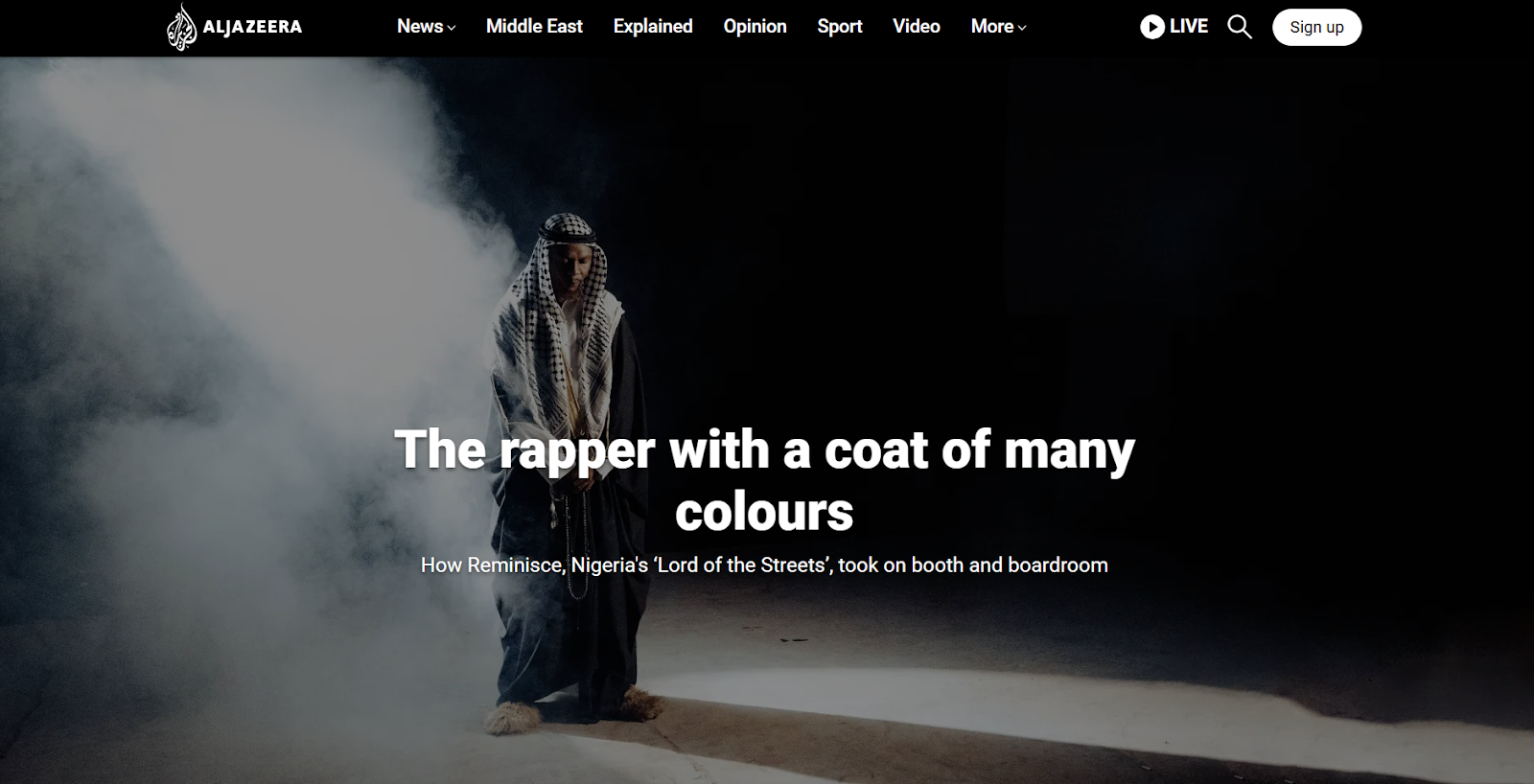
First is Al Jazeera’s profile of Remilekun Khalid Safaru, popularly known as ‘Reminisce, ‘ written by Ayomide Tayo (his profile of DJ Y.K. Mule is also excellent).
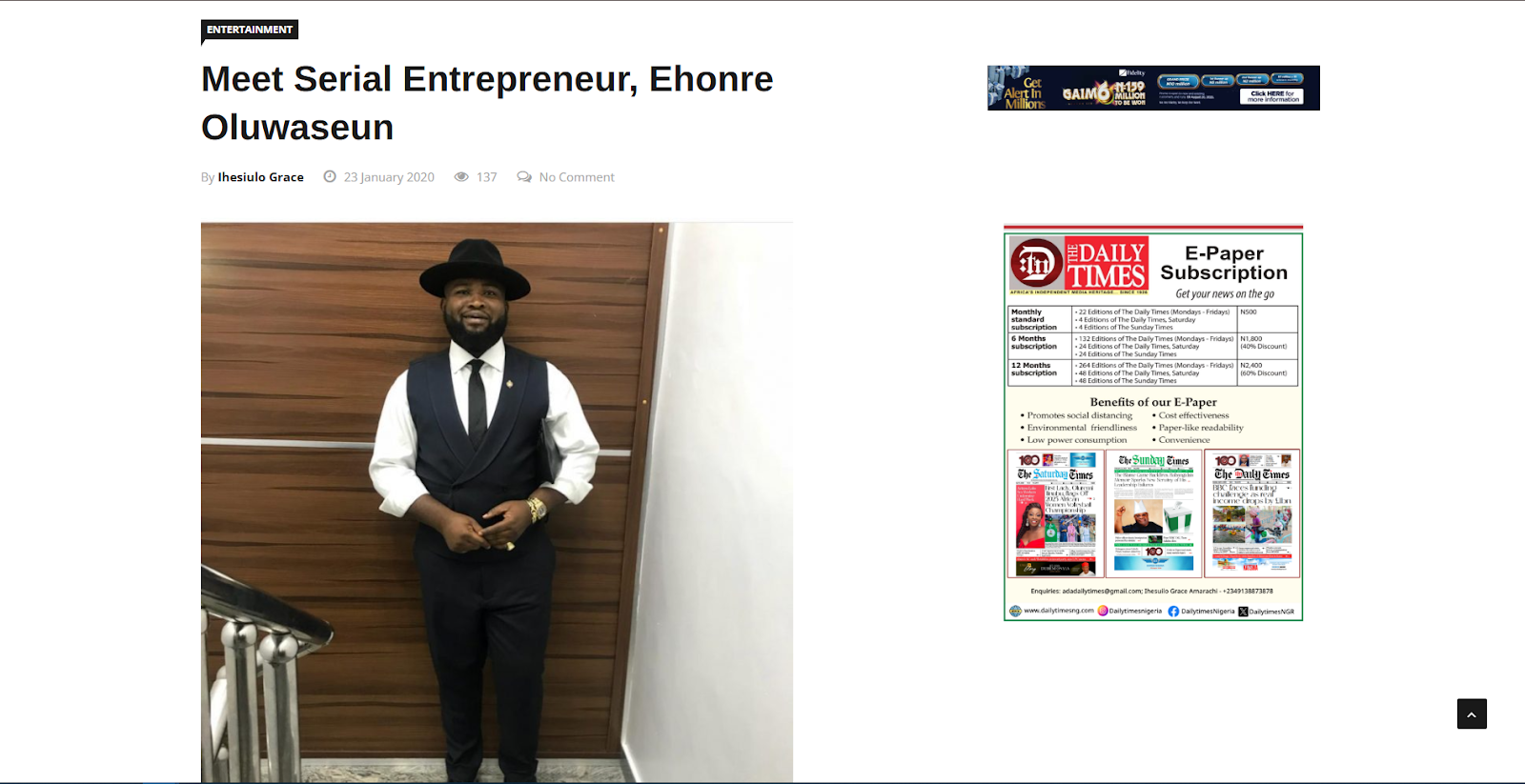
The other is the Daily Times’ feature of Ehonre Oluwaseun, aka “Classic Baggie”.
The contrasts between these pieces reveal everything wrong—and occasionally right—with contemporary Nigerian profile writing. One reads like journalism; the other like a press release that escaped into the wild, which it probably is.
Promotional Language
A lot of the features I’ve come across are overly salesy, more like they were written by an overzealous publicist who just discovered the thesaurus, or AI.
It’s all praise of the subject from start to finish.
Take the Daily Times piece on Ehonre Oluwaseun, which hails him as a “serial entrepreneur” and “often regarded as one of the youngest business entrepreneurs in Nigeria,” with a “philanthropic nature” and “consistent willingness to give back.”
The article boasts of his “Baggie Groups conglomerate” and even name-drops his socialite friends, yet offers no personal anecdotes, no sense of struggle or growth.
This language doesn’t invite readers into a story—it bombards them with unsubstantiated claims. When every adjective is superlative and every achievement “notable,” the effect is paradoxical: rather than building credibility, it erodes it.
The profile quotes unnamed “reports” that supposedly call him a “serial entrepreneur” and laud his “willingness to give back”—marketing copy masquerading as editorial content.
It’s all flat praise (“serial entrepreneur,” “socialite of many parts”) with no narrative arc or emotional depth. There are no quotes from Ehonre himself, no description of challenges he overcame, no insight into what actually drives him. We never meet him as a person—he remains a distant collection of buzzwords.
A profile should leave readers feeling as if the subject has been a longtime friend, not a miracle drug inside molue that needs peddling.
On the other hand, Al Jazeera’s profile of Nigerian rapper Reminisce serves as a masterclass in effective profile writing—the antithesis of the Daily Times approach.
The piece begins not with declarations about his greatness, but with immersive scene-setting: “It is a dark night in Ikeja, capital of Lagos… Deep inside the bowels of an empty factory is the award-winning rapper Reminisce.” This vivid opener—darkness, location, environment—immediately pulls readers in.
Throughout, the piece employs vivid sensory details and humanizing specifics: “I had seven bottles of beer,” Reminisce recalls of his first studio session—a detail that immediately grounds his story in relatable experience. The writer describes him as “a well-known celebrity who likes to play in the shadows… remaining a mysterious figure,” using metaphor and observation rather than empty superlatives.
The profile weaves in cultural context, explaining the significance of Yoruba in Nigerian rap and documenting the tension between English and indigenous language music. It even explores his tough childhood, including how his mother’s discipline “shaped me into who I am today”—giving readers insight into the person behind the persona.
What truly separates this profile from conventional Nigerian examples is its willingness to explore failure and frustration. Reminisce candidly admits: “I was frustrated. I was rapping, and people were not listening.” The profile doesn’t shy away from his commercial disappointments or his temporary exit from music to sell graffitied Converse sneakers.
The narrative arc of struggle, abandonment, return, and reinvention creates natural empathy. Rather than presenting an unrelatable superhuman, the profile reveals someone who faced obstacles, made compromises, and found success through adaptation and perseverance. The result is a multi-layered portrait: we see the artist’s world and hear his own voice.
Rolling Stone’s approach to profiling Davido demonstrates similar mastery, dropping readers into action rather than relying on bland introductions. The piece opens on the ground: it’s a warm Lagos afternoon and “David Adedeji Adeleke… has just arrived at the wide parking lot at Eko Convention Centre,” with outfit and entourage described in detail. Readers feel the moment—even hearing drummers chanting “Davido o!” as fans await. This rich backdrop contrasts sharply with the dry, contextless approach of profiles like Ehonre’s. The piece names specific dates, venues, and even describes his outfit and jewelry, grounding the narrative in reality rather than hearsay.
TechCabal’s profile of Motunrayo Sanyaolu (“UNILAG’s first Engineering Spirit”) offers another model of how to celebrate achievement without falling into hyperbole. Rather than simply listing titles, it narrates her journey with concrete specifics. The piece opens at her faculty awards dinner, noting a “new Engineering Spirit Award” being introduced, immediately signaling transformation rather than static achievement.
Crucially, the profile provides context and weight through specifics: the incubator costs “below ₦50,000 ($32)” and reduces hypothermia by 62%. Such detail shows why her work matters, moving beyond vague claims to measurable impact. The piece weaves in voices—Motunrayo’s classmate gushes, “If anyone else had won, it would have been shocking”—and human detail, mentioning her “bright smile and cornrows” as she demonstrates prototypes. These moments bring personality and credibility that’s entirely absent from template-driven profiles like the Ehonre piece.
The difference between these approaches is stark. While weak profiles present information in flat, linear progression without tension or revelation, effective profiles structure narratives around struggle, transformation, and specific moments that reveal character. One presents a flat resume; the others offer journeys with obstacles and transformations that engage readers on an emotional level.
The best profiles understand that readers don’t want to hear about perfect people—they want to understand how imperfect people became exceptional.
Sans Narrative Arc
What truly separates strong profiles is their willingness to explore failure and frustration.
Traditional Nigerian profiles often present information in flat, linear progression that lacks tension, conflict, or revelation—the very elements that make stories compelling.
This Samuel Ogendegbe’s profile perfectly exemplifies this approach: it merely lists accomplishments without situating them in any narrative context. There’s no beginning, middle, or end—just a collection of achievements floating in space. Same thing with this profile on Titi Olakotan, Innocent Ojo, Kito Nwaigbe, Joan Ologundudu, and countless others.
They follow a predictable formula:
- Introduction with grandiose claims
- Background/early life (usually minimal and generic)
- List of achievements (presented as inevitable)
- Future plans (always world-changing)
- Generic conclusion about future impact
Sometimes, it’s just an introduction and achievement list. Period. The end. Roll credits.
Missing is the narrative tension that drives effective storytelling. The Daily Times piece mentions Ehonre’s ventures and philanthropy but never explains what his businesses actually do (cyber fraud, allegedly), or why his projects matter. Numbers and specifics are absent: we learn he does entertainment and distributes aid, but we don’t know scale, impact, or motivation.
The difference is stark when compared to Al Jazeera’s approach with Reminisce, which structures its narrative around commercial failures and reinventions: “His first stab at music yielded no success… began selling graffitied Converse sneakers…” before revealing how this struggle led to his breakthrough.
One presents a flat resume; the other offers a journey with obstacles and transformations that engage readers on an emotional level.
The best profiles understand that readers don’t want to hear about perfect people—they want to understand how imperfect people became exceptional. They want the struggle, the doubt, the moment when everything could have gone wrong.
TechCabal’s Motunrayo profile similarly traces concrete transformation—from eager freshman co-designing projects to award-winning inventors with measurable impact. Rolling Stone’s Davido piece doesn’t just celebrate his current status but contextualizes his journey within Lagos’s music scene and his evolution as an artist.
Minimal Cultural Context
Another crucial deficiency in typical Nigerian profiles is their contextual poverty. Subjects like Ehonre exist in isolation, without the cultural, social, or historical backdrop that would give their achievements meaning. The Daily Times piece mentions his location and ventures but never contextualizes them within Nigeria’s business environment, regulatory challenges, or economic realities.
This approach strips away what could make stories distinctive and authentically Nigerian. Missing are explorations of the business environment subjects navigated, challenges specific to their industry or region, cultural influences on their approach, and broader economic conditions affecting their sector.
Facts are given without context. We’re told about Ehonre’s “Baggie Groups conglomerate” but never learn what the businesses actually do or why they matter in the Nigerian context. There’s no sense of the obstacles unique to building businesses in Nigeria, the regulatory hurdles, the infrastructure challenges, or the market dynamics that shaped his approach.
By contrast, effective profiles situate subjects within their environments. The Reminisce profile explores the cultural significance of Yoruba in Nigerian rap, the tension between English and indigenous language music, and his specific position within Lagos’s music scene. Readers understand not just what he’s accomplished, but why it matters in the specific Nigerian context.
Micro-Masterclass: Humans of New York
One profile series I find very excellent is Brandon Stanton’s Humans of New York (HONY). It shows just how powerful storytelling can be when grounded in radical simplicity and emotional honesty. Each HONY post is a micro-narrative—usually just a few paragraphs paired with a portrait—yet these short pieces often carry more emotional weight than lengthy, multi-page features.
The secret lies in Stanton’s interviewing approach. He explains: “Normally, I’ll let them lead the interview. A lot of times I’ll ask, ‘What’s your biggest challenge right now?’ or ‘What’s the biggest challenge that you’ve overcome?’” These open-ended questions invite reflection and real stories, not rehearsed answers.
What makes HONY so moving is its ability to uncover universal emotions through highly specific, personal stories. As Stanton puts it: “The one most singular emotion is pain… To really identify with somebody and have compassionate empathy for them is to identify pain in others, the same pain that you’ve felt.”
By focusing on struggle and vulnerability, HONY profiles feel deeply authentic. They don’t try to showcase perfection—they reveal humanity.
A worthy companion to HONY’s minimalist mastery is Nigerian filmmaker and YouTuber Eniola “Korty EO” Olanrewaju. In her YouTube series Flow with Korty, she sits down with everyone from Rema and Tems to everyday Nigerians, coaxing out the stories behind the headlines. With a relaxed, open-ended style, Korty invites her guests to steer the conversation—resulting in moments of genuine vulnerability and insight that more scripted interviews rarely do.
A Framework for Better Nigerian Media Profiles
Drawing on these exemplars, here’s a comprehensive framework for creating more compelling, authentic Nigerian media profiles:
1. Discover the Real Story Behind the Success
The foundation of any great profile lies in identifying not just what someone has achieved, but what narrative those achievements reveal. Look beyond the resume to uncover:
- The Origin Story: What formative experiences shaped their path? Was it a childhood in a particular Nigerian community? A specific educational experience? A family business that failed?
- The Obstacle Course: What barriers did they face that others in their position might not have? Gender discrimination in tech? Regional bias in business? Educational limitations?
- The Plot Twist: What unexpected elements exist in their journey? The banker who became a farmer? The dropout who revolutionized education?
- The Failure Portfolio: What didn’t work? What did they learn from setbacks? How did failure inform their eventual success?
- The Why Factor: What drives them beyond money or recognition? What problem are they trying to solve?
Profile writers often settle for the most obvious narrative: successful person achieved success through hard work.
This is a personal pet peeve, as it is for many of my friends – why does every ‘made’ Nigerian say hard work – which work exactly? What process?
I digress, but more compelling stories might include the tech developer who failed repeatedly before getting a breakthrough or the entrepreneur whose business model came from observing market gaps in their specific community.
2. Master the Art of Meaningful Conversation
The quality of a profile directly reflects the quality of the interviews that inform it. Move beyond predictable questions to ask:
- Instead of “What’s your biggest achievement?” try “What was your biggest misconception about this field when you started?”
- Instead of “What are your future plans?” try “Tell me about a time when you almost gave up.”
- Instead of “What makes you successful?” try “What do people in your industry understand that outsiders don’t?”
- Instead of “What advice do you have?” try “Which criticism of your work has stuck with you the most?”
- Instead of “What are you proud of?” try “What aspect of your success feels undeserved or surprising to you?”
These questions generate stories rather than statements, revealing character through specific experiences rather than abstract self-assessment. They also often lead to unexpected revelations that make profiles memorable.
3. Build Rich Context, Not Empty Space
Strong profiles never present subjects in isolation—they situate them within multiple layers of context:
- Historical Context: How does their work relate to what came before in Nigeria? Are they part of a trend, or breaking new ground?
- Cultural Context: What Nigerian or regional influences shaped their approach? How does their background inform their methods?
- Industry Context: What specific challenges or opportunities exist in their field in Nigeria? How do they navigate regulatory environments, infrastructure challenges, or market peculiarities?
- Social Context: How do factors like class, gender, ethnicity, region, or religion inform their experience? What advantages or disadvantages have they navigated?
- Economic Context: What relevant statistics, trends, or economic conditions contextualize their achievements? Are they benefiting from a boom, or succeeding despite challenges?
4. Show, Don’t Just Tell
While traditional Nigerian profiles tell readers what to think about subjects, effective profiles show subjects in action through:
- Scene Reconstruction: Place readers in specific moments. Instead of “He’s a hard worker,” describe him at 6 AM in his office, explaining why he starts early.
- Sensory Details: What do their environments look, sound, and feel like? The smell of machinery in their factory? The sound of keyboards in their tech office?
- Revealing Anecdotes: Small stories that illustrate larger truths about character. The CEO who still remembers customers’ names? The entrepreneur who keeps failed product prototypes on her desk?
- Authentic Voice: Preserve the subject’s distinctive way of speaking. Their particular expressions, their accent reflected in word choice, their unique perspective on common experiences.
- Behavioral Observations: Actions that reveal character better than claims. How do they treat staff? What’s on their desk? How do they handle interruptions during the interview?
5. Embrace Complexity, Not Perfection
Perhaps the most crucial departure from Nigerian profile conventions is embracing a balanced portrayal. Authentic profiles acknowledge that:
- All success stories include setbacks and doubt
- All accomplished people have insecurities and blind spots
- All innovators have failures alongside breakthroughs
- All public images have private complexities
This balance doesn’t undermine subjects—it humanizes them. Include voices beyond the subject’s self-assessment: colleagues who can speak to their work style, collaborators who understand their process, industry observers who can contextualize their impact, and occasionally even thoughtful critics (with fair context).
The goal isn’t to tear down, but to build up through honesty. Readers connect with struggle and vulnerability far more than with perfection.
6. Craft Visual Stories, Not Just Pictures
The visual component of profiles deserves as much thought as the text. Consider:
- Environmental Portraits: Showcase subjects in spaces that reveal something about their work or personality—their office, home, factory floor, or community.
- Process Documentation: Behind-the-scenes images of their work, their team, their creative process, or their daily routine.
- Historical Depth: Photos that show evolution over time—their first office, old products, early team photos, and personal milestones.
- Cultural Context: Images that place them within their community, their region, and their industry’s ecosystem.
Interactive Elements: Where possible, audio clips of their distinctive voice, video snippets of them explaining their work, or interactive timelines of their journey.
7. Structure for Impact, Not Just Information
The best profiles have an intentional architecture that serves the story:
- Hook with Humanity: Open with a specific moment, scene, or revelation that immediately shows the subject as a complex person, not a success story.
- Build Through Contradiction: Use tension between expectations and reality, past and present, public image and private truth to maintain reader interest.
- Layer Information: Weave background, achievements, and context throughout the narrative rather than dumping them in separate sections.
- Create Rhythm: Alternate between broad context and intimate detail, between serious insights and lighter moments, between the subject’s voice and your observations.
- End with Evolution: Close not with summation but with a sense of ongoing journey—what they’re still figuring out, still working toward, still questioning.
Why Better Profiles Matter
Profile writing is, ultimately, human storytelling. When we recognize subjects as complex, contradictory, evolving individuals navigating specific contexts, we create portraits that resonate beyond momentary promotion. We preserve experiences that contribute to our collective understanding of Nigerian innovation, creativity, and resilience.
More practically, better profiles serve everyone’s interests: readers get engaging content worth their time, subjects get authentic representation that builds a genuine connection with audiences, and media outlets build credibility and readership through quality journalism.
The current template-driven approach serves no one well. Readers see through the artifice, subjects become forgettable despite their accomplishments, and media outlets become indistinguishable from PR firms.
By embracing these principles and practices, Nigerian media can transform profile writing from shallow image laundering to authentic storytelling—serving readers, subjects, and the profession of journalism itself.
The goal isn’t to stop “image laundering” entirely—it’s to do it so well, so authentically, and so engagingly that nobody minds being cleaned up in the process. And that, perhaps, is the highest compliment any profile can receive: that it made someone more interesting than they already were, while still being completely honest about who they are.
Because in the end, the best profiles don’t just tell us about successful people—they help us understand what success actually looks like – struggles and all.



June 16, 2026
Isreal Oyarinde
The Nigerian Data Problem: We Don’t Know How Many We Are, Where We Live, or What We Earn
In God we trust, all others bring data. – W. Edwards Deming In 2023, I was working on a business plan for a client who wanted to launch a logistics company in Kano State. Simple enough, right? Except it wasn’t. We needed basic data. The population of Kano metropolitan area, number of registered businesses, average household income, road network coverage, number of delivery addresses and that is where it became a nightmare. You would think this information would be readily available for the most populous state in Nigeria. You would be wrong. The population figure we found ranged from 9 million to 16 million depending on which source you used. The Natonal Bureau of Statistics had one number, the state government had another. The UN population estimates had a third. The World Bank used yet another figure. And the last actual census was in 2006, nearly two decades ago, when the Kano population was counted at about 9.4 million. In a state growing at maybe 3 percent annually, the current population could be anything. We were literally guessing and our guesses were not even informed by any reliable data. The number of registered businesses? No comprehensive database exists. Average household income? The NBS does household surveys, but the sample sizes are small, the methodology is questionable, and the data is years out of date by the time it is published. Road network coverage? I called three different agencies and got three completely different answers. Number of delivery addresses? Nigeria does not have a functional address system. Most streets in Kano do not have names. Most houses do not have numbers. How do you run a delivery company in a country where you cannot describe where people live? That experience crystallized something I had been thinking about for years. Nigeria does not have a data problem, Nigeria has a data crisis. We are running a country of over 200 million people essentially blind. We do not know how many we are. We do not know where we live. We do not know what we earn. We do not know what we produce. We do not know what we consume. And because we do not know any of this, every policy decision is a guess, every budget is fiction, and every business projection is built on vibes and In Sha Allah. This is not a minor administrative inconvenience. This is a fundamental governance failure that affects every aspect of Nigerian life, from healthcare to education to infrastructure to security. You cannot solve problems you cannot measure. You cannot allocate resources to populations you cannot count. You cannot plan for a future you cannot model. And yet here we are, the giant of Africa, stumbling around in the dark because we refuse to turn on the light. The Census Catastrophe Let us start with the most basic data point of all. How many Nigerians are there? The honest answer is nobody knows. Nigeria’s last census was in 2006. It counted 140 million people, a number that was immediately controversial. Northern states claimed they were undercounted. Southern states claimed the north was overcounted. Ethnic groups accused each other of inflating numbers for political advantage. The census became not a statistical exercise but a political weapon, because in Nigeria, population determines revenue allocation, political representation, and power. The 2006 census itself was riddled with problems. Enumerators were poorly trained. Some areas were inaccessible due to security concerns. The technology was outdated. There were widespread allegations of manipulation. The results were challenged in court by several states. And yet, nearly twenty years later, this deeply flawed count remains the official basis for planning in Africa largest economy. The World Bank and the UN use projections based on this flawed baseline, which means their estimates are also unreliable. A new census has been planned, postponed, replanned, and re-postponed multiple times. The National Population Commission has been promising a new census for over a decade. Each time, the exercise is derailed by political disagreements, funding shortfalls, or security concerns. Meanwhile, the gap between our population estimates and reality grows wider every year. Are we 210 million? 220 million? 230 million? Nobody can say with confidence, and the margin of error is not a few percentage points but potentially tens of millions of people. The political dimension of the census cannot be overstated. In Nigeria, population is money and power. Federal revenue allocation is partly based on population. States with larger populations get more money. The number of House of Representatives seats is based on population. So every census becomes a high-stakes political battle. Until we can decouple the census from resource allocation, or find some way to make the count politically neutral, we will continue to fight over numbers instead of collecting them. NBS and the Methodology Problem The National Bureau of Statistics is supposed to be the authoritative source of data on the Nigerian economy and society. In fairness, the NBS does important work with limited resources. But the limitations are severe, and they undermine the reliability of virtually everything the NBS publishes. Take the unemployment figure for example. For years, the NBS reported Nigeria’s unemployment rate as being in the low single digits, which was laughable to anyone who had walked through any Nigerian city and seen the armies of young people with nothing to do. The problem was methodological. The NBS was using the International Labour Organization definition of unemployment, which counted anyone who had done even one hour of work in the past week as employed. A man who washed one car for two hundred naira on a Saturday was classified as employed. A woman who sold three sachets of pure water on a Monday was employed. The definition bore no relationship to the reality of Nigerian labour markets. Eventually, the NBS adopted a broader measure that better captured underemployment and disguised unemployment, and suddenly the combined unemployment and underemployment rate jumped to over 33 percent. The economy had not changed. The measurement