
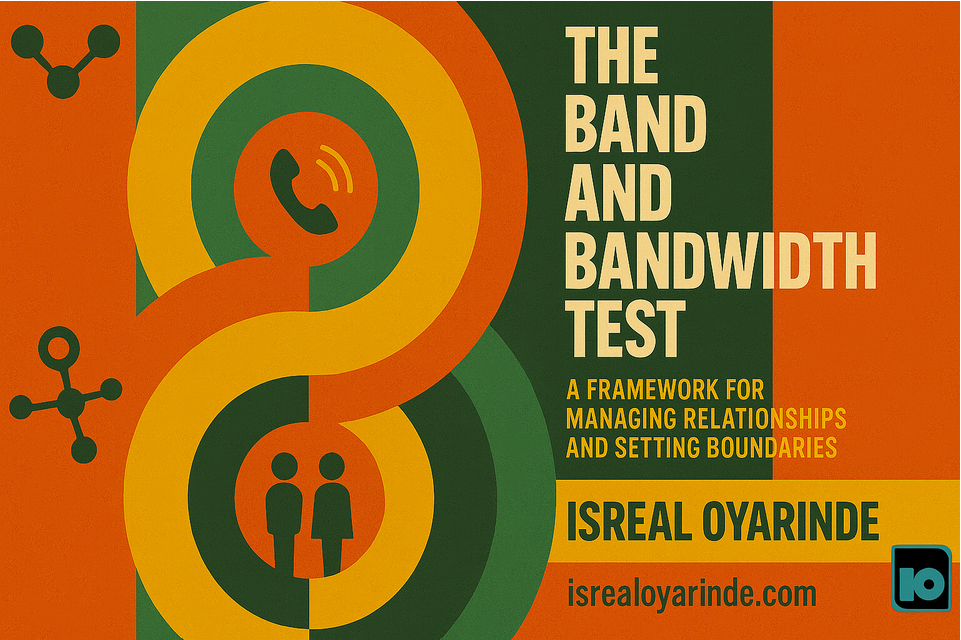
If you struggle to balance how much help you give others, here’s a framework I use that might help you triage who you need to help, and how much help you should offer.
Much of it comes from my experience navigating interpersonal relationships over the years.
Not long ago, I struggled to say no.
I’d bend over backward to help people, often at my own expense. I’d give time, energy, even money, to almost anyone who asked. But I learned the hard way that not everyone reciprocates. Some take advantage, others just take.
That’s when I developed my Band and Bandwidth Test, primarily as a tool to gauge how far I should go into a rabbit hole, and secondly, as a justification and philosophy to guide my actions.
Most importantly, it’s a mental framework for managing relationships without losing myself in the process.
Side note: I have a background in law, and there are always funny named tests like the “reasonable person test” or the “but-for test” that lawyers use to simplify otherwise complex situations and apply the same standard to different situations.
This might or might not have informed my reasoning for creating my own test for something equally complex: relationships. Cue the Band and Bandwidth Test.
But first, an extended side-note on my thoughts on philosophy.
Why Philosophy Matters (But Shouldn’t Be the Point)
My thoughts on philosophy goes like this:
“If you can think—and not make thoughts your aim;”
This line from Rudyard Kipling’s If summaries what I believe: Think deeply, but don’t let thoughts hijack your ability to act.
You should absolutely think deeply and have guiding principles. But philosophy shouldn’t consume you or paralyze you from actually doing things.
I strongly believe it’s important to have some philosophy that guides your outlook on life. Without core principles, one will be like sand on a beach, washed back and forth by every wave that hits.
We need something to anchor our decisions when life feels chaotic.
However, if one makes philosophy the primary focus, we risk becoming one of those people who think endlessly but never act. The type can debate the ethics of helping someone for hours, but never actually help anyone.
It’s a balancing act, to be sure. Life comes fast, and it’s important to hold firm to principles that matter, but stay flexible enough to adapt when reality doesn’t match the theories.
For me, one principle stands above the rest: Do to others as you’d have them do to you.
Simple, maybe even cliché, but it works as a north star for almost all relationship decisions.
To me, it’s about reciprocity, fairness, maintaining a clear conscience, and helping me sleep better at night.
The funny thing is, life has a way of testing even the simplest principles. That golden rule sounds great until you meet people who don’t play by the same rules.
The Band and Bandwidth Test
I think it’s best to start this section with a caveat.
I don’t use this test every day. It’s neither necessary nor wise to keep score with most people you interact with daily. This test is what I use when my relationships with people need more definition or when things start getting mildly uncomfortable.
That said, the Band and Bandwidth Test is my way of balancing generosity with self-preservation.
It’s disciplined in its approach. The main thesis is to control your boundaries and not let others dictate your energy, but be flexible enough in acknowledging that relationships aren’t black-and-white.
It sounds transactional, but not really. It’s not really about what others are doing for me, but a way for me to be consistent about how far I’ll go with helping others, i.e., the exact step I should take without building resentment in myself.
Again, the test isn’t about keeping score, but setting the field for mutual respect. I expect fairness, and I’m okay walking away when it’s not there.
Here’s how it works.
The Bands
Under this test, I categorize people into three bands based on our relationship and mutual obligations:
- Inner Band: Family and very close friends. Day ones. These are the people I’d move heaven and earth for. They get the most of my time, energy, and emotional bandwidth because our bond is built on mutual trust and history.
- Middle Band: Acquaintances, friends of friends, colleagues. These are people I like and respect, but our connection isn’t as deep. They get my help within reason, but I’m more guarded.
- Outer Band: Strangers, chairman, boss, or loose connections. These folks get basic courtesy, maybe some help if it’s low-effort, but they’re not entitled to my resources, except for real, verified emergencies.
Each band has a “rubber band” of tolerance, a limit to how much bad behavior I’ll take before I snap. When the band snaps, the consequences depend on the band:
- Outer Band: Snap, and they’re gone. No reconciliation, no second chances. Life’s too short to mop around for strangers who disrespect my boundaries.
- Middle Band: If the offense is severe, they’re demoted to Outer Band or cut off entirely. If it’s minor, I’ll most likely scale back my investment in the relationship.
- Inner Band: These are the toughest. Family and close friends are vital, but even they can snap the band. When that happens, I don’t cut them off completely; emergencies still matter, but I pull back and limit my involvement to protect my peace.
This framework focuses on what I can control: my boundaries, my responses. But it has emotional nuances.
I can’t treat all people with equal indifference. I’m human, not a robot. My Inner Band deserves more than my Outer Band, and I’m okay with that bias.
My golden rule, which is to do unto others, still guides me, but it’s not a blank check.
Reciprocity is key.
I’ll go all out for friends who’d have my back, but I’m not a charity for those who wouldn’t.
That doesn’t make them bad people; it just means they don’t get Inner Band privileges.
The Bandwidth
The “bandwidth” part of the test is about capacity.
I only have so much time, energy, and emotional space.
Early on, I’d stretch myself thin trying to help everyone, leaving nothing for myself. Now, I’m ruthless about prioritizing.
If someone’s demands exceed my bandwidth—especially if they’re in the Outer or Middle Band—they get a polite “no” or a scaled-back version of help. If they are persistent, they’ll get a laundry list of things I need help with too. Two can play that game.
This approach has saved me from burnout. I used to feel guilty saying no, like I was betraying my own principles. But I’ve learned that overextending myself doesn’t just hurt me, it makes me less effective for the people who actually matter.
Stick to your values (be helpful), but don’t let them destroy you.
Gray Areas and Practical Applications
The Band and Bandwidth Test is meant to be applied in real situations that test your boundaries. Over the years, I’ve encountered patterns that have taught me important lessons about when to adjust my approach.
Speaking Out Before You Snap
I used to have, and still have to some extent, the habit of keeping quiet even when I’m not happy with something. I’ve learned that it’s not always right to keep quiet. If I don’t like something, it’s very important I speak out so resentment doesn’t fester. When you eventually burst, it’s because of many accumulated things, and you end up lashing out and making things a bigger mess.
The key is addressing issues early and directly rather than letting them pile up until you explode. This prevents the all-too-common scenario where minor irritations become major blowouts that damage relationships unnecessarily.
The Documentation Principle
I no longer subscribe to the “quiet giving” philosophy. People tend to forget things fast. I do too, and I’ve been on both ends. You know those situations where someone asks “what have you done for me?” after you’ve given your all and then some.
While I won’t make it a fanfare whenever I do something or start listing everything I’ve done, small acts of documentation make a difference. Sending a transaction receipt with a note, or dropping a WhatsApp text saying “I’ve sent X amount of money to be used for Y” might make all the difference one day. It’s not about keeping score, but creating clarity and preventing misunderstandings.
Reading the Patterns
It’s important to take the time to understand people’s true disposition. We tend to make excuses for people, but Occam’s razor applies here: most things are exactly as they appear.
Someone who doesn’t give when they have little won’t suddenly become generous when they have more.
Someone who gives excuses every time you need help isn’t worth running yourself ragged for. That doesn’t make them a bad person—it might just be their philosophy. But it also doesn’t make you a bad person for adjusting your expectations and living by the same standard they’ve set.
The Tough Love Moments
Some situations require you to step back entirely, even when it feels harsh:
Someone who refuses to work but relies on you financially needs tough love, not continued enablement.
Someone who spends money on frivolities doesn’t deserve access to the emergency funds you’ve carefully saved.
These aren’t cruel judgments but necessary boundaries that prevent you from becoming an unwilling participant in someone else’s poor choices.
The key insight here is that helping someone avoid the natural consequences of their actions often prevents them from learning and growing.
Sometimes the most loving thing you can do is step back and let reality be their teacher.
Making It Work
People move between bands as relationships blossom or wither. A Middle Band colleague who consistently shows up might move to Inner Band. An Inner Band friend who repeatedly violates boundaries might get demoted.
The key is being honest with yourself about where people stand based on their actions, not just their proximity or history with you. Your time, energy, and emotional capacity are finite resources that deserve to be invested wisely.
Therefore, make your generosity sustainable so it doesn’t burn you out.
Some days, you’ll have bandwidth to spare and can afford to help someone in your Outer Band. Other days, you’ll need to focus everything on your Inner Band. Both responses are valid, as long as you’re making conscious choices rather than defaulting to yes out of guilt or habit.
The ultimate test of any relationship philosophy is simple: Does it help you sleep better at night? Does it allow you to show up authentically for the people who matter most? Does it protect your ability to be generous without breeding resentment?
When you’re not stretched impossibly thin, you can be fully present for the relationships that truly matter. And that’s a golden rule worth living by.


June 16, 2026
Isreal Oyarinde
The Nigerian Data Problem: We Don’t Know How Many We Are, Where We Live, or What We Earn
In God we trust, all others bring data. – W. Edwards Deming In 2023, I was working on a business plan for a client who wanted to launch a logistics company in Kano State. Simple enough, right? Except it wasn’t. We needed basic data. The population of Kano metropolitan area, number of registered businesses, average household income, road network coverage, number of delivery addresses and that is where it became a nightmare. You would think this information would be readily available for the most populous state in Nigeria. You would be wrong. The population figure we found ranged from 9 million to 16 million depending on which source you used. The Natonal Bureau of Statistics had one number, the state government had another. The UN population estimates had a third. The World Bank used yet another figure. And the last actual census was in 2006, nearly two decades ago, when the Kano population was counted at about 9.4 million. In a state growing at maybe 3 percent annually, the current population could be anything. We were literally guessing and our guesses were not even informed by any reliable data. The number of registered businesses? No comprehensive database exists. Average household income? The NBS does household surveys, but the sample sizes are small, the methodology is questionable, and the data is years out of date by the time it is published. Road network coverage? I called three different agencies and got three completely different answers. Number of delivery addresses? Nigeria does not have a functional address system. Most streets in Kano do not have names. Most houses do not have numbers. How do you run a delivery company in a country where you cannot describe where people live? That experience crystallized something I had been thinking about for years. Nigeria does not have a data problem, Nigeria has a data crisis. We are running a country of over 200 million people essentially blind. We do not know how many we are. We do not know where we live. We do not know what we earn. We do not know what we produce. We do not know what we consume. And because we do not know any of this, every policy decision is a guess, every budget is fiction, and every business projection is built on vibes and In Sha Allah. This is not a minor administrative inconvenience. This is a fundamental governance failure that affects every aspect of Nigerian life, from healthcare to education to infrastructure to security. You cannot solve problems you cannot measure. You cannot allocate resources to populations you cannot count. You cannot plan for a future you cannot model. And yet here we are, the giant of Africa, stumbling around in the dark because we refuse to turn on the light. The Census Catastrophe Let us start with the most basic data point of all. How many Nigerians are there? The honest answer is nobody knows. Nigeria’s last census was in 2006. It counted 140 million people, a number that was immediately controversial. Northern states claimed they were undercounted. Southern states claimed the north was overcounted. Ethnic groups accused each other of inflating numbers for political advantage. The census became not a statistical exercise but a political weapon, because in Nigeria, population determines revenue allocation, political representation, and power. The 2006 census itself was riddled with problems. Enumerators were poorly trained. Some areas were inaccessible due to security concerns. The technology was outdated. There were widespread allegations of manipulation. The results were challenged in court by several states. And yet, nearly twenty years later, this deeply flawed count remains the official basis for planning in Africa largest economy. The World Bank and the UN use projections based on this flawed baseline, which means their estimates are also unreliable. A new census has been planned, postponed, replanned, and re-postponed multiple times. The National Population Commission has been promising a new census for over a decade. Each time, the exercise is derailed by political disagreements, funding shortfalls, or security concerns. Meanwhile, the gap between our population estimates and reality grows wider every year. Are we 210 million? 220 million? 230 million? Nobody can say with confidence, and the margin of error is not a few percentage points but potentially tens of millions of people. The political dimension of the census cannot be overstated. In Nigeria, population is money and power. Federal revenue allocation is partly based on population. States with larger populations get more money. The number of House of Representatives seats is based on population. So every census becomes a high-stakes political battle. Until we can decouple the census from resource allocation, or find some way to make the count politically neutral, we will continue to fight over numbers instead of collecting them. NBS and the Methodology Problem The National Bureau of Statistics is supposed to be the authoritative source of data on the Nigerian economy and society. In fairness, the NBS does important work with limited resources. But the limitations are severe, and they undermine the reliability of virtually everything the NBS publishes. Take the unemployment figure for example. For years, the NBS reported Nigeria’s unemployment rate as being in the low single digits, which was laughable to anyone who had walked through any Nigerian city and seen the armies of young people with nothing to do. The problem was methodological. The NBS was using the International Labour Organization definition of unemployment, which counted anyone who had done even one hour of work in the past week as employed. A man who washed one car for two hundred naira on a Saturday was classified as employed. A woman who sold three sachets of pure water on a Monday was employed. The definition bore no relationship to the reality of Nigerian labour markets. Eventually, the NBS adopted a broader measure that better captured underemployment and disguised unemployment, and suddenly the combined unemployment and underemployment rate jumped to over 33 percent. The economy had not changed. The measurement