
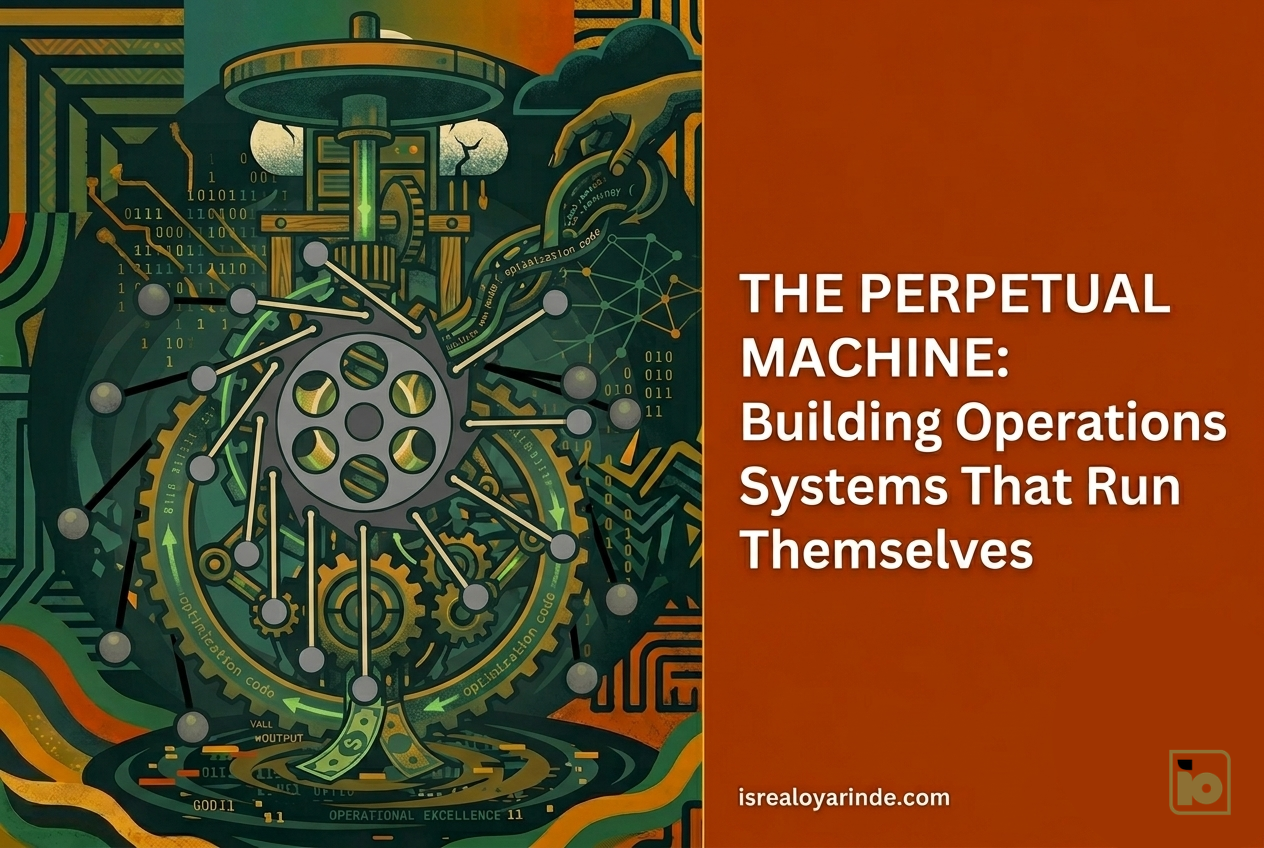
The idea of a perpetual machine seems exciting. Something that runs on its own without any input. As an entrepreneur reaching this point in my businesses is my ultimate goal. Having resilient and profitable businesses that do not need me slaving away at my desk for the better part of 18 hours a day so I can have time to do other things I love and spend time with the people I care about.
In this article, I will be sharing some advice that has worked for me as I am building. I do not purport to know it all as I am still in the process of transitioning from a solopreneur to a CEO myself. So, I would love for you to think of this as an ongoing conversation. Let’s get into it.
Where (or Who) Is the Battery?
In science fiction, a perpetual machine is a hypothetical device that operates indefinitely without any external energy source, producing work or motion forever. A perpetual machine is deemed scientifically impossible so why is it something to aspire to in business?
I think as entrepreneurs we aspire to this impossible “machine” not because we think we can ignore the laws of physics, but because we want to minimize the “Energy of Supervision.” Simply put, we want to reduce our input to the very minimum while simultaneously getting maximum output out of the business.
So the idea is not that we get to a point where we can completely ignore the business and it just continues to run efficiently on its own. Rather, it is that we are minimising input for maximum output.
The hardest part of building a perpetual motion machine is finding out where to hide the battery. Basic science tells us that a machine cannot run forever without an energy source. But a machine can run without a huge battery or energy pack attached to it. The battery can be tiny and inbuilt and it is the same with businesses too.
We look at companies with presence in multiple countries that have existed for decades, long after the original visionary is retired or dead and wonder how they continue to run. In most Nigerian businesses, the “battery” is the founder. The business runs on them. Remove the founder and the whole thing grinds to a halt like a generator that just ran out of diesel.
I have watched it happen more times than I can count. A sharp Oga builds a thriving business, employs 30 people, handles the biggest clients personally, negotiates every major deal, and signs every cheque.
Then he travels for two weeks, and by the time he lands at Murtala Muhammed, three clients have complained, two staff have been fighting, and someone has been helping themselves to petty cash. The business did not collapse because of the market. It collapsed because the entire operation was a one-man show wearing a company costume.
In software engineering, there is a concept called the “bus factor.” It asks: how many people on your team would need to be hit by a bus before the project stalls? If the answer is one, you have a problem. In most Nigerian SMEs, the bus factor is literally one: the founder. If they get sick, travel, die, or simply burn out, the business is finished.
The Tribal Knowledge Problem
The root cause is what I call “tribal knowledge,” information that lives in your head and nowhere else. You know which supplier gives you the best rate. You know which staff member cannot be trusted with cash.
You know that Client A always pays late but Client B will bounce a cheque entirely. You know that LASTMA operates heaviest on Tuesdays on that particular route your delivery trucks use.
All of this is critical operational intelligence. And none of it is written down.
When you leave, all of that leaves with you. Your replacement, whether it is a hired manager or your own child, starts from zero. They make mistakes you solved ten years ago. They trust the wrong people. They take the wrong route on Tuesday. And they wonder why things are not working.
This is the exact pattern that killed countless Nigerian businesses. Ekene Dili Chukwu ran like clockwork under its founder. Within years of his passing, the fleet was in disrepair, routes were mismanaged, and the brand that once dominated the East became a memory. The same story plays out in restaurants, law firms, trading companies, and tech startups. The founder was the system, and when the founder left, the system left too.
The Franchise vs Buka Test
Here is a simple test for whether your business is a system or a personality cult: could someone franchise it?
Think about Chicken Republic. Whether you walk into the one in Lekki or the one in Abuja, you get roughly the same experience. The jollof rice tastes the same. The service follows the same pattern. The menu is the same. That is not because every branch has the same brilliant manager. It is because there is a system, SOPs, checklists, training manuals, supply chain processes, and quality controls that ensure consistency regardless of who is behind the counter.
Now think about your favourite local buka. Mama Nkechi’s rice is legendary. People drive across town for it. But what happens when Mama Nkechi is sick? Or when she travels to the village for a funeral?
The rice does not taste the same. Customers notice. Some stop coming. If Mama Nkechi retires, the buka closes. Her recipe, her timing, her seasoning instincts, all tribal knowledge that was never transferred.
The difference between a Chicken Republic and a Mama Nkechi buka is not talent, it is systems. And if you want to build something that outlasts you, you need to build systems.
The ‘If I Die Tomorrow’ Document
The fix is simple, though not easy. It is the “If I Die Tomorrow” document. You need to move knowledge from your brain to a repository. But do not write a 100-page manual that nobody will read. Be lazy. Be smart about it.
Here is how:
- Use SOPs (Standard Operating Procedures): “When you do X, you do Y.” Keep them short, specific, and actionable. Not essays. Not philosophy. Just: step 1, step 2, step 3.
- Use checklists: Atul Gawande wrote an entire book about how checklists save lives in surgery and aviation. If checklists can keep a 747 in the air, they can keep your business running.
- Record important stuff: Use Loom, use voice notes, use Google Docs. The medium does not matter. What matters is that it exists outside your brain.
- Create a “Key Contacts” document: who are the critical suppliers, customers, and partners? What are their quirks? Who do you call when NEPA takes light and the generator does not start?
In fact, I would go further to suggest that if your business is reliant on artisans, document every artisan you have ever worked with and their output. Let whoever is coming after you know who tends to inflate the price of raw materials and who has an issue with timing.
- Document the exceptions, not just the rules: Every business has weird edge cases. “If Client X complains about pricing, here is the real story.” “If the Apapa warehouse floods in August (it always does), here is the contingency.” Those exceptions are where tribal knowledge is most dangerous when lost.
- Document what failed or didn’t work well: You don’t just document what works, document what doesn’t as well so someone does not think their next new idea is something you already tried and which didn’t work. Even if they end up adopting that process, it must be an informed choice they make knowing the possible downsides.
- Make knowledge accessible: There is no point documenting everything and then leave it locked behind an encrypted system no one can access. I am not saying give away all your business secrets in an open file just anybody can access, but there has to be a structured process for knowledge transfer.
Think of it this way: if you were in a hospital bed tomorrow, could someone access the business’ files, read your documents, and keep the business running for 30 days? If the answer is no, you have work to do.
No-Trust Architecture: People Will Disappoint You
I love people I work with. I do not think you should work with people you do not like or are not trustworthy. In fact, when I notice someone is overly particular about money, I limit my involvement with them. Inevitably, you will have dishonest folks come in.
Because for most businesses, you cannot build a perpetual machine if parts of the machine are fencing and stealing the parts.
This is where No-Trust Architecture comes in. The name sounds harsh, but the concept is simple: design your systems so that no single person has enough control to cause catastrophic damage, even if they wanted to.
Banks do this. That is why a teller cannot approve their own transactions. That is why auditors exist. That is why there are withdrawal limits. They do not assume every employee is honest; they build systems that make dishonesty difficult. Your business should do the same.
Key Principles of No-Trust Architecture
Actions Have Consequences: If you find anyone can steal, regardless of size, seniority or relationship, it is no longer a question of trust. They are no longer in the system. I have seen business owners forgive theft because “he has been with me for 15 years” or “she is my cousin’s wife.”
That is how you lose everything. A driver who steals N5,000 in fuel today will steal N500,000 in inventory tomorrow when the opportunity presents itself. Theft is not about amount, it is about character. Cut the loss early.
The Separation Principle: Separate the money-maker from the person who spends. Build a system where the banking and cheque handling is split. The person who approves expenditure should not be the person who makes the payment.
The person who receives goods should not be the person who records them in the system. The person who handles cash should not be the person who reconciles the accounts. This is basic internal controls, but I am amazed how many Nigerian businesses have one person doing all of it. That is not trust, that is negligence.
The ‘Two Key Rule’: Split responsibilities like a nuclear submarine. Nobody alone has full access. In a submarine, launching a missile requires two officers to turn their keys simultaneously. Neither can act alone. Apply this to your business.
Two signatories on every cheque above a certain amount. Two people verifying inventory counts. Two approvals for major purchases. It slows things down slightly, yes, but it also means no single person can sink your ship.
Knowledge Moats: Protecting Your Business Intelligence
These principles create what I call “Knowledge Moats.” Even if your best staff leaves, they will not be the same person as when they were in the system. Why? Because no single person held all the keys.
This is also a retention strategy, by the way. When staff know that the business is not dependent on any one person, there is less temptation to use their position as leverage. “If I leave, the whole thing collapses” is a powerful bargaining chip, and some employees cultivate that dependency deliberately. Systems eliminate that leverage.
I have seen Nigerian businesses where one accountant has been the only person who understands the books for 12 years. Nobody else can read the spreadsheets. Nobody else knows the bank reconciliation process.
That accountant effectively holds the business hostage, and the owner does not even realise it. When that accountant eventually leaves, and they always do, the owner discovers that the books are a mess, money is missing, and nobody can trace what happened.
A knowledge moat means the business retains critical knowledge regardless of staff turnover. The moat protects the castle, not the knight.
Practical Steps: Building the Machine
So how do you actually build a perpetual machine? Here is a practical checklist:
- Week 1: Write down the top 10 things only you know about the business. Supplier contacts, client quirks, financial processes, passwords, everything.
- Week 2: Create simple SOPs for your most critical processes. Keep each under one page.
- Week 3: Identify single points of failure. Who is your one-person dependency? What happens if they leave?
- Week 4: Implement the Two-Key Rule for financial transactions. Set up dual signatories and separation of duties.
- Month 2: Cross-train at least one person on every critical function. Nobody should be the only person who knows how to do something.
- Month 3: Test it. Take a week off. Do not answer calls. See what breaks. Fix those things.
This is not glamorous work. It is not the kind of thing that gets you speaking invitations at Lagos Business School. But it is the difference between a business that survives you and a business that dies with you.
Real-World Examples: Who Got It Right and Who Did Not
Let me give you a contrast. Think about a franchise like Coldstone, every branch operates from the same playbook. The recipe, the flavours, the delivery time target, the customer greeting, even down to what to do when a customer leaves a tip, all documented, all repeatable. A manager in one city can transfer to another and be productive within a week because the system is the system, not the person.
Now think about a typical Nigerian distribution company. The founder knows which warehouse staff are reliable for the night shift. He knows that the Benin route needs to be dispatched by 4 AM or the trucks will hit the Ore gridlock. He knows that Customer X always orders late but pays cash, so you accommodate them. None of this is written anywhere. The day the founder is not available, chaos. Trucks dispatch late. The wrong staff are assigned. Customer X gets ignored, and a N2 million monthly account walks out.
I know of a printing business in Lagos that ran beautifully for 18 years under its founder. The man could estimate paper costs in his head, knew every machine’s quirks, and had personal relationships with every major client.
When he had a stroke, the business ground to a halt within three weeks. His wife, who was supposed to take over, did not know the machine maintenance schedule, the supplier payment terms, or even the WiFi password to the office network. Within six months, two of the three machines broke down, clients moved to competitors, and the business that employed 25 people was reduced to a skeleton crew of five.
Contrast that with a tech startup I know that built its entire operation around Notion databases. Every process, from onboarding a new client to handling a server outage, lives in a shared workspace. When the CTO relocated to Canada, the team did not skip a beat. They promoted a senior developer, who read the documentation, and the transition was seamless. The founder was replaceable, not because he was not talented, but because he had made himself replaceable by design.
That is the difference. One business was a person wearing a company costume. The other was a company that happened to have talented people. The second model survives. The first does not.
The Real Perpetual Machine
The real perpetual machine is not one that runs without energy. It is one that generates its own energy. A business where knowledge is documented, responsibilities are distributed, and no single point of failure exists. A business where you can take a vacation without checking your phone every five minutes. A business where, if the worst happens, your family is not left scrambling to understand what you built.
You do not need to be immortal. You just need to build something that does not need you to be immortal.
Start writing things down. Today, not tomorrow. Not “when things slow down” (they never do). Today.
Your future self, your family, and your employees will thank you.


June 16, 2026
Isreal Oyarinde
The Nigerian Data Problem: We Don’t Know How Many We Are, Where We Live, or What We Earn
In God we trust, all others bring data. – W. Edwards Deming In 2023, I was working on a business plan for a client who wanted to launch a logistics company in Kano State. Simple enough, right? Except it wasn’t. We needed basic data. The population of Kano metropolitan area, number of registered businesses, average household income, road network coverage, number of delivery addresses and that is where it became a nightmare. You would think this information would be readily available for the most populous state in Nigeria. You would be wrong. The population figure we found ranged from 9 million to 16 million depending on which source you used. The Natonal Bureau of Statistics had one number, the state government had another. The UN population estimates had a third. The World Bank used yet another figure. And the last actual census was in 2006, nearly two decades ago, when the Kano population was counted at about 9.4 million. In a state growing at maybe 3 percent annually, the current population could be anything. We were literally guessing and our guesses were not even informed by any reliable data. The number of registered businesses? No comprehensive database exists. Average household income? The NBS does household surveys, but the sample sizes are small, the methodology is questionable, and the data is years out of date by the time it is published. Road network coverage? I called three different agencies and got three completely different answers. Number of delivery addresses? Nigeria does not have a functional address system. Most streets in Kano do not have names. Most houses do not have numbers. How do you run a delivery company in a country where you cannot describe where people live? That experience crystallized something I had been thinking about for years. Nigeria does not have a data problem, Nigeria has a data crisis. We are running a country of over 200 million people essentially blind. We do not know how many we are. We do not know where we live. We do not know what we earn. We do not know what we produce. We do not know what we consume. And because we do not know any of this, every policy decision is a guess, every budget is fiction, and every business projection is built on vibes and In Sha Allah. This is not a minor administrative inconvenience. This is a fundamental governance failure that affects every aspect of Nigerian life, from healthcare to education to infrastructure to security. You cannot solve problems you cannot measure. You cannot allocate resources to populations you cannot count. You cannot plan for a future you cannot model. And yet here we are, the giant of Africa, stumbling around in the dark because we refuse to turn on the light. The Census Catastrophe Let us start with the most basic data point of all. How many Nigerians are there? The honest answer is nobody knows. Nigeria’s last census was in 2006. It counted 140 million people, a number that was immediately controversial. Northern states claimed they were undercounted. Southern states claimed the north was overcounted. Ethnic groups accused each other of inflating numbers for political advantage. The census became not a statistical exercise but a political weapon, because in Nigeria, population determines revenue allocation, political representation, and power. The 2006 census itself was riddled with problems. Enumerators were poorly trained. Some areas were inaccessible due to security concerns. The technology was outdated. There were widespread allegations of manipulation. The results were challenged in court by several states. And yet, nearly twenty years later, this deeply flawed count remains the official basis for planning in Africa largest economy. The World Bank and the UN use projections based on this flawed baseline, which means their estimates are also unreliable. A new census has been planned, postponed, replanned, and re-postponed multiple times. The National Population Commission has been promising a new census for over a decade. Each time, the exercise is derailed by political disagreements, funding shortfalls, or security concerns. Meanwhile, the gap between our population estimates and reality grows wider every year. Are we 210 million? 220 million? 230 million? Nobody can say with confidence, and the margin of error is not a few percentage points but potentially tens of millions of people. The political dimension of the census cannot be overstated. In Nigeria, population is money and power. Federal revenue allocation is partly based on population. States with larger populations get more money. The number of House of Representatives seats is based on population. So every census becomes a high-stakes political battle. Until we can decouple the census from resource allocation, or find some way to make the count politically neutral, we will continue to fight over numbers instead of collecting them. NBS and the Methodology Problem The National Bureau of Statistics is supposed to be the authoritative source of data on the Nigerian economy and society. In fairness, the NBS does important work with limited resources. But the limitations are severe, and they undermine the reliability of virtually everything the NBS publishes. Take the unemployment figure for example. For years, the NBS reported Nigeria’s unemployment rate as being in the low single digits, which was laughable to anyone who had walked through any Nigerian city and seen the armies of young people with nothing to do. The problem was methodological. The NBS was using the International Labour Organization definition of unemployment, which counted anyone who had done even one hour of work in the past week as employed. A man who washed one car for two hundred naira on a Saturday was classified as employed. A woman who sold three sachets of pure water on a Monday was employed. The definition bore no relationship to the reality of Nigerian labour markets. Eventually, the NBS adopted a broader measure that better captured underemployment and disguised unemployment, and suddenly the combined unemployment and underemployment rate jumped to over 33 percent. The economy had not changed. The measurement