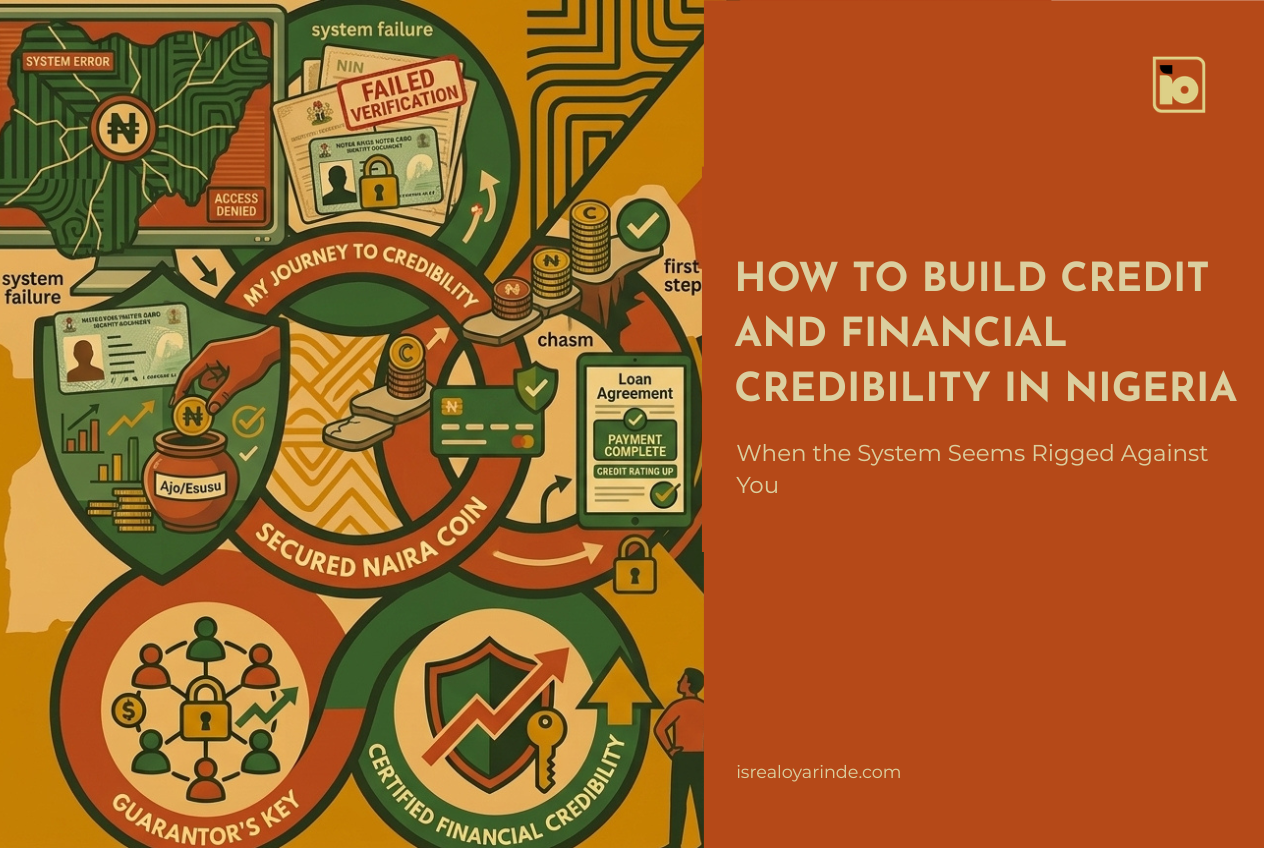
The uncomfortable truth about credit and financial credibility in Nigeria is that the system is, in many meaningful ways, rigged against ordinary people, and pretending otherwise would be dishonest.
Unlike countries like the United States where a centralized credit scoring system like FICO tracks your credit history and makes it possible to build creditworthiness over time through responsible borrowing and repayment, Nigeria’s credit infrastructure is fragmented, underdeveloped, and barely functional for the vast majority of the population.
Unfortunately, many Nigerians are internalising this systemic failure as something that they need to fix behaviourally. It is not uncommon to hear a Nigerian say that Nigerians do not “know how to” leverage credit when the reality is that most Nigerians do not have access to credit.
Despite significant improvement in the last few years, many Nigerians are still invisible to the formal credit system with no credit history, credit score or a pathway to build one through normal channels.
Why the Nigerian Credit System Is Broken and Who Benefits From Keeping It That Way
The current system where banks require landed property as collateral for virtually all lending, massively favors people who already have wealth, particularly those who inherited property or accumulated it during earlier periods of Nigerian history when real estate was cheaper and more accessible.
If your father or grandfather bought property in Lagos or Abuja thirty or forty years ago, you have access to collateral that can unlock millions of naira in bank credit, regardless of your actual business acumen or ability to repay.
If you are a first-generation entrepreneur from a family without property, you are essentially locked out of bank credit no matter how brilliant your business idea or how strong your revenue, because the banks have decided that your human capital, your skills, your track record, and your future earnings are worth nothing as collateral.
This is not just unfair, it is economically irrational, because it systematically directs capital toward people with inherited assets rather than people with the highest likelihood of generating returns, which is exactly backwards from how a functional credit market should work.In our current credit system, it is not just the work of your hands that is judged, it is the property you have.
The Central Bank of Nigeria has made various policy interventions to try to expand access to credit, including various interventions targeted at specific sectors and regulations requiring banks to dedicate a certain percentage of their deposits to lending to small and medium enterprises.
But the fundamental structural problem persists: Nigerian banks are incentivized to minimize risk rather than maximize economic impact, and in an environment where contract enforcement is slow and unreliable, property collateral is the easiest way for banks to protect themselves against default.
This creates a circular trap where people without property cannot get loans, people without loans cannot grow their businesses fast enough to acquire property, and the wealth gap between the propertied and the property-less continues to widen with each generation.
The fintech revolution is beginning to crack this system open, but slowly, and not without its own problems. Companies like Carbon (formerly Paylater), FairMoney, Branch, and Renmoney have developed alternative lending models that use smartphone data, transaction history, social media presence, and other non-traditional data sources to assess creditworthiness and provide loans without traditional collateral.
These platforms have dramatically expanded access to credit for millions of Nigerians who were previously completely excluded from the formal lending system. However, the interest rates charged by many of these platforms are extremely high, often ranging from 5 to 30 percent per month, which translates to annual percentage rates of 60 to 360 percent or more.
While these rates are partly justified by the higher default risk associated with unsecured lending, they also mean that fintech credit is expensive credit, and borrowers who are not extremely careful about how they use it can quickly find themselves trapped in debt cycles that make their financial situation worse rather than better.
The emergence of these platforms is a positive development, but it is a partial solution at best, and it does not address the fundamental need for affordable, long-term credit that enables real business growth and wealth building.
Building Your Financial Credibility From Zero — The Step-by-Step Approach
We know what the problem is and we have spent considerable time discussing it. However, as an entrepreneur you have neither the resources nor the capacity to fix the systemic issues that we have addressed earlier. What this translates to in practical terms is that you must learn to navigate the credit system as it is while continually advocating for what we want it to become. How do you do this?
Building financial credibility in Nigeria requires patience and discipline that most people underestimate. The first step is to formalize your financial life completely. This means opening accounts at multiple banks, not just one, because having relationships with several financial institutions creates more opportunities and gives you redundancy if one bank fails you.
Ensure you have a savings account, a current account, and ideally a domiciliary account for foreign currency if you have any international income or transactions. Use these accounts actively, making regular deposits and withdrawals that create a transaction history demonstrating consistent financial activity.
Creditors assess your creditworthiness partly based on your account activity, and an account with regular, consistent transactions over a period of years tells a very different story than a dormant account that only receives the occasional deposit
The second step is to build a relationship with your bank that goes beyond the transactional. This sounds old-fashioned in the age of mobile banking, but personal relationships still matter enormously in banking. Get to know your account officer by name. Visit the branch regularly enough that the staff recognize you. When you have good financial news, like landing a new contract or reaching a revenue milestone, share it with your account officer.
When the bank offers financial products like fixed deposits or treasury bill investments, participate, because these activities demonstrate financial sophistication and create additional touchpoints in your relationship. Over time, your account officer becomes an advocate for you within the bank, and when you eventually apply for credit, having someone inside the institution who knows you, trusts you, and can vouch for your character and business acumen can make an enormous difference.
I know this sounds like the kind of advice your grandfather would give, and it is, because some things about how business works in Nigeria have not changed despite all the technology, and the importance of personal relationships is one of them.
Third, establish and maintain a perfect record with microfinance institutions and cooperative societies, because these organizations can serve as stepping stones to larger credit facilities. Microfinance banks operate under Central Bank regulation and offer smaller loans with less stringent collateral requirements than commercial banks, making them more accessible for first-time borrowers.
Take small loans from reputable microfinance banks and repay it perfectly, every installment on time, every naira accounted for. Each successful repayment creates a credit record that can be reported to the credit bureaus and referenced when you apply for larger facilities at commercial banks.
Similarly, joining a cooperative society and participating actively in its savings and lending activities builds both financial credibility and access to affordable credit. Many cooperatives offer loans at interest rates of 10 to 15 percent per annum, which is a fraction of what commercial banks or fintech platforms charge, and the social accountability of cooperative membership creates incentives for responsible borrowing and repayment that benefit all members.
The foundation of financial credibility is consistent, documented, verifiable financial behavior over time. Every on-time payment, every regular savings deposit, every tax filing, every formal financial transaction adds another brick to the foundation of your financial credibility.
The entrepreneurs who start building this foundation early, even before they need credit, are the ones who can access capital when the need arises.
Leveraging Technology to Build Your Credit Profile
The good news is that technology is creating new pathways to financial credibility that did not exist even five years ago, and smart Nigerians are using these tools to build credit profiles that open doors the traditional system keeps locked.
The most immediate step you can take is to request your credit report from one or all three licensed credit bureaus in Nigeria: CRC Credit Bureau, FirstCentral Credit Bureau, and CreditRegistry. You can access your credit score for as low as four hundred naira and a full report for about five thousand naira. Reviewing this report tells you exactly what information the credit system has about you, whether any of it is inaccurate, and where the gaps are that you need to fill.
Many people discover errors in their credit reports that are negatively affecting their creditworthiness, and disputing and correcting these errors is one of the fastest ways to improve your credit standing. If you have no credit history at all, which is the case for the majority of Nigerian adults, your report will be essentially blank, which is better than having negative information but still represents a significant disadvantage when applying for credit.
Mobile money and digital banking platforms are powerful tools for building a documented financial history, because every transaction you make through these platforms creates a digital record that contributes to your financial profile.
Using platforms like Opay, Kuda, Moniepoint, and PalmPay for your daily transactions, paying bills, receiving payments, and transferring money, all creates data that these platforms and their partner financial institutions can use to assess your creditworthiness.
Many of these platforms also offer credit products to users with sufficient transaction history, starting with small amounts and increasing as you demonstrate responsible repayment behavior. The interest rates on these products are still higher than traditional bank loans, but they serve an important function as credit-building tools.
Beyond mobile banking, there are other technology-enabled strategies for building financial credibility. First, if you run a business, use accounting software like Wave or Zoho Books to maintain professional financial records that you can present to lenders as evidence of your business performance. A business with clean, organized financial statements is far more creditworthy than one that keeps records in a notebook or not at all, regardless of how much revenue either one generates.
Second, use digital payment systems for as many of your business transactions as possible, because digital transactions are verifiable in ways that cash transactions are not. A bank or lender can verify your digital transaction history to confirm the revenue you claim; they cannot verify cash transactions.
Finally and very importantly, register your business with the Corporate Affairs Commission and obtain your Tax Identification Number from the Nigeria Revenue Service, because these registrations are prerequisites for accessing many formal credit facilities and they signal to lenders that you are operating a legitimate, formalized business rather than an informal operation. Beyond registration, you must also stay compliant in terms of timely fillings of annual returns and tax returns for your business.
Alternative Funding Sources When Banks Say No
While building your credit profile is a long-term strategy, the reality is that many Nigerian entrepreneurs need capital now and cannot wait two or three years to build the kind of credit history that satisfies traditional bank requirements.
The good news is that bank loans are not the only source of business capital, and in many cases they are not even the best source, because the interest rates, collateral requirements, and rigid repayment schedules of bank loans are poorly suited to the cash flow patterns of many small and growing businesses.
So where do you go when bank loans are out of reach to you?
Government intervention funds represent one of the most underutilized funding sources, partly because many entrepreneurs do not know they exist and partly because the application processes can be opaque and bureaucratic.
The Bank of Industry offers loans at single-digit interest rates for manufacturing, agribusiness, and other productive sectors. The NIRSAL Microfinance Bank provides loans under various CBN intervention programs targeting youth, women, and agricultural enterprises. The National Social Investment Programme includes the Government Enterprise and Empowerment Programme (GEEP) which provides interest-free loans to market traders and small business operators.
Finally, you can look into cooperative societies as a funding source. I know I mentioned them earlier in the context of credit building, but they deserve more attention as a capital source in their own right. Nigerian cooperative societies collectively manage billions of naira in savings and provide loans to their members at rates that are typically a fraction of what banks or fintech platforms charge.
The beauty of cooperative lending is that it is based on social trust and mutual accountability rather than property collateral, which makes it accessible to exactly the people who are excluded from bank credit. A typical cooperative operates on a model where members save regularly, the pooled savings are lent to members at modest interest rates, and the interest earned is distributed back to members as dividends.
The lending limits are usually based on a multiple of your total savings, typically two to three times, which means that building up your savings in a cooperative simultaneously builds your borrowing capacity. I know entrepreneurs who fund significant business investments entirely through cooperative loans at 12 to 15 percent per annum, while their peers are paying 25 to 30 percent at commercial banks or 60 percent or more on fintech platforms.
Equity investment is another option that many entrepreneurs overlook or dismiss because they are uncomfortable with the idea of giving up ownership in their business. But for businesses with high growth potential, equity investment can be far more advantageous than debt, because equity investors share both the risk and the reward of your business rather than demanding fixed repayments regardless of your business performance.
The Nigerian angel investment and venture capital ecosystem has also grown significantly in recent years, with organizations like the Lagos Angel Network, Ventures Platform, and numerous individual angel investors actively seeking investment opportunities in Nigerian startups and small businesses.
International venture capital firms like Sequoia Capital, Y Combinator, and Techstars have also increased their focus on African markets, with Nigeria receiving the largest share of venture capital investment on the continent.
While these investors typically focus on technology-enabled businesses with potential for rapid scaling, the principle of equity investment applies more broadly, and bringing in a partner who contributes capital in exchange for a share of ownership can be the right move for many types of businesses at certain stages of growth.
Protecting Your Financial Credibility Once You Have Built It
Building financial credibility is hard enough in Nigeria, but protecting it once you have built it requires ongoing vigilance and discipline, because there are numerous ways your credibility can be damaged, some of them through no fault of your own.
Identity theft and fraud are growing problems in Nigeria’s digital economy, and if someone uses your identity to take out loans or engage in fraudulent financial transactions, the negative records can appear on your credit report and damage your creditworthiness before you even know what happened. Regularly monitoring your credit reports, which you can do by requesting annual reports from the three credit bureaus, is essential for catching unauthorized activity early.
You should also protect your personal financial information by never sharing your BVN, account numbers, PINs, or passwords with anyone, no matter how trustworthy they seem, and by being extremely cautious about phishing scams and social engineering attacks that are increasingly sophisticated and targeted at Nigerian consumers and business owners.
Also, as a business owner, refrain from acting as a guarantor for people you cannot vouch for completely or who have a history of not acting with integrity. Acting as a guarantor creates a legal obligation that can destroy your financial credibility if the primary borrower defaults.
My advice on guaranteeing loans is simple and absolute. Do not do it unless you are fully prepared to pay the entire loan amount yourself and can afford to do so without financial hardship. If someone asks you to guarantee their loan, ask yourself this question: would I give this person this amount of money as a gift, knowing I might never see it again? If the answer is no, then you should not guarantee their loan, regardless of the social pressure or emotional manipulation they apply.
The discipline required to maintain financial credibility extends to every aspect of your financial life, including tax compliance. Many Nigerian entrepreneurs treat tax obligations as optional, either not filing at all or filing inaccurate returns that understate their income. While this might seem like a smart move in the short term, it creates serious long-term risks to your financial credibility.
Unpaid taxes create a legal liability that can result in penalties, interest, and even criminal prosecution. Second, banks and other financial institutions increasingly cross-reference loan applications with tax records, and discrepancies between the income you claim on your loan application and the income you report to the tax authorities raise red flags that can result in loan denial.
Third, a clean tax record is increasingly important for accessing international business opportunities, as foreign partners and clients often require tax compliance certificates as part of their due diligence process. The Nigeria Revenue Service has made tax filing easier through its online portal, and the investment of time and money in maintaining accurate, compliant tax records pays dividends in financial credibility that far exceed the cost.
The Psychology of Financial Credibility: Changing Your Money Mindset
It is tough to build financial credibility when your entire relationship with money has been shaped by scarcity, instability, and distrust of financial institutions, which is the reality for most Nigerians.
The psychological dimension of financial credibility is just as important as the practical steps, because your mindset about money influences every financial decision you make, from how much you save to how you handle debt to how you respond when opportunities or crises arise.
Many Nigerians have inherited a money mindset shaped by decades of economic volatility, currency devaluation, bank failures, and government policies that seemed designed to punish saving and reward consumption.
When your parents or grandparents watched their savings evaporate during bank consolidation or saw their naira holdings lose half their value overnight, it is natural to develop a mindset that distrusts formal financial systems, prioritizes immediate consumption over long-term saving, and sees financial planning as futile in a country where the rules change without warning. But while this mindset is understandable given our history, it is also a prison that keeps you trapped in exactly the financial vulnerability you are trying to escape.
Changing your money mindset starts with financial education, which is tragically absent from the Nigerian educational system. Most Nigerians graduate from university without ever taking a course in personal finance, investing, or business accounting, which means they enter the workforce and build businesses with no framework for making sound financial decisions.
The good news is that financial education is more accessible now than at any point in human history, thanks to the internet and the explosion of high-quality financial content available for free online. Resources like Investopedia, books like Rich Dad Poor Dad and The Psychology of Money, Nigerian financial literacy platforms, and the growing community of Nigerian personal finance content creators on YouTube, Twitter, and blogs provide financial knowledge to anyone with an internet connection and the discipline to study consistently.
My recommendation is to commit to at least one hour of financial education every week, reading, watching videos, listening to podcasts, whatever format works for you, and to treat this education with the same seriousness you would treat a professional certification or a university course. The knowledge you gain will compound over time, improving every financial decision you make for the rest of your life.
Building financial credibility requires treating your financial life, business or personal with the intentionality, discipline, and long-term thinking that is difficult but essential in a country that seems to reward short-term thinking at every turn.
This means creating and following a budget, tracking every naira that comes in and goes out, setting financial goals and measuring progress toward them, building emergency savings before investing in anything else, and making financial decisions based on analysis rather than emotion.
It means saying no to social pressures that push you to spend money you do not have, whether it is becoming a sponsor of yet another tech event —the business equivalent of spending money on an owambe that is not really your bread and butter; renting a fancy office space to impress people who do not care about you, or lending money to relatives who have no intention of repaying.
Financial credibility is built through thousands of small, disciplined decisions made consistently over years, and there is no shortcut, no hack, and no substitute for the steady, patient work of building a financial life that commands respect from institutions, partners, and yourself.
The Road Ahead — A More Inclusive Financial Future for Nigeria
Despite all the challenges I have described, I am genuinely optimistic about the future of financial inclusion and credit accessibility in Nigeria, and that optimism is grounded not in wishful thinking but in observable trends that are systematically dismantling the barriers that have excluded most Nigerians from the formal financial system.
The growth of fintech, digital banking, and mobile money is creating alternative pathways to financial participation that bypass the traditional banking system’s gatekeepers and their property-obsessed lending criteria.
The emergence of open banking frameworks, where financial data can be shared securely between institutions with the customer’s consent, will eventually enable more sophisticated and accurate credit scoring that considers a person’s entire financial life rather than just whether they own land.
The increasing availability of digital identity infrastructure, anchored by the BVN system and expanding to include NIN (National Identification Number) integration, is making it easier for financial institutions to verify identity and assess risk, reducing their dependence on property collateral as a risk mitigation tool. We have also seen an upsurge in the number of Nigerians captured in at least one of the three licensed credit bureaus moving the percentage of coverage from about 15% to 40% in a few years.
The role of regulation in driving financial inclusion cannot be overstated, and the Central Bank of Nigeria deserves credit for several policy initiatives that are pushing the banking system toward greater inclusivity. The tiered Know Your Customer (KYC) requirements, which allow basic bank accounts to be opened with minimal documentation, have brought millions of previously unbanked Nigerians into the formal financial system.
The licensing of payment service banks and mobile money operators has created new channels for financial services delivery that reach populations the traditional banking system has failed to serve. These initiatives are imperfect and progress is slower than anyone would like, but the direction of travel is clear and irreversible.
Your financial credibility journey is a journey of steps, each one small but each one moving you closer to the financial freedom and respect that every hardworking Nigerian deserves. Start moving today.