May 7, 2026

9 minute

Isreal Oyarinde

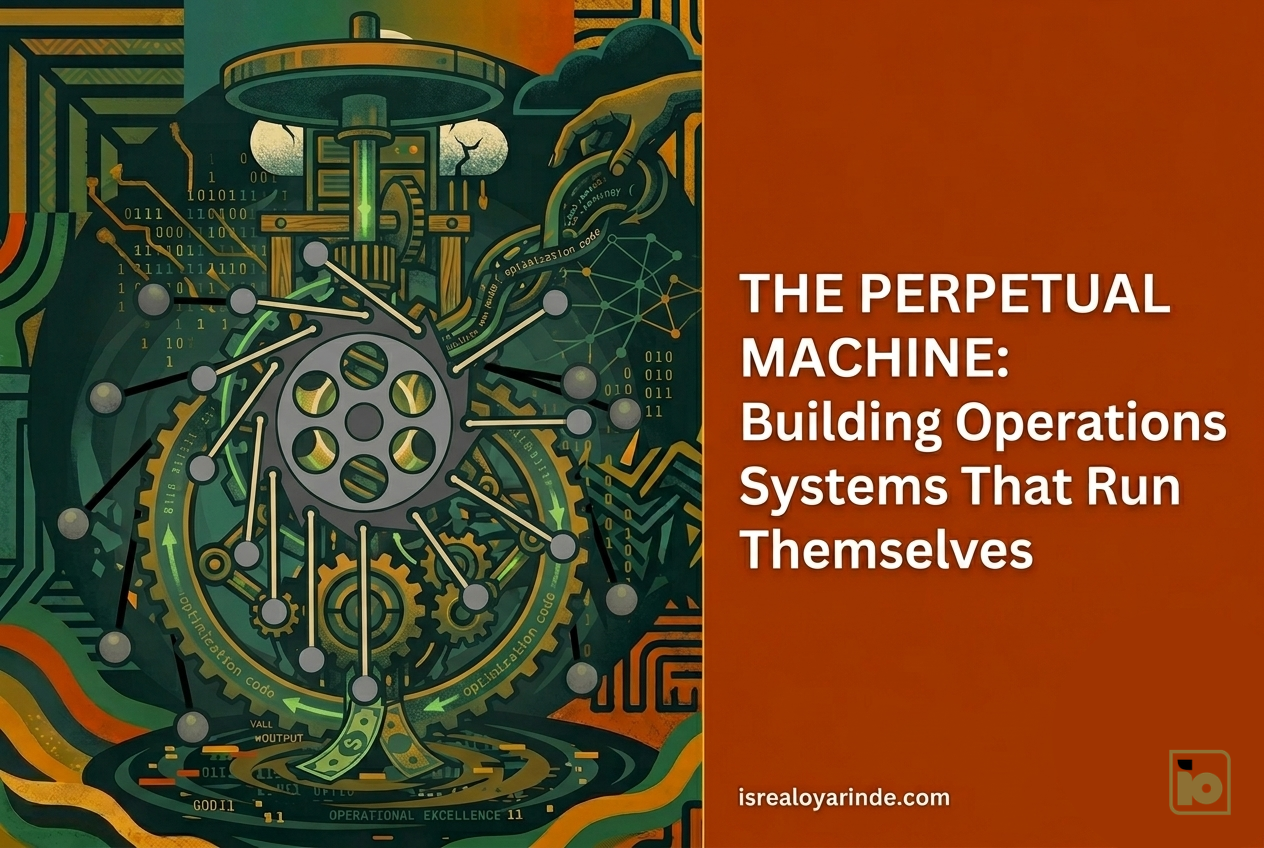
The Perpetual Machine: Building Operations Systems That Run Themselves

Table of Contents

The idea of a perpetual machine seems exciting. Something that runs on its own without any input. As an entrepreneur reaching this point in my businesses is my ultimate goal. Having resilient and profitable businesses that do not need me slaving away at my desk for the better part of 18 hours a day so I can have time to do other things I love and spend time with the people I care about.

In this article, I will be sharing some advice that has worked for me as I am building. I do not purport to know it all as I am still in the process of transitioning from a solopreneur to a CEO myself. So, I would love for you to think of this as an ongoing conversation. Let’s get into it.  

Where (or Who) Is the Battery?

In science fiction, a perpetual machine is a hypothetical device that operates indefinitely without any external energy source, producing work or motion forever. A perpetual machine is deemed scientifically impossible so why is it something to aspire to in business?

I think as entrepreneurs we aspire to this impossible “machine” not because we think we can ignore the laws of physics, but because we want to minimize the “Energy of Supervision.” Simply put, we want to reduce our input to the very minimum while simultaneously getting maximum output out of the business. 

So the idea is not that we get to a point where we can completely ignore the business and it just continues to run efficiently on its own. Rather, it is that we are minimising input for maximum output. 

The hardest part of building a perpetual motion machine is finding out where to hide the battery. Basic science tells us that a machine cannot run forever without an energy source. But a machine can run without a huge battery or energy pack attached to it. The battery can be tiny and inbuilt and it is the same with businesses too.

We look at companies with presence in multiple countries that have existed for decades, long after the original visionary is retired or dead and wonder how they continue to run.  In most Nigerian businesses, the “battery” is the founder. The business runs on them. Remove the founder and the whole thing grinds to a halt like a generator that just ran out of diesel.

I have watched it happen more times than I can count. A sharp Oga builds a thriving business, employs 30 people, handles the biggest clients personally, negotiates every major deal, and signs every cheque. 

Then he travels for two weeks, and by the time he lands at Murtala Muhammed, three clients have complained, two staff have been fighting, and someone has been helping themselves to petty cash. The business did not collapse because of the market. It collapsed because the entire operation was a one-man show wearing a company costume.

In software engineering, there is a concept called the “bus factor.” It asks: how many people on your team would need to be hit by a bus before the project stalls? If the answer is one, you have a problem. In most Nigerian SMEs, the bus factor is literally one: the founder. If they get sick, travel, die, or simply burn out, the business is finished.

The Tribal Knowledge Problem

The root cause is what I call “tribal knowledge,” information that lives in your head and nowhere else. You know which supplier gives you the best rate. You know which staff member cannot be trusted with cash. 

You know that Client A always pays late but Client B will bounce a cheque entirely. You know that LASTMA operates heaviest on Tuesdays on that particular route your delivery trucks use.

All of this is critical operational intelligence. And none of it is written down.

When you leave, all of that leaves with you. Your replacement, whether it is a hired manager or your own child, starts from zero. They make mistakes you solved ten years ago. They trust the wrong people. They take the wrong route on Tuesday. And they wonder why things are not working.

This is the exact pattern that killed countless Nigerian businesses. Ekene Dili Chukwu ran like clockwork under its founder. Within years of his passing, the fleet was in disrepair, routes were mismanaged, and the brand that once dominated the East became a memory. The same story plays out in restaurants, law firms, trading companies, and tech startups. The founder was the system, and when the founder left, the system left too.

The Franchise vs Buka Test

Here is a simple test for whether your business is a system or a personality cult: could someone franchise it?

Think about Chicken Republic. Whether you walk into the one in Lekki or the one in Abuja, you get roughly the same experience. The jollof rice tastes the same. The service follows the same pattern. The menu is the same. That is not because every branch has the same brilliant manager. It is because there is a system, SOPs, checklists, training manuals, supply chain processes, and quality controls that ensure consistency regardless of who is behind the counter.

Now think about your favourite local buka. Mama Nkechi’s rice is legendary. People drive across town for it. But what happens when Mama Nkechi is sick? Or when she travels to the village for a funeral? 

The rice does not taste the same. Customers notice. Some stop coming. If Mama Nkechi retires, the buka closes. Her recipe, her timing, her seasoning instincts, all tribal knowledge that was never transferred.

The difference between a Chicken Republic and a Mama Nkechi buka is not talent, it is systems. And if you want to build something that outlasts you, you need to build systems.

The ‘If I Die Tomorrow’ Document

The fix is simple, though not easy. It is the “If I Die Tomorrow” document. You need to move knowledge from your brain to a repository. But do not write a 100-page manual that nobody will read. Be lazy. Be smart about it.

Here is how:

  • Use SOPs (Standard Operating Procedures): “When you do X, you do Y.” Keep them short, specific, and actionable. Not essays. Not philosophy. Just: step 1, step 2, step 3.
  • Use checklists: Atul Gawande wrote an entire book about how checklists save lives in surgery and aviation. If checklists can keep a 747 in the air, they can keep your business running.
  • Record important stuff: Use Loom, use voice notes, use Google Docs. The medium does not matter. What matters is that it exists outside your brain.
  • Create a “Key Contacts” document: who are the critical suppliers, customers, and partners? What are their quirks? Who do you call when NEPA takes light and the generator does not start? 

In fact, I would go further to suggest that if your business is reliant on artisans, document every artisan you have ever worked with and their output. Let whoever is coming after you know who tends to inflate the price of raw materials and who has an issue with timing.

  • Document the exceptions, not just the rules: Every business has weird edge cases. “If Client X complains about pricing, here is the real story.” “If the Apapa warehouse floods in August (it always does), here is the contingency.” Those exceptions are where tribal knowledge is most dangerous when lost. 
  • Document what failed or didn’t work well: You don’t just document what works, document what doesn’t as well so someone does not think their next new idea is something you already tried and which didn’t work. Even if they end up adopting that process, it must be an informed choice they make knowing the possible downsides. 
  • Make knowledge accessible: There is no point documenting everything and then leave it locked behind an encrypted system no one can access. I am not saying give away all your business secrets in an open file just anybody can access, but there has to be a structured process for knowledge transfer.  

Think of it this way: if you were in a hospital bed tomorrow, could someone access the business’ files, read your documents, and keep the business running for 30 days? If the answer is no, you have work to do.

No-Trust Architecture: People Will Disappoint You

I love people I work with. I do not think you should work with people you do not like or are not trustworthy. In fact, when I notice someone is overly particular about money, I limit my involvement with them. Inevitably, you will have dishonest folks come in.

Because for most businesses, you cannot build a perpetual machine if parts of the machine are fencing and stealing the parts.

This is where No-Trust Architecture comes in. The name sounds harsh, but the concept is simple: design your systems so that no single person has enough control to cause catastrophic damage, even if they wanted to.

Banks do this. That is why a teller cannot approve their own transactions. That is why auditors exist. That is why there are withdrawal limits. They do not assume every employee is honest; they build systems that make dishonesty difficult. Your business should do the same.

Key Principles of No-Trust Architecture

Actions Have Consequences: If you find anyone can steal, regardless of size, seniority or relationship, it is no longer a question of trust. They are no longer in the system. I have seen business owners forgive theft because “he has been with me for 15 years” or “she is my cousin’s wife.” 

That is how you lose everything. A driver who steals N5,000 in fuel today will steal N500,000 in inventory tomorrow when the opportunity presents itself. Theft is not about amount, it is about character. Cut the loss early.

The Separation Principle: Separate the money-maker from the person who spends. Build a system where the banking and cheque handling is split. The person who approves expenditure should not be the person who makes the payment. 

The person who receives goods should not be the person who records them in the system. The person who handles cash should not be the person who reconciles the accounts. This is basic internal controls, but I am amazed how many Nigerian businesses have one person doing all of it. That is not trust, that is negligence.

The ‘Two Key Rule’: Split responsibilities like a nuclear submarine. Nobody alone has full access. In a submarine, launching a missile requires two officers to turn their keys simultaneously. Neither can act alone. Apply this to your business. 

Two signatories on every cheque above a certain amount. Two people verifying inventory counts. Two approvals for major purchases. It slows things down slightly, yes, but it also means no single person can sink your ship.

Knowledge Moats: Protecting Your Business Intelligence

These principles create what I call “Knowledge Moats.” Even if your best staff leaves, they will not be the same person as when they were in the system. Why? Because no single person held all the keys.

This is also a retention strategy, by the way. When staff know that the business is not dependent on any one person, there is less temptation to use their position as leverage. “If I leave, the whole thing collapses” is a powerful bargaining chip, and some employees cultivate that dependency deliberately. Systems eliminate that leverage.

I have seen Nigerian businesses where one accountant has been the only person who understands the books for 12 years. Nobody else can read the spreadsheets. Nobody else knows the bank reconciliation process. 

That accountant effectively holds the business hostage, and the owner does not even realise it. When that accountant eventually leaves, and they always do, the owner discovers that the books are a mess, money is missing, and nobody can trace what happened.

A knowledge moat means the business retains critical knowledge regardless of staff turnover. The moat protects the castle, not the knight.

Practical Steps: Building the Machine

So how do you actually build a perpetual machine? Here is a practical checklist:

  • Week 1: Write down the top 10 things only you know about the business. Supplier contacts, client quirks, financial processes, passwords, everything.
  • Week 2: Create simple SOPs for your most critical processes. Keep each under one page.
  • Week 3: Identify single points of failure. Who is your one-person dependency? What happens if they leave?
  • Week 4: Implement the Two-Key Rule for financial transactions. Set up dual signatories and separation of duties.
  • Month 2: Cross-train at least one person on every critical function. Nobody should be the only person who knows how to do something.
  • Month 3: Test it. Take a week off. Do not answer calls. See what breaks. Fix those things.

This is not glamorous work. It is not the kind of thing that gets you speaking invitations at Lagos Business School. But it is the difference between a business that survives you and a business that dies with you.

Real-World Examples: Who Got It Right and Who Did Not

Let me give you a contrast. Think about a franchise like Coldstone, every branch operates from the same playbook. The recipe, the flavours, the delivery time target, the customer greeting, even down to what to do when a customer leaves a tip, all documented, all repeatable. A manager in one city can transfer to another and be productive within a week because the system is the system, not the person.

Now think about a typical Nigerian distribution company. The founder knows which warehouse staff are reliable for the night shift. He knows that the Benin route needs to be dispatched by 4 AM or the trucks will hit the Ore gridlock. He knows that Customer X always orders late but pays cash, so you accommodate them. None of this is written anywhere. The day the founder is not available, chaos. Trucks dispatch late. The wrong staff are assigned. Customer X gets ignored, and a N2 million monthly account walks out.

I know of a printing business in Lagos that ran beautifully for 18 years under its founder. The man could estimate paper costs in his head, knew every machine’s quirks, and had personal relationships with every major client. 

When he had a stroke, the business ground to a halt within three weeks. His wife, who was supposed to take over, did not know the machine maintenance schedule, the supplier payment terms, or even the WiFi password to the office network. Within six months, two of the three machines broke down, clients moved to competitors, and the business that employed 25 people was reduced to a skeleton crew of five.

Contrast that with a tech startup I know that built its entire operation around Notion databases. Every process, from onboarding a new client to handling a server outage, lives in a shared workspace. When the CTO relocated to Canada, the team did not skip a beat. They promoted a senior developer, who read the documentation, and the transition was seamless. The founder was replaceable, not because he was not talented, but because he had made himself replaceable by design.

That is the difference. One business was a person wearing a company costume. The other was a company that happened to have talented people. The second model survives. The first does not.

The Real Perpetual Machine

The real perpetual machine is not one that runs without energy. It is one that generates its own energy. A business where knowledge is documented, responsibilities are distributed, and no single point of failure exists. A business where you can take a vacation without checking your phone every five minutes. A business where, if the worst happens, your family is not left scrambling to understand what you built.

You do not need to be immortal. You just need to build something that does not need you to be immortal.

Start writing things down. Today, not tomorrow. Not “when things slow down” (they never do). Today.

Your future self, your family, and your employees will thank you.
Related Blogs

October 7, 2026

Isreal Oyarinde

Have you ever patronised a business and even though they delivered what was promised in terms of the product or service, you never went back just because of how they made you feel? That is the power of customer service, a secret weapon I believe most businesses, especially in the Nigerian market are underutilising.  A good number of people are happy to pay a premium if it means they get a better experience. In a competitive market where margins are thin; differentiation is difficult; and customer loyalty is fragile, customer service is not a ‘nice to have’ —it is the single most powerful competitive advantage a business can develop.  Yet most Nigerian business owners treat it as an afterthought, something to worry about after they have sorted out the ‘real’ business issues. Customer service IS the real business issue, and the sooner Nigerian entrepreneurs figure that out, the sooner they will start building businesses that actually last. The big question is, “how do we leverage customer service for business growth?”. Let’s start with defining the problem.  The Nigerian Customer Service Problem. It’s Worse Than You Think Consumers more often than not rank customer service as one of the most important factors in their purchasing decisions, yet they consistently rate the quality of customer service they receive as poor to average across virtually every industry —banking, aviation, telecommunications, retail, hospitality, healthcare, transportation.  The telecommunications sector is probably the most visible offender and there seems to be a consensus among providers never to treat their customers like kings. In aviation, flight schedules are routinely changed and no reprieve offered to customers who have to spend long hours at the airport waiting for a flight they are not sure would eventually take off.  Despite the banking sector being one of the most profitable industries in Nigeria, customer service remains a persistent clog with many customers feeling stuck to their current provider because the competition is not any better. The retail sector, both formal and informal, suffers from the same malaise.  Walk into a typical Nigerian establishment and observe the body language of the sales staff —arms folded, phone in hand, chatting with colleagues, barely making eye contact with the customer who has walked in. If you ask a question, you get a one-word answer. If you ask to see a different product, you get an eye-roll. If you haggle on price, you are treated as if you have committed a personal insult.  The concept of a return policy is almost alien to most Nigerian businesses. Once they have your money, that transaction is over. Any attempt to return a defective product or request a refund is treated as an act of aggression.  This attitude is so pervasive that many Nigerians have simply learned to accept bad customer service as normal, which is exactly the problem. When your customers stay just because the grass is not greener on the other side and not because they feel valued, there is a problem.  The Economics of Good Customer Service: Why Good Service Is Good Business You might be wondering, if the average customer has learned to accept bad service as the norm, why should I go the extra mile for my customers in my business?  This is where what I call the economics of good service comes in. According to the Harvard Business Review, acquiring a new customer is anywhere from five to 25 times more expensive than retaining an existing one. Also, research done by Frederick Reichheld of Bain & Company who invented the net promoter score shows increasing customer retention rates by 5% increases profits by 25% to 95%. Every time a customer walks away from your business because of bad service, you are not just losing that customer’s future purchases, you are also increasing your marketing and acquisition costs because you now have to find a new customer to replace the one you lost. Loyal customers buy more over time, they are less price-sensitive, they cost less to serve because they are familiar with your processes, and they refer new customers to your business through word-of-mouth.  In Nigeria, where trust is scarce and word-of-mouth is the most powerful form of marketing, the value of a satisfied customer who tells their friends, family, and colleagues about your business cannot be overstated.  Think about how you choose restaurants, mechanics, tailors, doctors, and virtually every other service provider. Most times, you simply ask people you trust for recommendations. A single satisfied customer who recommends your business to ten people is worth more than a million-naira advertising campaign, because those ten people come with a built-in trust advantage that no advert can provide. Conversely, the cost of bad customer service is devastating. Research from the historical White House Office of Consumer Affairs studies shows that dissatisfied customers tell 9 to 15 people about a poor experience.  In the age of social media, those numbers are exponentially higher. A single negative review on Twitter or Instagram can reach thousands of potential customers within hours. Nigerian social media is particularly brutal when it comes to calling out bad business experiences.  Remember those viral posts where someone shares a terrible experience with a business and thousands of people pile on with their own stories? Those threads have destroyed businesses, tanked reputations, and cost companies millions in lost revenue.  And the businesses that fare the worst in those situations are the ones that respond poorly —deleting comments, arguing with customers, or going silent altogether. The businesses that survive and even thrive after negative publicity are the ones that respond quickly, take responsibility, fix the problem, and demonstrate genuine commitment to improving.  Clearly, there is both a quantitative and qualitative case for making customer service central to your business. What World-Class Customer Service Looks Like  If you want to improve your bottomline and build a community of loyal customers, you cannot treat customer service as something reserved for only “luxury” clients. Even a “problematic” client deserves a good experience with your

October 2, 2026

Isreal Oyarinde

I used to wear my constant burnout like a badge of honor. I remember those years I was running myself ragged trying to make money from every angle possible. Working a full-time job during the day, freelancing at night, trying to trade forex in between meetings, running a small side business on weekends, and somehow convincing myself that sleeping three hours a night was a sign of hustle rather than a highway to the hospital.  I thought that was what it meant to build multiple streams of income. I thought you had to grind yourself into dust, sacrifice your health, your relationships, your sanity, and your sleep just to have more than one source of revenue coming in. I was wrong. Dead wrong.  In my defence, I had merely replicated the model of work around me. Nigeria is a side hustle-driven society and you might look like you aren’t trying enough or worse, foolish, if you do not have multiple things you are doing to make money.  I am writing this because I see so many Nigerian professionals making the same mistake I made,  confusing activity with productivity, confusing exhaustion with effort, and confusing the number of things they are doing with the quality of income they are generating.  In this article, I will try to expose you to a sustainable framework for building multiple income streams.  We Should All Be Hustlers  We live in a society where the “grind” has premium social value. Even when there is no corresponding financial value, the mere fact that a person is seen to be trying their hands at multiple things is met with a nod of approval.  While this is not necessarily a bad thing afterall, a moving man will one day meet his luck, the problem is that we might be overindexing on effort while forgetting to measure outcomes. So, a young professional working a 9-5 while running multiple businesses might be seen as working hard whereas none of the businesses is meeting any critical growth markers.  The truth is that building multiple income streams is not just about doing more, it is about doing the right things, in the right order, with the right systems, so that your income grows while your stress levels stay manageable.  It is not easy, I will not lie to you about that, but it is absolutely possible, and it does not require you to destroy your health and your relationships in the process.  The ability to build multiple income streams matter so much for Nigerian professionals specifically. In most developed countries, a single good salary can provide a comfortable life — mortgage payments, car payments, utilities, food, healthcare, savings, and a vacation once or twice a year.  In Nigeria, that calculation simply does not work for the vast majority of people. Even professionals who are considered well-paid by Nigerian standards — doctors, lawyers, engineers, bankers — often find that their salary alone cannot keep up with well…anything.  For the majority, a single income stream is simply not sufficient for financial stability, let alone financial growth. This is not a character flaw or a failure of ambition, it is a structural reality of living in an economy where inflation consistently outpaces salary growth, where the currency loses value faster than most investments can compensate, and where the social safety net is essentially non-existent.  Building multiple income streams is not a luxury in Nigeria, it is a survival strategy. Building Income Streams Sustainably Now, let’s talk strategy.  The goal, remember, is not to stop grinding, it is to ensure that we are maximising output and building multiple income streams in a way that doesn’t lead to burnout. The Foundation: Stabilize Before You Diversify The biggest mistake I see Nigerian professionals make when they decide to build multiple income streams is starting too many things at once without having a stable foundation. They hear about someone making money from real estate, someone else killing it with e-commerce, another person doing well with content creation, and they try to do all of it simultaneously while still holding down their day job.  Within three months, they are exhausted, none of the ventures are doing well because none of them are getting enough attention, their performance at their main job is suffering because they are distracted, and they end up worse off than when they started — financially, physically, and emotionally. Please do not do this.  The first and most important principle of building multiple income streams is to stabilize your primary income before you diversify. Your primary income whether it is a salary, a business, or freelance work is your foundation.  Stabilizing your primary income means several things. First, it means making sure you are earning as much as you can from your primary occupation. If you are employed, have you negotiated your salary recently? If you are a freelancer or business owner, are you pricing your services appropriately? Are you serving the right clients or customers? Are there ways to increase your revenue from existing clients before chasing new ones?  Second, stabilizing your primary income means building an emergency fund, at least three to six months of living expenses set aside in a place where you can access it quickly but will not be tempted to spend it on non-emergencies. Putting away your emergency fund in a money market fund offers this critical balance.  Third, stabilizing your primary income means getting your financial house in order. That is understanding exactly how much you earn, how much you spend, where your money goes, and where the leaks are.  Most Nigerian professionals, if they are honest with themselves, are spending money on things that do not align with their priorities, and plugging those leaks can free up significant capital for investment in additional income streams.  Understanding What You Are Building: Income Stream Categories Before we get into specific strategies, it is important to understand the different categories of income streams, because not all income streams are created equal, and

August 31, 2026

Isreal Oyarinde

Many small and medium-sized businesses in Nigeria think about cybersecurity as something only big corporations and government agencies have to prioritise. In reality, because small businesses form the backbone of Nigeria’s economy and often have weaker defenses, they are the easiest targets for cybercriminals. The scale of the cybersecurity threat facing Nigerian businesses is staggering and growing every day, driven by the rapid digitization of the Nigerian economy, the increasing sophistication of cybercriminals, and the pervasive lack of cybersecurity awareness and investment among Nigerian businesses.  Managing cyber risks has become a big part of building a business today. Regardless of the size of your business, you must incorporate cybersecurity strategies that would protect your business from cyberattacks that could lead to financial ruin, reputational damage, or total operational collapse. Common Cyber Threats Targeting Businesses Understanding the threat landscape is the first step towards protecting yourself. Hence, it is important to identify some of the most common threats that businesses face today.  Business Email Compromise (BEC) targets people, not technology. By hacking or impersonating legitimate accounts, attackers trick employees into diverting funds or sharing sensitive data.  BEC bypasses technical security by exploiting human trust, losses from BEC exceed billions of dollars annually, and Nigeria is both a major source and a major victim of BEC attacks.  Ransomware is a rapidly growing threat to businesses. In a ransomware attack, criminals use malware to encrypt a company’s files, databases, and systems, rendering them completely inaccessible, and then demand a ransom payment, usually in cryptocurrency in exchange for the decryption key.  Ransoms range from hundreds of thousands to billions of naira, yet paying never guarantees data recovery. Beyond the immediate extortion, the operational downtime often leads to lost revenue, regulatory fines, and long-term reputational damage.  Malicious actors flood company servers or websites with overwhelming traffic, causing system crashes and severe service disruptions.                                                                                                                       The Nigeria Computer Emergency Response Team (ngCERT) warns that a sustained wave of Distributed Denial-of-Service (DDoS) attacks are increasingly threatening Nigeria’s critical digital infrastructure, with both public and private sector organisations under heightened risk. Fraudulent emails, text messages, or websites designed to trick people into revealing passwords, financial information, or other sensitive data is another common entry point for virtually all types of cyber attacks, including BEC and ransomware.  Nigerian businesses are particularly vulnerable to phishing because of low levels of cybersecurity awareness among employees, the widespread use of personal email accounts and devices for work purposes, and the general culture of clicking on links and opening attachments without verifying their legitimacy.  I have only highlighted the above as they are the most common forms of cyberattacks targeting businesses. There are other examples of cyber attacks targeting businesses such as Supply Chain Attacks, and SQL Injection & Zero-Day Exploit among others.  Why Small and Medium Businesses Are the Most Vulnerable There is a dangerous misconception that cybercriminals only target large corporations because that is where the big money is. This could not be further from the truth.  Small and medium-sized businesses are disproportionately targeted by cybercriminals precisely because they tend to have weaker security defences, less cybersecurity awareness, and fewer resources for incident response and recovery.  A cybercriminal might not be able to steal a billion naira from a single business, but they can steal ten million naira each from a hundred small businesses with a fraction of the effort it would take to breach a major bank or telecom company.  According to Kaspersky, 86% of small and medium sized businesses encountered cybersecurity incidents over the past year. The average cost of a cyber attack for a small business is often enough to threaten the viability of the entire enterprise.  In the Nigerian context, where most businesses operate with thin profit margins, limited cash reserves, and no cyber insurance, a single significant cyber attack can be an extinction-level event forcing the business to close permanently because it simply cannot absorb the financial loss or recover from the operational disruption. The vulnerability of Nigerian SMEs is compounded by several factors that are specific to the Nigerian business environment. First, most Nigerian SMEs do not have dedicated IT staff, let alone cybersecurity specialists. Technology decisions are often made by the business owner or a generalist office manager who may have basic computer skills but no expertise in cybersecurity.  Second, the rapid digitization of Nigerian businesses driven by mobile payments, online banking, e-commerce, cloud computing, and social media marketing has dramatically expanded the attack surface for cybercriminals without a corresponding increase in security awareness and investment.  A small business owner who used to operate entirely in cash and paper now has a POS terminal, a mobile banking app, an Instagram business account, a WhatsApp business number, and a cloud-based accounting system, each of which represents a potential entry point for cybercriminals.  Third, the BYOD (Bring Your Own Device) culture that is prevalent in many small Nigerian businesses creates significant security risks because employees are accessing sensitive business data and systems from personal phones and laptops that may be infected with malware, connected to unsecured public Wi-Fi networks, or shared with family members and friends.  The Human Factor: Your Employees Are Your Biggest Security Vulnerability Cybersecurity professionals have a saying: humans are the weakest link in the security chain, and this is especially true in the Nigerian context where cybersecurity awareness and training are virtually non-existent in most organizations.  Think about how many times a day your employees click on links in emails without checking where they lead, open attachments from unknown senders, use the same password for their personal email, their bank account, and their work systems, share sensitive business information over WhatsApp without encryption, connect to public Wi-Fi at hotels, airports, and coffee shops while accessing company systems, and leave their laptops unlocked and unattended in public spaces.  Each of these behaviours represents a potential security breach waiting to happen, and in an organization with dozens or hundreds of employees all engaging in these risky behaviours simultaneously, it is only