When Did This Start Tasting Different?
You know that moment when you open a pack of something you have been buying for years and something feels… off? The biscuit is smaller. The flavour is thinner. The packaging looks the same, maybe even fancier, but the product itself has quietly, subtly, become worse.
You ask yourself: “Did my taste change, or did they change the recipe?” The answer, almost always, is that they changed the recipe. And they are hoping you will not notice.
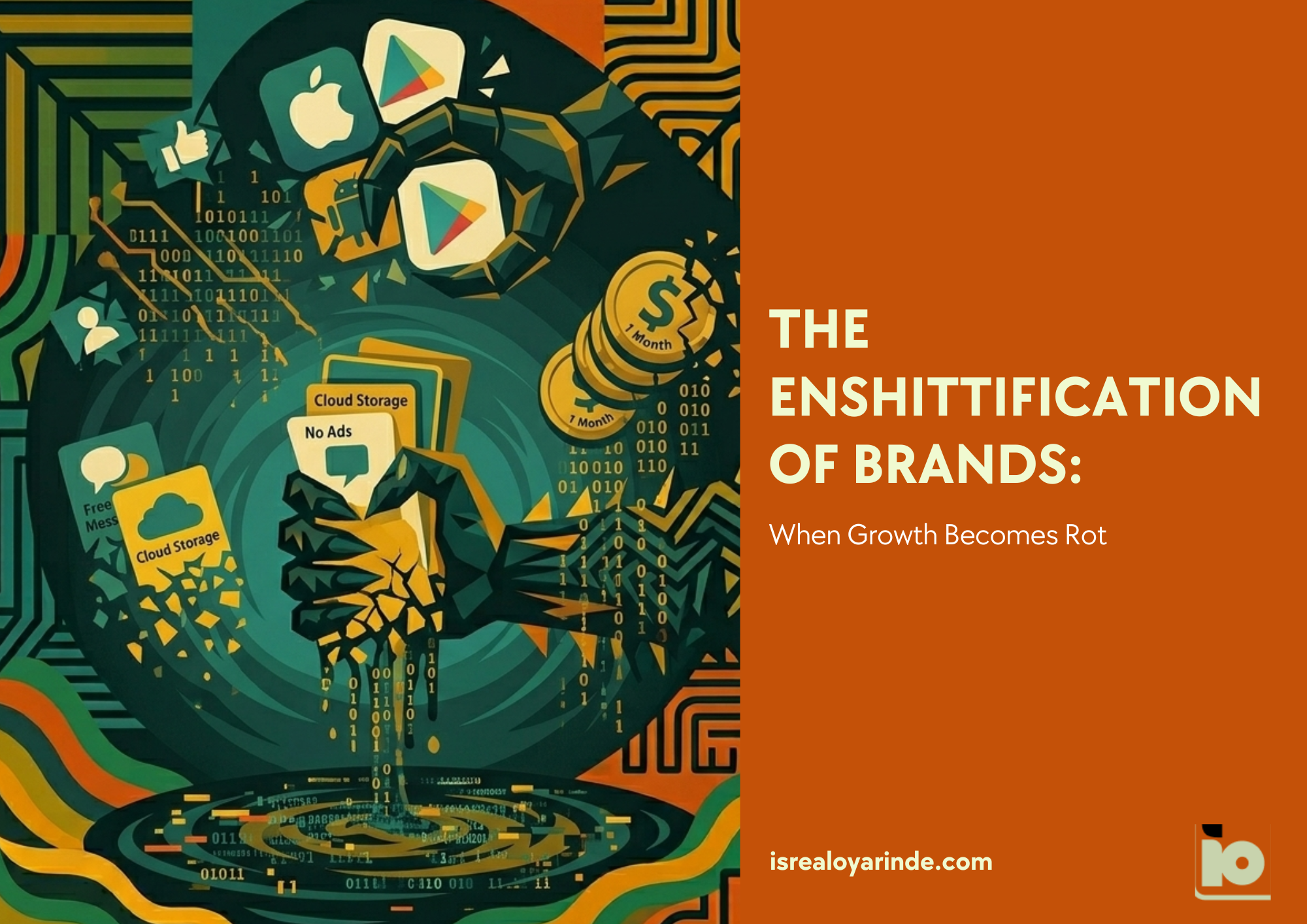
There is something called “Enshittification” where sellers create more products, stuff in more features, add more flavours, and advertise, but then slowly erode the quality of those products to increase profit margins.
The term was coined by Cory Doctorow, the Canadian-British writer and digital rights activist, in a 2023 essay. He originally used it to describe how technology platforms degrade over time: first they are good to users to attract them, then they are good to business customers at users’ expense, then they are good to nobody except shareholders. But the concept applies far beyond tech. It is a universal disease of capitalism, and Nigerian brands are not immune.
The Lifecycle of Enshittification
Every enshittified brand follows roughly the same trajectory:
Phase 1 – The Honeymoon: The brand launches with genuine quality and value. They need customers, so they deliver their best. The product is excellent, the price is fair, the customer service is responsive. Think of Nigerian banks when they first launched mobile banking, zero charges, instant transfers, 24/7 customer support. Remember when GTBank was actually innovative?
Phase 2 – The Squeeze Begins: Growth slows. Investors want returns. The CFO starts asking uncomfortable questions. So the brand starts making small changes. A little less product for the same price. A fee here. A surcharge there. Reduced customer service hours. They test how much they can take before customers notice.
Phase 3 – The Extraction: Now the focus has fully shifted from “how do we make this better?” to “how do we make more from this?” Quality drops. Costs are cut. The brand coasts on its reputation while actively depleting it. Every decision is a spreadsheet exercise. The customer is no longer the priority; the shareholder is.
Phase 4 – The Exodus: Customers start leaving, slowly at first, then all at once. The brand wonders what happened. But by this point, the damage is done. The trust account is overdrawn.
Nigerian Case Studies in Enshittification
The Indomie Debates: Ask any Nigerian over 25 and they will swear that Indomie used to taste better. The noodle strands were thicker, the seasoning was more potent, the portion was bigger. Is it nostalgia? Maybe partly. But the objective reality is that the product has been reformulated multiple times, portion sizes have been adjusted, and ingredient quality has shifted. The brand remains dominant because of its distribution power and brand loyalty, but the gap between what Indomie was and what it is now is a textbook example of incremental enshittification.
Bank Service Degradation: Nigerian banks are a masterclass in enshittification. They once competed fiercely on service quality. Now they compete on who can charge the most fees while providing the least service. SMS alert charges. Card maintenance fees. Transfer charges. Stamp duty. USSD charges. Meanwhile, the apps crash during salary week, the customer care lines play hold music for 45 minutes, and branch visits feel like a punishment. They have monetized every touchpoint while degrading the experience at every touchpoint. Revenue is up. Customer satisfaction is in the gutter.
Ribena and the Quiet Reformulation: When Suntory acquired Ribena from GlaxoSmithKline, the formula changed. Sugar was reduced (partly due to UK sugar taxes), and many consumers, including Nigerians who grew up on the brand, noticed the taste difference immediately. The brand kept the same packaging, the same marketing, the same price, but the product was fundamentally different. That is enshittification with a health-washing veneer.
The Global Disease: Boeing, Twitter, and the Rest
This is not just a Nigerian problem or a consumer goods issue. Some of the biggest brands including digital businesses and SAAS companies in the world have enshittified themselves into crisis:
Boeing: Once the gold standard of aviation engineering, Boeing shifted from an engineering-first culture to a finance-first culture after the McDonnell Douglas merger. Cost-cutting, outsourcing critical engineering, and prioritizing shareholder returns over safety led to the 737 MAX disasters that killed 346 people. The stock price had been going up for years. On a spreadsheet, Boeing looked like a success. In reality, they were extracting from their most valuable asset: their engineering reputation.
Twitter/X: The platform that once prided itself on being the “global town square” has been systematically stripped of the features and people that made it valuable. Verification became a paid product rather than a trust signal. Moderation was gutted. APIs were locked behind paywalls. The result? Advertisers fled, power users migrated, and the platform’s cultural relevance has eroded steadily.
Amazon: Search for any product on Amazon today and the first page is dominated by ads and sponsored listings. The search experience has degraded so much that many users now add “reddit” to their Google searches to find genuine product recommendations. Amazon prioritized ad revenue over search quality, and users are finding workarounds.
The Spreadsheet Illusion: When Metrics Mask Decline
There are also some pricing innovations where brands try to make more from existing customers, increasing pricing bit by bit, more features.
But the thing that comes to the fore is when the focus changes from “how do we make this better?” to “how do we make more from this?” And that is where the first sign of the quiet, subtle decline begins.
On a spreadsheet, enshittification looks like success. Your margins look good. Revenue is up. Cost per unit is down. Efficiency ratios are improving. The quarterly report is beautiful.
But here is where they move from value to tactics for some squeeze to extract. The issue is that you are extracting value from the “brand equity” you have built, the intangible trust built over the years. However, a lot of time, you are making a withdrawal from a bank account you cannot see, and you are no longer depositing into.
The metrics that matter, the ones that signal long-term health, are often the ones that enshittifying companies stop tracking:
- Net Promoter Score (NPS): Are customers recommending you, or just tolerating you?
- Customer Lifetime Value (CLV): Is each customer worth more over time, or less?
- Repeat Purchase Rate: Are people coming back because they want to, or because they have no choice?
- Employee Satisfaction: Are your own people proud of what they sell, or embarrassed?
- Complaint Resolution Time: Are you solving problems faster or slower than last year?
If revenue is up but NPS is down, you are not growing, you are harvesting. And harvests have a season. They end.
How Nigerian Consumers Respond
Value is relative, but trust is not. When you start trading on short-term revenue over the “Unspoken Contract” with your customers, the people who chose you and turned your brand partner into a parasite, that is when switching costs become negligible.
Nigerian consumers respond to enshittification in distinctive ways:
- Brand switching without loyalty: Unlike in markets where consumers stick with brands out of emotional attachment, Nigerian consumers are pragmatists. When Gala increased prices and reduced size, Bigi Sausage Roll entered the market and captured share almost overnight. Loyalty in Nigeria is thin because consumers have been betrayed too often.
- The “make we manage” mentality: Some consumers will stick with a degraded product because alternatives are worse. This is not loyalty; it is resignation. Nigerian banks benefit enormously from this. Where else will you go? They are all bad.
- Social media accountability: Twitter (X), Tiktok and other social platforms have become the Nigerian consumer’s complaint department. Brands that ignore this do so at their peril. One viral thread about poor service can do more damage than a year of quiet customer churn.
- Counterfeit and alternative markets: When legitimate brands enshittify, counterfeit products fill the gap. If your branded product is no longer worth the premium, customers will find a cheaper knockoff that is “almost as bad but costs half.” The counterfeit economy thrives partly because legitimate brands abandoned quality first.
How to Avoid Enshittifying Your Own Brand
With all that’s been said about enshittification, it is time to offer practical solutions to entrepreneurs who feel like they may be in one of the stages of enshittification or those who want to avoid it altogether. This doesn’t mean you cannot raise your prices or cut costs, but it should never be at the expense of your customers. They are your most important stakeholders.
The question you should always ask is this: “If I were the customer, would I still feel this is worth it?” If the answer makes you hesitate, that hesitation is your signal.
Here are practical strategies to grow without rotting:
- Protect the core product ruthlessly: Cut costs everywhere else before you touch the product itself. Your customers do not care about your office furniture or your company retreat in Dubai. They care about the product.
- Do not let the adjacent business take over: Many successful brands fall into this trap. You have a successful business that gave you a brand reputation so strong you could afford to start a completely unrelated business that becomes successful because of the existing brand trust. Then you focus so much on these “sidequests” that your original business becomes a shadow of itself. I have many examples of this but I think you also know them so no need to name and shame
- Track trust metrics, not just financial metrics: NPS, customer satisfaction, repeat purchase rates. If these are declining while revenue grows, you are on the enshittification highway.
- Listen to complaints as data, not noise: When customers complain, they are giving you free market research. The brands that survive are the ones that treat complaints as the most valuable feedback they receive.
- Be transparent about changes: If you must reformulate, reduce, or reprice, tell your customers why. “Our cocoa costs went up 40%, so we had to adjust” is infinitely better than quietly shrinking the product and hoping nobody notices. Nigerians respect honesty, even when the news is bad.
- Have a “soul check” every quarter: Gather your team and ask: “Are we still the company that our first customers fell in love with?” If the answer is no, figure out what changed and fix it.
Remember that switching costs are lower than you think. In a market where everyone has a smartphone and can compare options instantly, the moat of inconvenience that used to protect brands is gone. Your customer is one bad experience away from trying your competitor.
Shrinkflation: The Silent Cousin of Enshittification
There is a particular variant of enshittification that deserves its own mention: shrinkflation. This is when companies reduce the size or quantity of a product while keeping the price the same or even raising it. It is technically not a price increase, so it does not trigger the same consumer resistance. But it is absolutely a decrease.
Walk through any Nigerian supermarket and you will see it everywhere. The sachet of milk that used to be 30g is now 25g. The bottle of cooking oil that was 750ml is now 700ml but in a bottle shaped to look the same size. The roll of tissue paper that has fewer sheets. The pack of noodles where the seasoning sachet is noticeably (or maybe not noticeably) smaller.
In some cases, shrinkflation is genuinely necessary. Commodity prices rise, import costs fluctuate, and margins get squeezed. But the dishonesty is in the silence. When you change the product and pretend nothing changed, you are betting that your customer is too distracted to notice. Sometimes they are. But they always feel it, even if they cannot articulate it. The product just does not feel “worth it” anymore, and that vague dissatisfaction erodes loyalty over time.
Bottomline
You can be the brand that grows and keeps its soul. Or you can be the brand that grows and starts to rot from the inside. The choice is with you. Bad economy or not, there is a level of loyalty you owe your customers to expect the same from them.
The saddest thing about enshittification is that it is almost always a choice. Nobody forces a company to cut corners. Nobody forces them to prioritize margins over quality. Nobody forces them to treat customers as revenue units rather than human beings who trusted them with their money.
Every time you make a decision that trades long-term trust for short-term profit, you are making a withdrawal from an account you cannot see. And unlike your bank account, this one does not send you a balance notification. You only find out it is empty when your customers stop showing up.
Build something worth buying. Keep it worth buying. And if you must change it, change it in ways that make your customers glad they stayed, not in ways that make them wish they had left sooner.