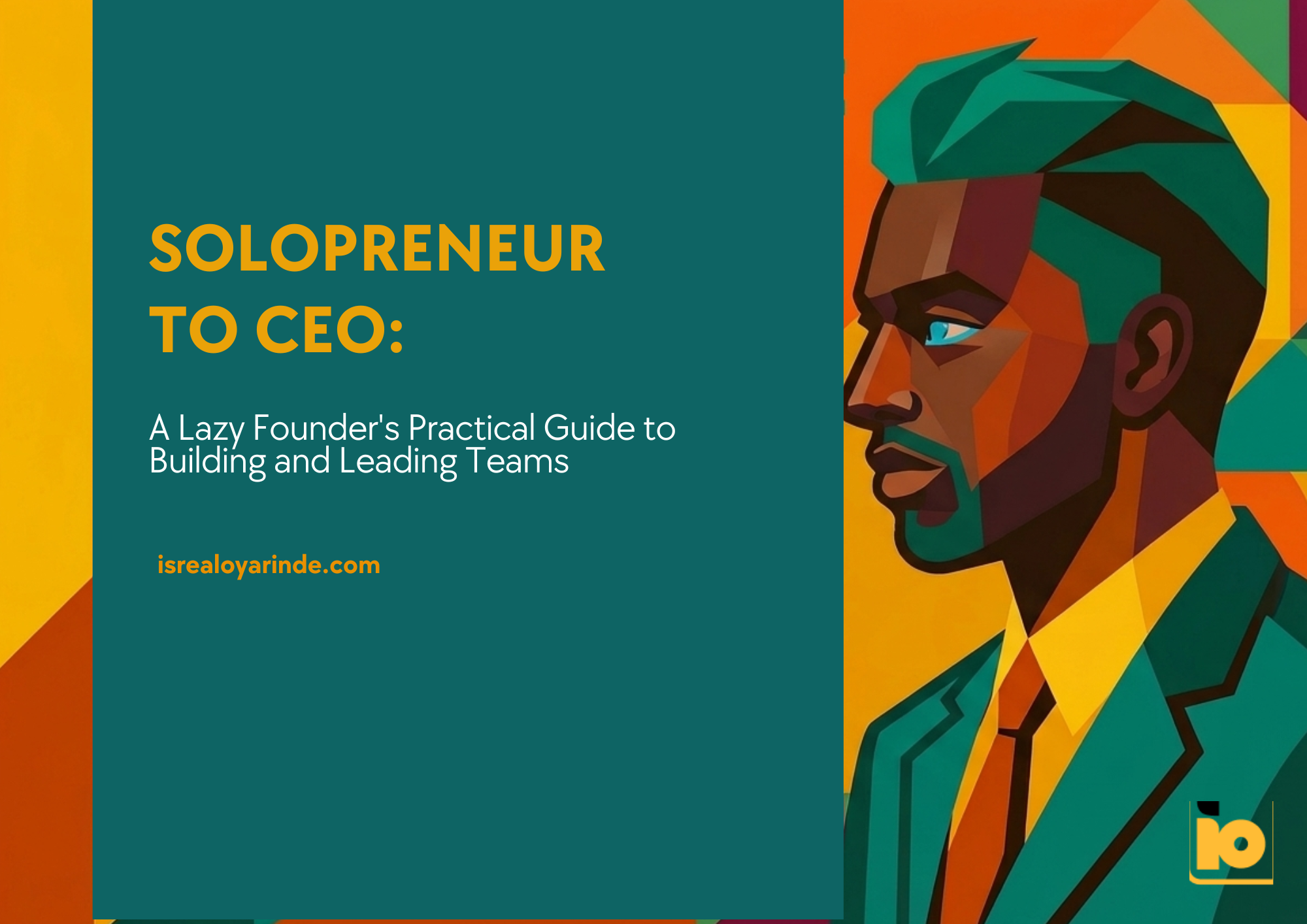
People close to me hold two ironic views of me. One is that I am lazy and I delegate too much. The other is that I am somehow hardworking. Both are true. And that contradiction is the entire philosophy of this essay.
You Are the Problem (And That’s OK)
I am probably a bonafide member of the hustle culture club —you know, the one that sleeps by 3am-4am, up by 8am at most, running on caffeine and persistent burnout. But I also believe it is madness to do the same thing by yourself over and over again.
Here is the uncomfortable truth: if you are still the smartest person in the room, and if your business grinds to a halt when you leave, you are not a CEO. You are a glorified freelancer with overheads.
To transition from solopreneur to CEO, you must embrace what I call the “Lazy Founder Methodology” which is really about finding the smartest, most leveraged way to set things up so they run without you. Leverage is the keyword here. And the first step? Admitting that you are the problem.
If you have created a monopoly where you are the only provider of solutions, you probably have a founder-dependency disease. The good news? It is curable. The bad news? The cure requires you to let go.
The SPOF Diagnosis: Are You a Single Point of Failure?
I have spoken extensively about “Single Point of Failure” (SPOF) in engineering and business. In most businesses —including, at various points, my own — the founder is the SPOF. You are the Chief Marketing Officer, the Head of Sales, the Customer Support Lead, and the only person who can sign off on anything. You are the bottleneck disguised as a leader.
Here is a quick self-diagnosis. Answer honestly:
- Can your business process an order if you are on a flight for 8 hours?
- Can a customer get support if you are sick in bed for a week?
- Does anyone else know the password to your business bank account?
- If you disappeared for 30 days, would the business still generate revenue?
- Can anyone else on your team close a deal or sign a new client?
If you answered “no” to more than two of those, congratulations —you are a SPOF. Your business is not a business; it is a job that you created for yourself with extra steps. And the irony is that this job has no leave days, no pension, and the HR department (also you) is terrible.
The Eisenhower Matrix is your friend here. Categorize every task you do into four quadrants:
- Urgent + Important: Do it yourself (for now). These are fires. Put them out.
- Important + Not Urgent: Schedule and systematize. These are the tasks that build long-term value e.g strategy, relationship building, product development.
- Urgent + Not Important: Delegate immediately. These are the tasks that feel important but are really just operational noise e.g scheduling, responding to routine emails, invoice follow-ups.
- Not Urgent + Not Important: Eliminate. Stop doing them. This includes most social media scrolling you disguise as “market research.”
The fear of delegation is real. If a task requires your specific skill like strategy or closing high-value clients, you can keep it. But everything else? Start looking for what you can let go of. It is not about burning yourself out less. It is about building something that does not require your fire to stay warm.
The next natural step after this is finding qualified and trustworthy people who can take up the things you are letting go of. So, to the next big question, how do you hire?
Hiring in Nigeria: A Nightmare With Solutions
Let me be honest: hiring in Nigeria is a nightmare. I have had bad hires that did the worst damage to projects precisely because the role was fully remote and unsupervised. In the early days of running Contentika, I found it really hard to find and retain talents.
The good ones get entrepreneurial fast or get poached by international companies paying in dollars. The mediocre ones come with inflated CVs, fake experience, and LinkedIn profiles that read like fiction.
And let me add, we do not have a robust system to verify credentials the way some countries do. There is no centralized background check database. Reference checks are often a formality where the “referee” is the candidate’s cousin using a different phone number.
In short, I would not sugar coat what it takes by simply saying “hire the best people”. The truth is hiring the best people is very hard and keeping them is even harder. But it is not impossible. Here is what I have learned about finding and keeping them:
Where to Find Talent
- Jobberman: Still the largest job board in Nigeria. Good for mid-level and entry-level roles. Use their assessment tools to filter candidates.
- LinkedIn: Better for senior roles and specialized positions. Nigerian professionals are increasingly active here. Post the role AND actively search, the best candidates often are not job-hunting.
- Twitter (X): Surprisingly effective for tech roles. Nigerian Tech Twitter is a real community. A well-crafted tweet about an open role can reach thousands of qualified people.
- Andela Talent / Turing / AltSchool Africa alumni networks: For developers and technical roles, these communities produce vetted talent.
- Referrals: Still the most reliable channel. Offer referral bonuses to your existing team. Good people tend to know other good people.
How to Filter
Do not hire cheaply. When I interview somebody, I run rigorous assessments regardless of their CV. I have seen first-class graduates who cannot write a coherent email and HND holders who can architect entire systems. The paper means less than the proof.
- Give a real-world test: Not a trick question or a brain teaser. Give them a task that mirrors what they would actually do in the role. Pay them for the test if it takes more than 2 hours — it shows respect and attracts serious candidates.
- Trial periods: A 2-4 week paid trial before full commitment has saved me from multiple bad hires. You learn more in two weeks of working together than in ten interviews.
- Check their work, not their words: Ask for portfolios, GitHub profiles, writing samples, or client testimonials. Anybody can talk. Show me the receipts.
Smart people do not come cheap. When you get them “cheap,” you get the enshittification of your product and service. It is a false economy. Budget for talent the way you budget for infrastructure —it is not optional.
Documentification: The Ultimate Legacy
This is the first thing I did when I started managing people instead of just managing myself: I wrote everything down. Everything.
“Documentification” is my term for the obsessive documentation of every process, decision, and standard in your business. It is the single most important thing you can do to transition from solo operator to CEO. Here is why: if the knowledge of how your business operates lives only in your head, it dies when you step away. Every. Single. Time.
When starting (or restructuring) a business, script everything:
- How do we answer the phone? Script it.
- How do we handle a complaint? Script it.
- How do we post on Instagram? Template it.
- How do we onboard a new client? Checklist it.
- How do we process a refund? Flowchart it.
- How do we handle a data breach? Incident response plan.
The tools for this are abundant and mostly affordable:
- Notion: My personal favourite. Free for individuals, $8-10/month per user for teams. You can build an entire company wiki, SOPs, project management, and knowledge base in one place.
- Google Docs / Google Drive: Free. Not as structured as Notion, but accessible and familiar. Good enough for early-stage documentation.
- Process Street: Specifically built for SOPs and checklists. $25/month. Great if you are scaling a service-based business.
- Loom: Record video SOPs for visual processes. Free tier available. Sometimes showing is better than writing.
- Tango: Automatically creates step-by-step guides as you perform tasks on your computer. Free tier with generous limits.
This protects against the enshittification of your business. Everything about the decline of your service quality starts with undocumented processes. When the person who “knows how” leaves — and they will leave— the knowledge leaves with them. Documentation is your insurance policy against brain drain.
Note that it is not just enough to document, draw data from what you have documented and apply them to improve your processes.
No-Trust Architecture: Trust the System, Not the Person
“No-Trust” is not about being paranoid or treating your employees like criminals. It is about building systems where consistency does not depend on any single person’s goodwill, competence, or presence. If the quality of your product or service is dependent on your physical presence or specific salespeople, that is a red flag. Build a quality culture instead.
SOPs ensure consistency. Consistency builds trust. And trust is cumulative. Every time a customer has the same positive experience regardless of who serves them, your brand equity goes up.
Theft is a silent killer, invisible when starting a business. Inventory shrinkage, fake hours, and ghost expenses all bleed your margins dry. If your margin is 10% and an employee steals ₦10,000, you do not just lose that ₦10,000. You have to generate ₦100,000 in revenue just to break even. Just to get back to where you were.
Your work as a founder includes these non-negotiables:
- Remove the opportunity for theft. Never allow personal bank accounts for business collections. Ever.
- Track everything. Use software that scales. Inventory management, time tracking, expense reporting. Automate the paper trail even if it is ₦5.
- Spot checks and audits. Random, unannounced reviews keep people accountable. It is not about catching thieves. It is about removing the temptation.
- Separation of duties. The person who approves expenses should not be the same person who processes payments. Basic accounting principle, routinely ignored in small Nigerian businesses.
The most valuable asset is the business itself. If you are extracting value from your team without giving back through training, fair pay, respect, growth opportunities, you are making withdrawals from an account that will eventually go bankrupt. One way or the other, the bill comes due.
I have written extensively about managing employee theft and building a no-trust architecture in your business here.
Building the Culture: The Lazy Founder’s Secret Weapon
“Culture” sounds like a corporate buzzword, but it is really just “how we do things here when nobody is watching.” And for a Lazy Founder, culture is your ultimate leverage — because a strong culture means the team self-corrects without your intervention.
Here is what I have learned about building it:
- Hire for values, train for skills. You can teach someone to use a CRM. You cannot teach someone to care about quality or to be honest.
- Results over hours. Allow people to work how they want. I do not care if you work 4 hours or 12 hours. What I care about is that the problem is solved and all KPIs are met. Micromanagement is the enemy of productivity and the hallmark of an insecure leader.
- Invest in your people. Training, certifications, conferences, books — these are not expenses, they are investments. The people who grow with your company become your most loyal and capable team members.
- Review regularly. Quarterly reviews at minimum. Not to punish, but to align. “Are we still going the same direction? What do you need from me?” These conversations prevent small frustrations from becoming resignation letters.
- Keep the people who matter. Retention is cheaper than recruitment. If a key employee asks for a raise and they deserve it, pay it. The cost of replacing them recruiting, onboarding, lost productivity, knowledge drain is more than their annual salary.
The business does not just survive under this model. It runs. Build the system. Love the people who run the system. Trust the system. Strive to make yourself unnecessary. That is the Lazy Founder way. That is how you go from Solo to CEO.
The Bottom Line
Being a CEO is not about working harder. It is about working on the right things and building systems that work when you do not. The Lazy Founder is not actually lazy — they are strategic. They invest energy upfront in documentation, systems, hiring, and culture so they can eventually step back and let the machine run.
Your goal is not to be indispensable. Your goal is to be unnecessary. A business that cannot survive without its founder is not a business, it is a hostage situation where everyone, including the founder, is the hostage.
Build the system. Document everything. Hire smart. Prevent theft structurally. Build culture intentionally. Review regularly. And then? Go take a nap. You have earned it.