May 7, 2026

9 minute

Isreal Oyarinde

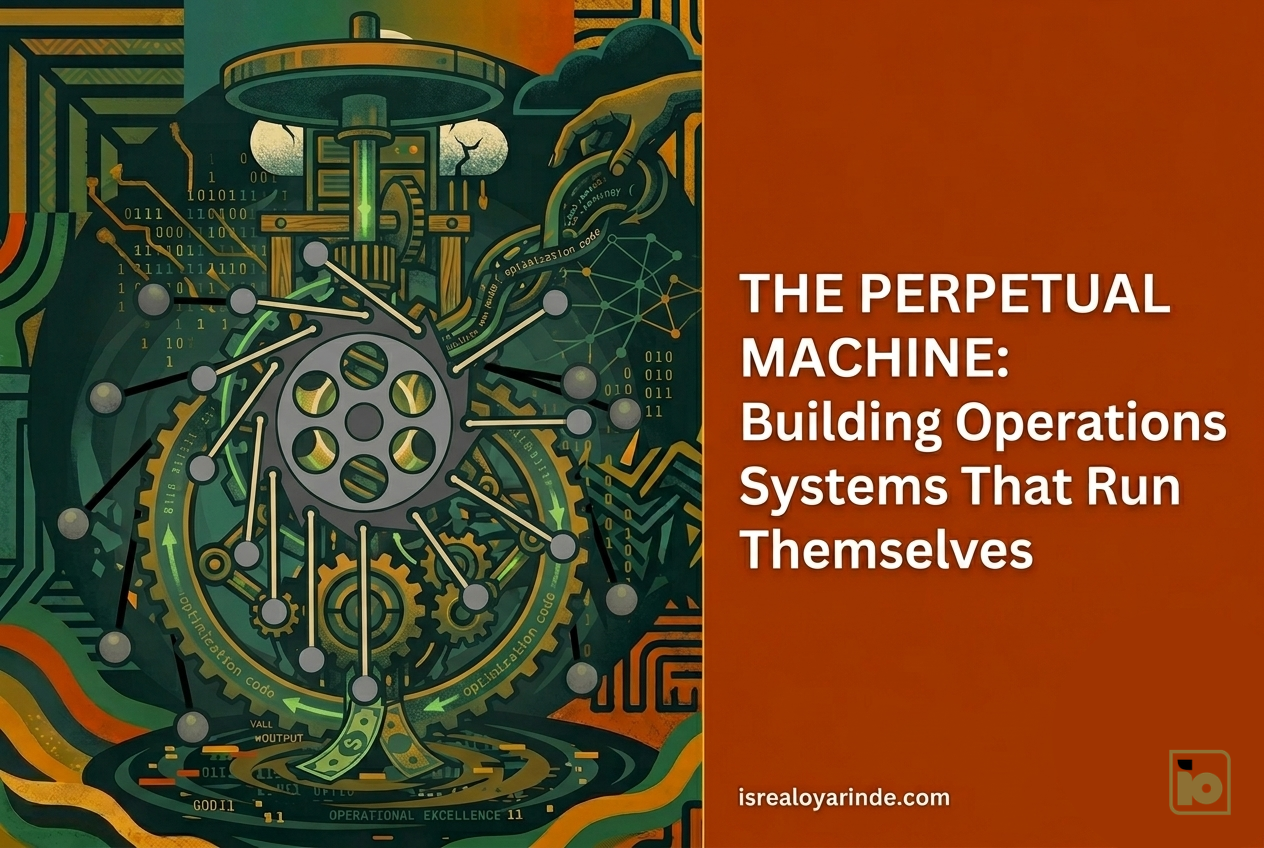
The Perpetual Machine: Building Operations Systems That Run Themselves

Table of Contents

The idea of a perpetual machine seems exciting. Something that runs on its own without any input. As an entrepreneur reaching this point in my businesses is my ultimate goal. Having resilient and profitable businesses that do not need me slaving away at my desk for the better part of 18 hours a day so I can have time to do other things I love and spend time with the people I care about.

In this article, I will be sharing some advice that has worked for me as I am building. I do not purport to know it all as I am still in the process of transitioning from a solopreneur to a CEO myself. So, I would love for you to think of this as an ongoing conversation. Let’s get into it.  

Where (or Who) Is the Battery?

In science fiction, a perpetual machine is a hypothetical device that operates indefinitely without any external energy source, producing work or motion forever. A perpetual machine is deemed scientifically impossible so why is it something to aspire to in business?

I think as entrepreneurs we aspire to this impossible “machine” not because we think we can ignore the laws of physics, but because we want to minimize the “Energy of Supervision.” Simply put, we want to reduce our input to the very minimum while simultaneously getting maximum output out of the business. 

So the idea is not that we get to a point where we can completely ignore the business and it just continues to run efficiently on its own. Rather, it is that we are minimising input for maximum output. 

The hardest part of building a perpetual motion machine is finding out where to hide the battery. Basic science tells us that a machine cannot run forever without an energy source. But a machine can run without a huge battery or energy pack attached to it. The battery can be tiny and inbuilt and it is the same with businesses too.

We look at companies with presence in multiple countries that have existed for decades, long after the original visionary is retired or dead and wonder how they continue to run.  In most Nigerian businesses, the “battery” is the founder. The business runs on them. Remove the founder and the whole thing grinds to a halt like a generator that just ran out of diesel.

I have watched it happen more times than I can count. A sharp Oga builds a thriving business, employs 30 people, handles the biggest clients personally, negotiates every major deal, and signs every cheque. 

Then he travels for two weeks, and by the time he lands at Murtala Muhammed, three clients have complained, two staff have been fighting, and someone has been helping themselves to petty cash. The business did not collapse because of the market. It collapsed because the entire operation was a one-man show wearing a company costume.

In software engineering, there is a concept called the “bus factor.” It asks: how many people on your team would need to be hit by a bus before the project stalls? If the answer is one, you have a problem. In most Nigerian SMEs, the bus factor is literally one: the founder. If they get sick, travel, die, or simply burn out, the business is finished.

The Tribal Knowledge Problem

The root cause is what I call “tribal knowledge,” information that lives in your head and nowhere else. You know which supplier gives you the best rate. You know which staff member cannot be trusted with cash. 

You know that Client A always pays late but Client B will bounce a cheque entirely. You know that LASTMA operates heaviest on Tuesdays on that particular route your delivery trucks use.

All of this is critical operational intelligence. And none of it is written down.

When you leave, all of that leaves with you. Your replacement, whether it is a hired manager or your own child, starts from zero. They make mistakes you solved ten years ago. They trust the wrong people. They take the wrong route on Tuesday. And they wonder why things are not working.

This is the exact pattern that killed countless Nigerian businesses. Ekene Dili Chukwu ran like clockwork under its founder. Within years of his passing, the fleet was in disrepair, routes were mismanaged, and the brand that once dominated the East became a memory. The same story plays out in restaurants, law firms, trading companies, and tech startups. The founder was the system, and when the founder left, the system left too.

The Franchise vs Buka Test

Here is a simple test for whether your business is a system or a personality cult: could someone franchise it?

Think about Chicken Republic. Whether you walk into the one in Lekki or the one in Abuja, you get roughly the same experience. The jollof rice tastes the same. The service follows the same pattern. The menu is the same. That is not because every branch has the same brilliant manager. It is because there is a system, SOPs, checklists, training manuals, supply chain processes, and quality controls that ensure consistency regardless of who is behind the counter.

Now think about your favourite local buka. Mama Nkechi’s rice is legendary. People drive across town for it. But what happens when Mama Nkechi is sick? Or when she travels to the village for a funeral? 

The rice does not taste the same. Customers notice. Some stop coming. If Mama Nkechi retires, the buka closes. Her recipe, her timing, her seasoning instincts, all tribal knowledge that was never transferred.

The difference between a Chicken Republic and a Mama Nkechi buka is not talent, it is systems. And if you want to build something that outlasts you, you need to build systems.

The ‘If I Die Tomorrow’ Document

The fix is simple, though not easy. It is the “If I Die Tomorrow” document. You need to move knowledge from your brain to a repository. But do not write a 100-page manual that nobody will read. Be lazy. Be smart about it.

Here is how:

  • Use SOPs (Standard Operating Procedures): “When you do X, you do Y.” Keep them short, specific, and actionable. Not essays. Not philosophy. Just: step 1, step 2, step 3.
  • Use checklists: Atul Gawande wrote an entire book about how checklists save lives in surgery and aviation. If checklists can keep a 747 in the air, they can keep your business running.
  • Record important stuff: Use Loom, use voice notes, use Google Docs. The medium does not matter. What matters is that it exists outside your brain.
  • Create a “Key Contacts” document: who are the critical suppliers, customers, and partners? What are their quirks? Who do you call when NEPA takes light and the generator does not start? 

In fact, I would go further to suggest that if your business is reliant on artisans, document every artisan you have ever worked with and their output. Let whoever is coming after you know who tends to inflate the price of raw materials and who has an issue with timing.

  • Document the exceptions, not just the rules: Every business has weird edge cases. “If Client X complains about pricing, here is the real story.” “If the Apapa warehouse floods in August (it always does), here is the contingency.” Those exceptions are where tribal knowledge is most dangerous when lost. 
  • Document what failed or didn’t work well: You don’t just document what works, document what doesn’t as well so someone does not think their next new idea is something you already tried and which didn’t work. Even if they end up adopting that process, it must be an informed choice they make knowing the possible downsides. 
  • Make knowledge accessible: There is no point documenting everything and then leave it locked behind an encrypted system no one can access. I am not saying give away all your business secrets in an open file just anybody can access, but there has to be a structured process for knowledge transfer.  

Think of it this way: if you were in a hospital bed tomorrow, could someone access the business’ files, read your documents, and keep the business running for 30 days? If the answer is no, you have work to do.

No-Trust Architecture: People Will Disappoint You

I love people I work with. I do not think you should work with people you do not like or are not trustworthy. In fact, when I notice someone is overly particular about money, I limit my involvement with them. Inevitably, you will have dishonest folks come in.

Because for most businesses, you cannot build a perpetual machine if parts of the machine are fencing and stealing the parts.

This is where No-Trust Architecture comes in. The name sounds harsh, but the concept is simple: design your systems so that no single person has enough control to cause catastrophic damage, even if they wanted to.

Banks do this. That is why a teller cannot approve their own transactions. That is why auditors exist. That is why there are withdrawal limits. They do not assume every employee is honest; they build systems that make dishonesty difficult. Your business should do the same.

Key Principles of No-Trust Architecture

Actions Have Consequences: If you find anyone can steal, regardless of size, seniority or relationship, it is no longer a question of trust. They are no longer in the system. I have seen business owners forgive theft because “he has been with me for 15 years” or “she is my cousin’s wife.” 

That is how you lose everything. A driver who steals N5,000 in fuel today will steal N500,000 in inventory tomorrow when the opportunity presents itself. Theft is not about amount, it is about character. Cut the loss early.

The Separation Principle: Separate the money-maker from the person who spends. Build a system where the banking and cheque handling is split. The person who approves expenditure should not be the person who makes the payment. 

The person who receives goods should not be the person who records them in the system. The person who handles cash should not be the person who reconciles the accounts. This is basic internal controls, but I am amazed how many Nigerian businesses have one person doing all of it. That is not trust, that is negligence.

The ‘Two Key Rule’: Split responsibilities like a nuclear submarine. Nobody alone has full access. In a submarine, launching a missile requires two officers to turn their keys simultaneously. Neither can act alone. Apply this to your business. 

Two signatories on every cheque above a certain amount. Two people verifying inventory counts. Two approvals for major purchases. It slows things down slightly, yes, but it also means no single person can sink your ship.

Knowledge Moats: Protecting Your Business Intelligence

These principles create what I call “Knowledge Moats.” Even if your best staff leaves, they will not be the same person as when they were in the system. Why? Because no single person held all the keys.

This is also a retention strategy, by the way. When staff know that the business is not dependent on any one person, there is less temptation to use their position as leverage. “If I leave, the whole thing collapses” is a powerful bargaining chip, and some employees cultivate that dependency deliberately. Systems eliminate that leverage.

I have seen Nigerian businesses where one accountant has been the only person who understands the books for 12 years. Nobody else can read the spreadsheets. Nobody else knows the bank reconciliation process. 

That accountant effectively holds the business hostage, and the owner does not even realise it. When that accountant eventually leaves, and they always do, the owner discovers that the books are a mess, money is missing, and nobody can trace what happened.

A knowledge moat means the business retains critical knowledge regardless of staff turnover. The moat protects the castle, not the knight.

Practical Steps: Building the Machine

So how do you actually build a perpetual machine? Here is a practical checklist:

  • Week 1: Write down the top 10 things only you know about the business. Supplier contacts, client quirks, financial processes, passwords, everything.
  • Week 2: Create simple SOPs for your most critical processes. Keep each under one page.
  • Week 3: Identify single points of failure. Who is your one-person dependency? What happens if they leave?
  • Week 4: Implement the Two-Key Rule for financial transactions. Set up dual signatories and separation of duties.
  • Month 2: Cross-train at least one person on every critical function. Nobody should be the only person who knows how to do something.
  • Month 3: Test it. Take a week off. Do not answer calls. See what breaks. Fix those things.

This is not glamorous work. It is not the kind of thing that gets you speaking invitations at Lagos Business School. But it is the difference between a business that survives you and a business that dies with you.

Real-World Examples: Who Got It Right and Who Did Not

Let me give you a contrast. Think about a franchise like Coldstone, every branch operates from the same playbook. The recipe, the flavours, the delivery time target, the customer greeting, even down to what to do when a customer leaves a tip, all documented, all repeatable. A manager in one city can transfer to another and be productive within a week because the system is the system, not the person.

Now think about a typical Nigerian distribution company. The founder knows which warehouse staff are reliable for the night shift. He knows that the Benin route needs to be dispatched by 4 AM or the trucks will hit the Ore gridlock. He knows that Customer X always orders late but pays cash, so you accommodate them. None of this is written anywhere. The day the founder is not available, chaos. Trucks dispatch late. The wrong staff are assigned. Customer X gets ignored, and a N2 million monthly account walks out.

I know of a printing business in Lagos that ran beautifully for 18 years under its founder. The man could estimate paper costs in his head, knew every machine’s quirks, and had personal relationships with every major client. 

When he had a stroke, the business ground to a halt within three weeks. His wife, who was supposed to take over, did not know the machine maintenance schedule, the supplier payment terms, or even the WiFi password to the office network. Within six months, two of the three machines broke down, clients moved to competitors, and the business that employed 25 people was reduced to a skeleton crew of five.

Contrast that with a tech startup I know that built its entire operation around Notion databases. Every process, from onboarding a new client to handling a server outage, lives in a shared workspace. When the CTO relocated to Canada, the team did not skip a beat. They promoted a senior developer, who read the documentation, and the transition was seamless. The founder was replaceable, not because he was not talented, but because he had made himself replaceable by design.

That is the difference. One business was a person wearing a company costume. The other was a company that happened to have talented people. The second model survives. The first does not.

The Real Perpetual Machine

The real perpetual machine is not one that runs without energy. It is one that generates its own energy. A business where knowledge is documented, responsibilities are distributed, and no single point of failure exists. A business where you can take a vacation without checking your phone every five minutes. A business where, if the worst happens, your family is not left scrambling to understand what you built.

You do not need to be immortal. You just need to build something that does not need you to be immortal.

Start writing things down. Today, not tomorrow. Not “when things slow down” (they never do). Today.

Your future self, your family, and your employees will thank you.
Related Blogs

May 7, 2026

Isreal Oyarinde

The idea of a perpetual machine seems exciting. Something that runs on its own without any input. As an entrepreneur reaching this point in my businesses is my ultimate goal. Having resilient and profitable businesses that do not need me slaving away at my desk for the better part of 18 hours a day so I can have time to do other things I love and spend time with the people I care about. In this article, I will be sharing some advice that has worked for me as I am building. I do not purport to know it all as I am still in the process of transitioning from a solopreneur to a CEO myself. So, I would love for you to think of this as an ongoing conversation. Let’s get into it.   Where (or Who) Is the Battery? In science fiction, a perpetual machine is a hypothetical device that operates indefinitely without any external energy source, producing work or motion forever. A perpetual machine is deemed scientifically impossible so why is it something to aspire to in business? I think as entrepreneurs we aspire to this impossible “machine” not because we think we can ignore the laws of physics, but because we want to minimize the “Energy of Supervision.” Simply put, we want to reduce our input to the very minimum while simultaneously getting maximum output out of the business.  So the idea is not that we get to a point where we can completely ignore the business and it just continues to run efficiently on its own. Rather, it is that we are minimising input for maximum output.  The hardest part of building a perpetual motion machine is finding out where to hide the battery. Basic science tells us that a machine cannot run forever without an energy source. But a machine can run without a huge battery or energy pack attached to it. The battery can be tiny and inbuilt and it is the same with businesses too. We look at companies with presence in multiple countries that have existed for decades, long after the original visionary is retired or dead and wonder how they continue to run.  In most Nigerian businesses, the “battery” is the founder. The business runs on them. Remove the founder and the whole thing grinds to a halt like a generator that just ran out of diesel. I have watched it happen more times than I can count. A sharp Oga builds a thriving business, employs 30 people, handles the biggest clients personally, negotiates every major deal, and signs every cheque.  Then he travels for two weeks, and by the time he lands at Murtala Muhammed, three clients have complained, two staff have been fighting, and someone has been helping themselves to petty cash. The business did not collapse because of the market. It collapsed because the entire operation was a one-man show wearing a company costume. In software engineering, there is a concept called the “bus factor.” It asks: how many people on your team would need to be hit by a bus before the project stalls? If the answer is one, you have a problem. In most Nigerian SMEs, the bus factor is literally one: the founder. If they get sick, travel, die, or simply burn out, the business is finished. The Tribal Knowledge Problem The root cause is what I call “tribal knowledge,” information that lives in your head and nowhere else. You know which supplier gives you the best rate. You know which staff member cannot be trusted with cash.  You know that Client A always pays late but Client B will bounce a cheque entirely. You know that LASTMA operates heaviest on Tuesdays on that particular route your delivery trucks use. All of this is critical operational intelligence. And none of it is written down. When you leave, all of that leaves with you. Your replacement, whether it is a hired manager or your own child, starts from zero. They make mistakes you solved ten years ago. They trust the wrong people. They take the wrong route on Tuesday. And they wonder why things are not working. This is the exact pattern that killed countless Nigerian businesses. Ekene Dili Chukwu ran like clockwork under its founder. Within years of his passing, the fleet was in disrepair, routes were mismanaged, and the brand that once dominated the East became a memory. The same story plays out in restaurants, law firms, trading companies, and tech startups. The founder was the system, and when the founder left, the system left too. The Franchise vs Buka Test Here is a simple test for whether your business is a system or a personality cult: could someone franchise it? Think about Chicken Republic. Whether you walk into the one in Lekki or the one in Abuja, you get roughly the same experience. The jollof rice tastes the same. The service follows the same pattern. The menu is the same. That is not because every branch has the same brilliant manager. It is because there is a system, SOPs, checklists, training manuals, supply chain processes, and quality controls that ensure consistency regardless of who is behind the counter. Now think about your favourite local buka. Mama Nkechi’s rice is legendary. People drive across town for it. But what happens when Mama Nkechi is sick? Or when she travels to the village for a funeral?  The rice does not taste the same. Customers notice. Some stop coming. If Mama Nkechi retires, the buka closes. Her recipe, her timing, her seasoning instincts, all tribal knowledge that was never transferred. The difference between a Chicken Republic and a Mama Nkechi buka is not talent, it is systems. And if you want to build something that outlasts you, you need to build systems. The ‘If I Die Tomorrow’ Document The fix is simple, though not easy. It is the “If I Die Tomorrow” document. You need to move knowledge from your brain to a repository. But

May 4, 2026

Isreal Oyarinde

When Did This Start Tasting Different? You know that moment when you open a pack of something you have been buying for years and something feels… off? The biscuit is smaller. The flavour is thinner. The packaging looks the same, maybe even fancier, but the product itself has quietly, subtly, become worse. You ask yourself: “Did my taste change, or did they change the recipe?” The answer, almost always, is that they changed the recipe. And they are hoping you will not notice. There is something called “Enshittification” where sellers create more products, stuff in more features, add more flavours, and advertise, but then slowly erode the quality of those products to increase profit margins. The term was coined by Cory Doctorow, the Canadian-British writer and digital rights activist, in a 2023 essay. He originally used it to describe how technology platforms degrade over time: first they are good to users to attract them, then they are good to business customers at users’ expense, then they are good to nobody except shareholders. But the concept applies far beyond tech. It is a universal disease of capitalism, and Nigerian brands are not immune. The Lifecycle of Enshittification Every enshittified brand follows roughly the same trajectory: Phase 1 – The Honeymoon: The brand launches with genuine quality and value. They need customers, so they deliver their best. The product is excellent, the price is fair, the customer service is responsive. Think of Nigerian banks when they first launched mobile banking, zero charges, instant transfers, 24/7 customer support. Remember when GTBank was actually innovative? Phase 2 – The Squeeze Begins: Growth slows. Investors want returns. The CFO starts asking uncomfortable questions. So the brand starts making small changes. A little less product for the same price. A fee here. A surcharge there. Reduced customer service hours. They test how much they can take before customers notice. Phase 3 – The Extraction: Now the focus has fully shifted from “how do we make this better?” to “how do we make more from this?” Quality drops. Costs are cut. The brand coasts on its reputation while actively depleting it. Every decision is a spreadsheet exercise. The customer is no longer the priority; the shareholder is. Phase 4 – The Exodus: Customers start leaving, slowly at first, then all at once. The brand wonders what happened. But by this point, the damage is done. The trust account is overdrawn. Nigerian Case Studies in Enshittification The Indomie Debates: Ask any Nigerian over 25 and they will swear that Indomie used to taste better. The noodle strands were thicker, the seasoning was more potent, the portion was bigger. Is it nostalgia? Maybe partly. But the objective reality is that the product has been reformulated multiple times, portion sizes have been adjusted, and ingredient quality has shifted. The brand remains dominant because of its distribution power and brand loyalty, but the gap between what Indomie was and what it is now is a textbook example of incremental enshittification. Bank Service Degradation: Nigerian banks are a masterclass in enshittification. They once competed fiercely on service quality. Now they compete on who can charge the most fees while providing the least service. SMS alert charges. Card maintenance fees. Transfer charges. Stamp duty. USSD charges. Meanwhile, the apps crash during salary week, the customer care lines play hold music for 45 minutes, and branch visits feel like a punishment. They have monetized every touchpoint while degrading the experience at every touchpoint. Revenue is up. Customer satisfaction is in the gutter. Ribena and the Quiet Reformulation: When Suntory acquired Ribena from GlaxoSmithKline, the formula changed. Sugar was reduced (partly due to UK sugar taxes), and many consumers, including Nigerians who grew up on the brand, noticed the taste difference immediately. The brand kept the same packaging, the same marketing, the same price, but the product was fundamentally different. That is enshittification with a health-washing veneer. The Global Disease: Boeing, Twitter, and the Rest This is not just a Nigerian problem or a consumer goods issue. Some of the biggest brands including digital businesses and SAAS companies in the world have enshittified themselves into crisis: Boeing: Once the gold standard of aviation engineering, Boeing shifted from an engineering-first culture to a finance-first culture after the McDonnell Douglas merger. Cost-cutting, outsourcing critical engineering, and prioritizing shareholder returns over safety led to the 737 MAX disasters that killed 346 people. The stock price had been going up for years. On a spreadsheet, Boeing looked like a success. In reality, they were extracting from their most valuable asset: their engineering reputation. Twitter/X: The platform that once prided itself on being the “global town square” has been systematically stripped of the features and people that made it valuable. Verification became a paid product rather than a trust signal. Moderation was gutted. APIs were locked behind paywalls. The result? Advertisers fled, power users migrated, and the platform’s cultural relevance has eroded steadily. Amazon: Search for any product on Amazon today and the first page is dominated by ads and sponsored listings. The search experience has degraded so much that many users now add “reddit” to their Google searches to find genuine product recommendations. Amazon prioritized ad revenue over search quality, and users are finding workarounds. The Spreadsheet Illusion: When Metrics Mask Decline There are also some pricing innovations where brands try to make more from existing customers, increasing pricing bit by bit, more features. But the thing that comes to the fore is when the focus changes from “how do we make this better?” to “how do we make more from this?” And that is where the first sign of the quiet, subtle decline begins. On a spreadsheet, enshittification looks like success. Your margins look good. Revenue is up. Cost per unit is down. Efficiency ratios are improving. The quarterly report is beautiful. But here is where they move from value to tactics for some squeeze to extract. The issue is that you are extracting value from the

May 4, 2026

Isreal Oyarinde

The first time someone told me I was “wasting money on rent,” I was sitting in a rented apartment in Ajah, eating jollof rice I could actually afford because I hadn’t sunk my entire net worth into a building. The person giving me the advice? A landlord who had been trying to sell a property in Lekki for eight months with zero offers. The irony was thicker than Lagos traffic on a Friday evening. The rent-versus-buy debate in Nigeria is one of those conversations that generates more heat than light. Everyone has an opinion, most of them inherited from parents who built houses in the 1980s when a plot of land in Ikeja cost less than a Toyota Corolla costs today. But the Nigeria of 2026 is not the Nigeria of 1985.  Inflation is different. Interest rates are different. Urbanisation has changed our desires of what a good home is. The entire structure of how wealth is built and preserved has also shifted. So let us actually do the math, strip away the emotions, and figure out when renting wins, when buying wins, and when you should just mind your business and ignore your uncle’s WhatsApp forwards about “landed properties near Dangote refinery.” The Nigerian Dream of Owning a House Interesting topic because while the capitalist in me wants to make bank like Lagos and Abuja landlords, the socialist in me balks at the high price. As such, the realist in me definitely prefers the lower-priced rent and ample space of Arepo, or Magboro and Mowe. But of course, there’s always our parents’ voice in our head that says “Why are you paying rent? You’re making your landlord rich” “Buy your own land, start building your house” “This money you just paid as rent can build the foundation”  It’s like the Nigerian dream, if one ever existed. In fact, many of our parents started with one or two rooms in an uncompleted building before building out the rest. But times have changed. You certainly can’t do that in most parts of Lagos, that is even if you can afford to buy a quarter plot and build, or buy a house that can see into your neighbour’s bedroom. To put it in perspective, the average price of a 3-bedroom flat in Lekki Phase 1 now sits between N80 million and N200 million depending on the estate. In Abuja’s Maitama or Asokoro, you are looking at N150 million to N400 million for a decent detached house. Meanwhile, the median income in Lagos is roughly N150,000 to N250,000 a month. The gap between what people earn and what houses cost is not a gap; it is the Grand Canyon. According to the Centre for Affordable Housing Finance in Africa, Nigeria’s housing deficit stands at approximately 17 to 28 million units, depending on who you ask. The National Bureau of Statistics puts home ownership at about 25% in urban areas. Compare that to South Africa at around 65%, Kenya at 26%, and even Ghana at about 47%. We are not just behind; we are running the race in the wrong direction. The Math Behind Renting To take another look at our parents’ advice, for most people in the building phase of wealth, buying a house is making a financial mistake, except, of course, it is for investment purposes. The main argument is always: “Rent is a waste. At the end of the year, you have nothing to show for it.” Let’s test that. Imagine you want to live in an apartment in Lekki/Ajah worth N200 million. The rent for that house, a Phase 2 apartment, likely costs 4 million to 5 million a year. That is a rental yield of 2% to 2.5% per year. If you buy the house and live in it, you’re locking down N200 million of capital to save N5 million in rent, but that means that N200 million is working for you at a 5% return. In an economy with almost 30% inflation (yeah, it’s going down), that is a CAPITAL DISASTER. If you took the same N200 million and put it in a safe instrument, even a simple Treasury Bill or a Eurobond fund doing 10%, you’ll make N20 million a year. You could pay your N5 million rent and still have N15 million leftover. In this scenario, renting is actually profitable. Also, if you’re a business owner, putting in N200 million into inventory or expansion should yield 20-30%. Turning your capital into concrete means you are killing your business growth to satisfy your ego. Let me put it even more starkly. Nigerian rental yields are among the lowest in Africa: This means that as a landlord in Lagos, the rent you collect barely covers 2-4% of the property value per year. As a tenant, you are getting an incredible deal relative to the asset value you are occupying. The math favours renting in Lagos more than almost any other major African city. The Math Behind Buying Now that I’ve badmouthed buying a house enough, that does not mean you should never buy. Buying is not always a bad deal. It depends entirely on your situation, your goals, and your capital structure. For example, a house can be a financial investment. Say you get a mortgage at 9.75%, and you buy a house in an area giving you at least 10%, even if you’ll still be adding some money. If you rent out the whole house and are able to use the rent to offset the mortgage cost for a period of 10 years, you essentially get a 100 million property for 10 million plus the returns for 10 years.  Only a few asset classes can turn 10 million to 100 million in 10 years, possibly more because the house could appreciate as much as 150 million plus you’d still be collecting rent. Of course, maintenance costs apply too. The challenge, however, is that Nigerian mortgage rates are among the harshest in the world and they are