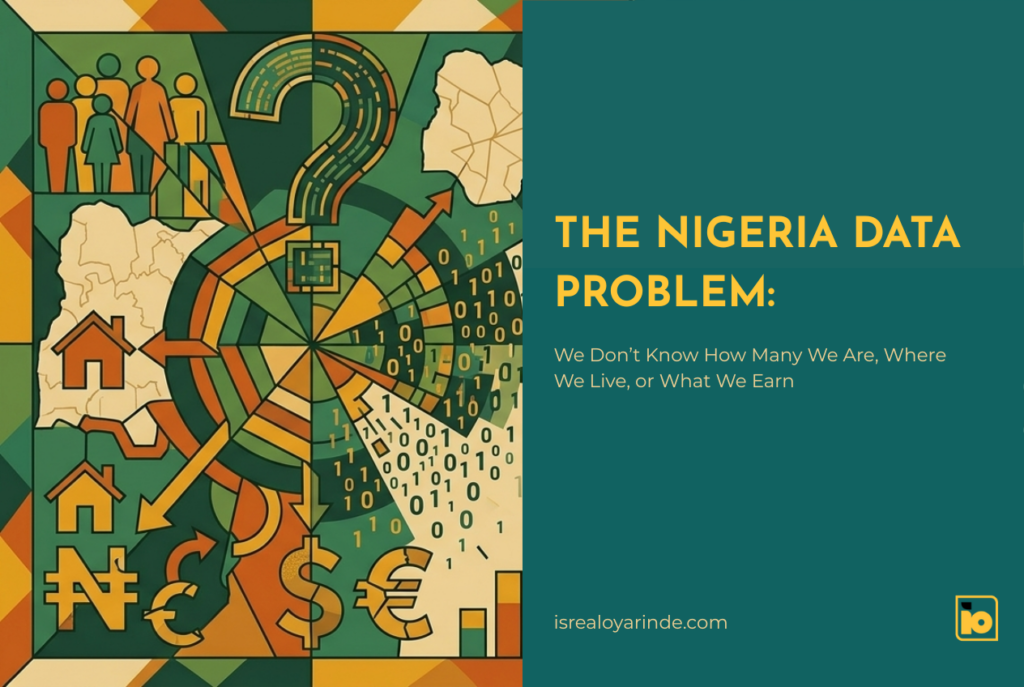
The Nigerian Data Problem: We Don’t Know How Many We Are, Where We Live, or What We Earn
In God we trust, all others bring data. – W. Edwards Deming In 2023, I was working on a business plan for a client who wanted to launch a logistics company in Kano State. Simple enough, right? Except it wasn’t. We needed basic data. The population of Kano metropolitan area, number of registered businesses, average household income, road network coverage, number of delivery addresses and that is where it became a nightmare. You would think this information would be readily available for the most populous state in Nigeria. You would be wrong. The population figure we found ranged from 9 million to 16 million depending on which source you used. The Natonal Bureau of Statistics had one number, the state government had another. The UN population estimates had a third. The World Bank used yet another figure. And the last actual census was in 2006, nearly two decades ago, when the Kano population was counted at about 9.4 million. In a state growing at maybe 3 percent annually, the current population could be anything. We were literally guessing and our guesses were not even informed by any reliable data. The number of registered businesses? No comprehensive database exists. Average household income? The NBS does household surveys, but the sample sizes are small, the methodology is questionable, and the data is years out of date by the time it is published. Road network coverage? I called three different agencies and got three completely different answers. Number of delivery addresses? Nigeria does not have a functional address system. Most streets in Kano do not have names. Most houses do not have numbers. How do you run a delivery company in a country where you cannot describe where people live? That experience crystallized something I had been thinking about for years. Nigeria does not have a data problem, Nigeria has a data crisis. We are running a country of over 200 million people essentially blind. We do not know how many we are. We do not know where we live. We do not know what we earn. We do not know what we produce. We do not know what we consume. And because we do not know any of this, every policy decision is a guess, every budget is fiction, and every business projection is built on vibes and In Sha Allah. This is not a minor administrative inconvenience. This is a fundamental governance failure that affects every aspect of Nigerian life, from healthcare to education to infrastructure to security. You cannot solve problems you cannot measure. You cannot allocate resources to populations you cannot count. You cannot plan for a future you cannot model. And yet here we are, the giant of Africa, stumbling around in the dark because we refuse to turn on the light. The Census Catastrophe Let us start with the most basic data point of all. How many Nigerians are there? The honest answer is nobody knows. Nigeria’s last census was in 2006. It counted 140 million people, a number that was immediately controversial. Northern states claimed they were undercounted. Southern states claimed the north was overcounted. Ethnic groups accused each other of inflating numbers for political advantage. The census became not a statistical exercise but a political weapon, because in Nigeria, population determines revenue allocation, political representation, and power. The 2006 census itself was riddled with problems. Enumerators were poorly trained. Some areas were inaccessible due to security concerns. The technology was outdated. There were widespread allegations of manipulation. The results were challenged in court by several states. And yet, nearly twenty years later, this deeply flawed count remains the official basis for planning in Africa largest economy. The World Bank and the UN use projections based on this flawed baseline, which means their estimates are also unreliable. A new census has been planned, postponed, replanned, and re-postponed multiple times. The National Population Commission has been promising a new census for over a decade. Each time, the exercise is derailed by political disagreements, funding shortfalls, or security concerns. Meanwhile, the gap between our population estimates and reality grows wider every year. Are we 210 million? 220 million? 230 million? Nobody can say with confidence, and the margin of error is not a few percentage points but potentially tens of millions of people. The political dimension of the census cannot be overstated. In Nigeria, population is money and power. Federal revenue allocation is partly based on population. States with larger populations get more money. The number of House of Representatives seats is based on population. So every census becomes a high-stakes political battle. Until we can decouple the census from resource allocation, or find some way to make the count politically neutral, we will continue to fight over numbers instead of collecting them. NBS and the Methodology Problem The National Bureau of Statistics is supposed to be the authoritative source of data on the Nigerian economy and society. In fairness, the NBS does important work with limited resources. But the limitations are severe, and they undermine the reliability of virtually everything the NBS publishes. Take the unemployment figure for example. For years, the NBS reported Nigeria’s unemployment rate as being in the low single digits, which was laughable to anyone who had walked through any Nigerian city and seen the armies of young people with nothing to do. The problem was methodological. The NBS was using the International Labour Organization definition of unemployment, which counted anyone who had done even one hour of work in the past week as employed. A man who washed one car for two hundred naira on a Saturday was classified as employed. A woman who sold three sachets of pure water on a Monday was employed. The definition bore no relationship to the reality of Nigerian labour markets. Eventually, the NBS adopted a broader measure that better captured underemployment and disguised unemployment, and suddenly the combined unemployment and underemployment rate jumped to over 33 percent. The economy had not changed. The measurement
Can and Should the Government Solve All Issues?
Every four years, Nigerians go to the polls looking for a messiah. Not a president, not a governor, not a local government chairman —a messiah. Someone who will fix the roads, bring light, lower prices, create jobs, cure corruption, and somehow make garri affordable again. All at once. Preferably within the first 100 days. And every four years, we are disappointed. Shocked, even. As if the last ten electoral cycles did not teach us anything. I am not saying the government does not matter. It matters enormously. But there is a dangerous gap between what the government should do, what the government can do, and what Nigerians expect the government to do. And that gap is where our collective frustration lives. So let us have an honest conversation: can the government solve all our issues? Should it even try? The Nigerian Messiah Complex We have a peculiar relationship with government in Nigeria. We simultaneously despise it and depend on it completely. We curse the governor on Twitter and then write him a letter begging for school fees. We call politicians thieves, then queue up at their houses for “stomach infrastructure” during elections. This is the Messiah Complex at work. The belief that somewhere out there, there is a leader who, if only they could get into power, would transform Nigeria overnight. Tinubu will do it. Obi will do it. Atiku will do it. Insert-name-here will do it. Nobody is doing it. Not because they are all individually terrible (though some are), but because the expectation itself is impossible. No single human, no single administration, can fix a country with 200 million people, 36 states, 774 local governments, hundreds of ethnic groups, decades of infrastructure neglect, institutional decay, and a culture that treats public office as a personal ATM. The Messiah Complex is not just naive. It is actively harmful. It encourages passivity. If the government is supposed to fix everything, then your role as a citizen is simply to wait, complain, and vote every four years. You do not organize your community. You do not maintain your street. You do not build parallel systems. You just wait for the saviour who never comes. Our streets have failed, created wealth through corruption, and took a lot from the society we have. Where we differ is there is no real debate about whether the government should do more. The overwhelming demand, the overconsumption of government promises, and the lack of proper systems and due process all combine to create the illusion that more government is always the answer. What Government Should Do (And Cannot Escape) Let me be clear. There are things that only the government can and should do. As an entrepreneur, I am all too aware of the costs of government failures in my business. These crucial services are non-negotiable, and no amount of “self-reliance” rhetoric changes this. These are the government’s core functions. The problem in Nigeria is not that the government tries to do these things. The problem is that it fails spectacularly at them while simultaneously trying to do a hundred other things it has no business doing. What Government Should Not Do (But Tries Anyway) Here is where it gets controversial. The Nigerian government has a long history of inserting itself into areas where it has no comparative advantage, usually with disastrous results. The fuel subsidy, which cost Nigeria over N4 trillion in 2022 alone, is the mother of all price control disasters. Instead of letting the market price signal direct investment into refining capacity, we spent decades subsidizing consumption of imported fuel, enriching a cartel of importers, and starving the economy of resources for health, education, and infrastructure. The government is terrible at targeting, terrible at distribution, and terrible at verification. The common thread in all these failures is that the government tried to be a market actor instead of a market enabler. The government should create the conditions for economic activity —stable rules, fair enforcement, sound infrastructure not try to be the economy itself. The Private Sector Gap Now, some of you are thinking: “If the government steps back, the private sector will fill the gap.” And in many areas, that is true. Nigerian entrepreneurs are among the most resilient and creative in the world. We build fintech platforms that bypass broken banking infrastructure. We create logistics networks that work despite terrible roads. We generate our own electricity. We dig our own boreholes. We are, in many ways, already running a parallel economy. But the private sector has its own limits, especially in Nigeria. This is the fundamental tension: the government is terrible at delivering services, but the private sector will not deliver them to everyone. There are market failures that only the government can address, and there are government failures that only markets can correct. The answer is not more government or less government. It is better government in its lane, and more space for private enterprise in theirs. Self-Reliance in a Failed State Let me tell you a story. In my estate in Lagos, we got tired of waiting for the government to fix our road. It had been bad for three years. We wrote letters. We called the local government. We tagged the governor on Twitter. Nothing happened. So we taxed ourselves. Every household contributed. We hired a contractor. We fixed the road. Cost us about ₦15 million collectively. It has lasted longer than most government roads, probably because we supervised the contractor ourselves instead of letting someone’s cousin do it with substandard materials. This is self-reliance in a failing state. And it is happening all over Nigeria. This is not ideal. It creates a two-tier society where the wealthy can buy their way out of government failure while the poor suffer. But it is the pragmatic response to a government that collects taxes and delivers almost nothing in return. If you treat the government like a service provider, you have purchasing power to ask: why am I paying this
How to Develop a Growth Mindset in a Country That Rewards Survival Over Ambition
I grew up in a household where the highest compliment anyone could give you was that you were ‘sharp.’ Not intelligent, not hardworking, not creative —sharp. Being sharp in the Nigerian context meant you knew how to navigate difficult situations, avoid trouble, and squeeze something out of nothing. Sharpness was the supreme virtue because sharpness kept you alive, and in a country where systems fail regularly and institutions cannot be trusted to protect you, staying ahead economically, physically, and socially was the primary objective. Nobody talked about the growth mindset. The conversation was always about today. How to survive today; how to eat today; how to pay rent today. And I understand why. Why the Growth Mindset is the Most Important Skill You Will Build When your daily existence is a series of obstacles that require all your energy and ingenuity just to survive, thinking about personal growth feels like a luxury you cannot afford. But the truth is that the survival mindset, while necessary and even admirable, is also a trap. It keeps you alive but it also keeps you exactly where you are. It is like treading water, you do not drown, but you do not go anywhere either. The growth mindset is what takes you somewhere, and developing it in a country like Nigeria is one of the most important and most difficult things you will ever do. Understanding the Survival Mindset and Why Nigeria Breeds It Before we talk about growth mindset, we need to understand what we are working against. The survival mindset is not a character flaw. It is a rational response to an irrational environment. When you live in a country where inflation can wipe out your savings overnight; where your employer can owe you six months of salary without consequence; where a medical emergency can bankrupt your entire extended family; and where the government’s primary function seems to be extracting resources from citizens rather than providing essential services, the first instinct you develop is survival. When this is your reality, of course you develop a short-term, defensive, risk-averse orientation. You focus on immediate returns because the future is uncertain and long-term investments feel like gambling. You prioritize social capital over genuine connections because knowing the right people, being connected, being ‘plugged in’ is the ultimate strategy in a country where formal institutions do not work. All of these make perfect sense as a survival strategy, and I would never criticize anyone for adopting it. I have seen instances where patients are turned away from public hospitals because “there are no beds”, yet one phone call to the right person could make a bedspace materialise. Personal relationships are the only reliable safety net where institutions are unforgivably weak. But I want you to understand that while the survival mindset keeps you safe, it also keeps you small. It prevents you from taking the calculated risks that lead to breakthrough growth. It prevents you from investing in skills and knowledge that pay off over years rather than weeks. It prevents you from building businesses and institutions that create lasting value. Ẹni tí ó bá bẹ̀rù ojúbọ a lọ sí ọjà —he who fears the shrine goes to the market instead. But the market of survival only offers subsistence, not abundance. The Nigerian environment actively punishes growth-oriented behavior in subtle and not-so-subtle ways. The formal financial system offers savings rates that are consistently below inflation, which means that saving money in a Nigerian bank is actually losing money in real terms. And if you decide to start a legitimate business, barriers to entry are so formidable that many people conclude that hustling and trading are more rational strategies than building formal enterprises. I have watched brilliant, ambitious young Nigerians get beaten down by this environment until they abandon their dreams and settle for survival. Not because they lacked talent or drive, but because the system made growth so difficult and survival so all-consuming that there was simply no space left for aspiration. This is the real tragedy of the Nigerian survival mindset. It is not that people choose survival over growth, it is that the system gives them no other viable choice. What Growth Mindset Actually Means if You Are a Young Nigerian The term ‘growth mindset’ was popularised by Carol Dweck, a psychologist at Stanford University, and it refers to the belief that your abilities, intelligence, and talents can be developed through effort, learning, and persistence, as opposed to a ‘fixed mindset,’ which assumes that these qualities are innate and unchangeable. In the Nigerian context, I want to expand this definition beyond individual psychology to include a set of practical orientations that enable long-term growth despite environmental obstacles. A Nigerian growth mindset includes the belief that you can improve through learning and effort, but it also includes the strategic patience to invest in long-term outcomes, the courage to take calculated risks in an uncertain environment, the discipline to resist the social pressure for immediate consumption, and the resilience to persist through setbacks that would crush most people. It is not about being naively optimistic or ignoring the very real obstacles that Nigerian life presents. It is about choosing to invest in your future even when the present is demanding all your attention, and doing so in a way that is smart, strategic, and grounded in reality. This is hard. I am not going to pretend it is easy. But it is the only path I know that leads from where you are to where you want to be. Rewiring Your Relationship with Failure and Risk One of the most crippling aspects of the survival mindset is its relationship with failure and risk. In survival mode, failure is catastrophic because you have no safety net. If your one income source fails, you cannot eat. If your small business collapses, you cannot pay rent. If you invest your savings and lose them, there is no social security system to catch you. This fear of failure
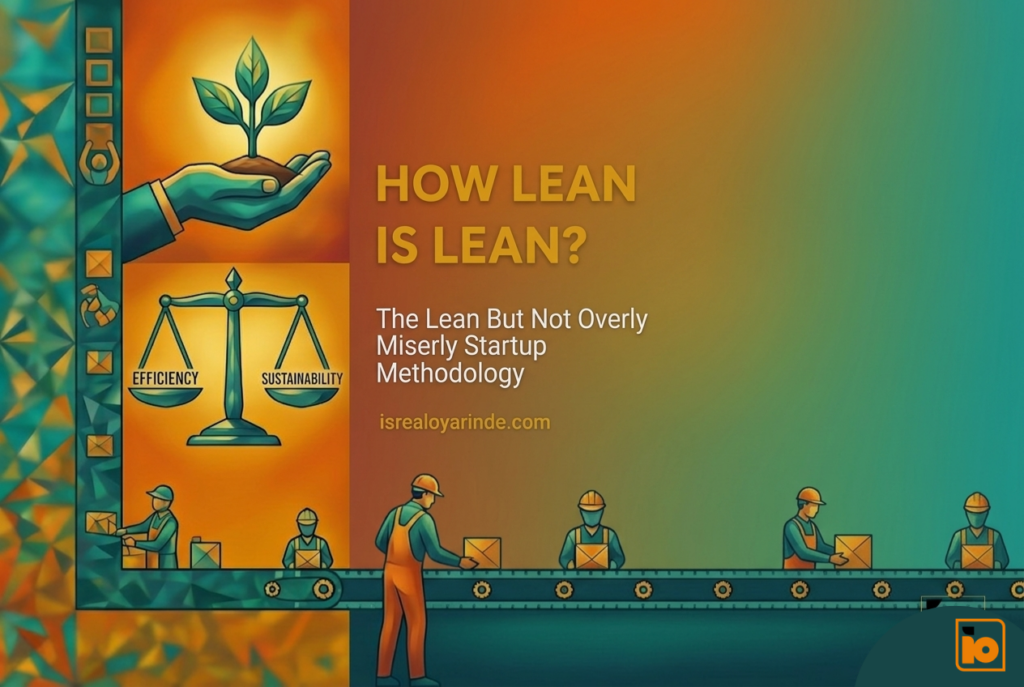
How Lean Is Lean? The Lean But Not Overly Miserly Startup Methodology
I once spent three months manually updating a spreadsheet that a $15/month tool could have automated in seconds. I told myself I was being ‘lean.’ I was being an idiot. Here is everything I have learned about the difference between the two. As a business owner, there is a fine balance between being lean and being miserly. Starting out in business, some of my decisions were wasteful, and now, I try to be efficient and judicious with resources. However, being efficient and lean does not mean “starving your business.” It does not mean refusing to experiment or trying to extract as much value as possible without loosening up a growth constraint. We hear stories of Jeff Bezos using a door as a desk, or Nigerians soaking garri for years while building their hustle, and we internalize a dangerous lesson, which is not the main point they are trying to pass across by the way, that suffering is a KPI. It is not. Suffering is a bug, not a feature. The difference between being lean and being Miserly is that one optimizes for speed of learning and the other optimizes for an inevitable death. What “Lean” Actually Means (Thank You, Eric Ries) Let us start with what lean actually means because the word has been abused more than “disruptive” at a Lagos tech meetup. Eric Ries published The Lean Startup in 2011, and the core idea is deceptively simple: minimize waste by building only what customers actually want, using a Build-Measure-Learn feedback loop. You build a Minimum Viable Product (MVP), measure how customers respond, learn from the data, and iterate. The goal is validated learning, not validated suffering. Ries was influenced by Toyota’s lean manufacturing, where waste (“muda”) is anything that does not add value for the customer. Notice that Toyota did not say “use the cheapest steel” or “skip quality control to save money.” They said eliminate unnecessary steps. That is a critical distinction. Y Combinator’s data on thousands of startups tells an interesting story. According to their analysis, the number one reason startups die is not running out of money — it is building something nobody wants. The second biggest killer is running out of cash, but often because the founders spent money on the wrong things (fancy offices, premature hiring, vanity marketing) rather than on validating their core hypothesis. Paul Graham famously said startups do not die from starvation; they die from indigestion. Spend on learning. Cut everything else. The Penny Wise, Pound Foolish Trap True Lean Methodology is about minimizing waste, not minimizing spending. Building something nobody wants is the ultimate waste. Using capital to find out what customers actually want faster? That is lean. It is easy to confuse the two, and experience is the best teacher, but even seasoned founders still get it wrong. Here is a simple example: say you refuse to pay for a $20/month software subscription (roughly ₦30,000) that would automate a 5-hour task, choosing instead to do it manually to “save money.” If you value your time as a CEO at even ₦5,000 per hour — which is extremely low — that 5-hour task costs the company ₦25,000 every single time you do it. The software costs ₦30,000 for the whole month. By being “miserly,” you are actually burning equity and executive bandwidth on administrative chaff. Your job as a business owner is to know what problem you solve and what outcome you create. Everything else is overhead. And overhead should be automated, delegated, or eliminated. Now, there are legitimate reasons to be careful with spending. If paying for the tool will adversely affect your runway, then spending some extra time to handle a task manually so you can redirect resources into where you are seeing more traction is worth it. Also, not all tools really optimize your process. One thing I do every year is audit and eliminate pricey tools and find better deals to avoid tool bloat. Some Nigerian SaaS tools worth knowing about: The Cost of Cheap Talent If you are starting out, I think you are better off with people who have intermediate expertise, for want of a better phrase. When you are pre-revenue, shelling out for top talent that does not have structure to excel will only cause you to waste resources because they will charge top rates. However, once you have traction, two things must happen: first, make sure the people who started with you grow as the company grows; and second, stop trying to hire the cheapest possible staff. For example, a senior developer will obviously charge more. In Nigeria, a solid mid-level full-stack developer charges between ₦500,000 to ₦1,500,000 monthly. A junior might cost ₦150,000 to ₦300,000. That looks like savings until you realize the junior will delay your time to market by three to six months and create technical debt that will crash your software on launch day. When you optimize solely for cost extraction rather than value creation, your product feels “enshittified” from Day One. I have been there. It cost me a year on a relevant product launch. The cost of fixing bad code, re-hiring after firing the incompetent cheap hires, and the reputational damage of a buggy launch is always higher than the cost of hiring right the first time. Y Combinator’s Sam Altman (before he went off to run OpenAI) used to say that you should spend the first 25% of your budget on getting the best possible first three to five hires. Because those people set the culture, the code quality, and the operational DNA of your company. Cheap out on them and you are building on sand. Infrastructure Is Not a Luxury We have obvious, if unique, infrastructure challenges in Nigeria. Investing in tools to make your work smooth is not optional —it is essential. My two best purchases work-wise are my fully off-grid solar and inverter system and my Starlink. My biggest issues used to be electricity and internet connectivity: network failing and electricity
The Perpetual Machine: Building Operations Systems That Run Themselves
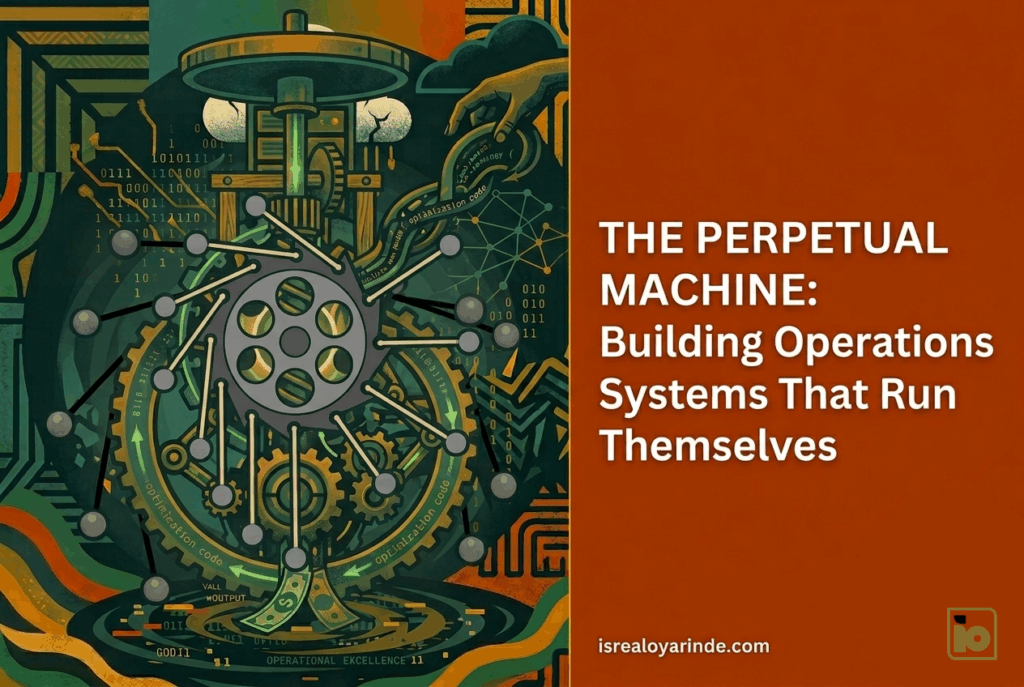
The idea of a perpetual machine seems exciting. Something that runs on its own without any input. As an entrepreneur reaching this point in my businesses is my ultimate goal. Having resilient and profitable businesses that do not need me slaving away at my desk for the better part of 18 hours a day so I can have time to do other things I love and spend time with the people I care about. In this article, I will be sharing some advice that has worked for me as I am building. I do not purport to know it all as I am still in the process of transitioning from a solopreneur to a CEO myself. So, I would love for you to think of this as an ongoing conversation. Let’s get into it. Where (or Who) Is the Battery? In science fiction, a perpetual machine is a hypothetical device that operates indefinitely without any external energy source, producing work or motion forever. A perpetual machine is deemed scientifically impossible so why is it something to aspire to in business? I think as entrepreneurs we aspire to this impossible “machine” not because we think we can ignore the laws of physics, but because we want to minimize the “Energy of Supervision.” Simply put, we want to reduce our input to the very minimum while simultaneously getting maximum output out of the business. So the idea is not that we get to a point where we can completely ignore the business and it just continues to run efficiently on its own. Rather, it is that we are minimising input for maximum output. The hardest part of building a perpetual motion machine is finding out where to hide the battery. Basic science tells us that a machine cannot run forever without an energy source. But a machine can run without a huge battery or energy pack attached to it. The battery can be tiny and inbuilt and it is the same with businesses too. We look at companies with presence in multiple countries that have existed for decades, long after the original visionary is retired or dead and wonder how they continue to run. In most Nigerian businesses, the “battery” is the founder. The business runs on them. Remove the founder and the whole thing grinds to a halt like a generator that just ran out of diesel. I have watched it happen more times than I can count. A sharp Oga builds a thriving business, employs 30 people, handles the biggest clients personally, negotiates every major deal, and signs every cheque. Then he travels for two weeks, and by the time he lands at Murtala Muhammed, three clients have complained, two staff have been fighting, and someone has been helping themselves to petty cash. The business did not collapse because of the market. It collapsed because the entire operation was a one-man show wearing a company costume. In software engineering, there is a concept called the “bus factor.” It asks: how many people on your team would need to be hit by a bus before the project stalls? If the answer is one, you have a problem. In most Nigerian SMEs, the bus factor is literally one: the founder. If they get sick, travel, die, or simply burn out, the business is finished. The Tribal Knowledge Problem The root cause is what I call “tribal knowledge,” information that lives in your head and nowhere else. You know which supplier gives you the best rate. You know which staff member cannot be trusted with cash. You know that Client A always pays late but Client B will bounce a cheque entirely. You know that LASTMA operates heaviest on Tuesdays on that particular route your delivery trucks use. All of this is critical operational intelligence. And none of it is written down. When you leave, all of that leaves with you. Your replacement, whether it is a hired manager or your own child, starts from zero. They make mistakes you solved ten years ago. They trust the wrong people. They take the wrong route on Tuesday. And they wonder why things are not working. This is the exact pattern that killed countless Nigerian businesses. Ekene Dili Chukwu ran like clockwork under its founder. Within years of his passing, the fleet was in disrepair, routes were mismanaged, and the brand that once dominated the East became a memory. The same story plays out in restaurants, law firms, trading companies, and tech startups. The founder was the system, and when the founder left, the system left too. The Franchise vs Buka Test Here is a simple test for whether your business is a system or a personality cult: could someone franchise it? Think about Chicken Republic. Whether you walk into the one in Lekki or the one in Abuja, you get roughly the same experience. The jollof rice tastes the same. The service follows the same pattern. The menu is the same. That is not because every branch has the same brilliant manager. It is because there is a system, SOPs, checklists, training manuals, supply chain processes, and quality controls that ensure consistency regardless of who is behind the counter. Now think about your favourite local buka. Mama Nkechi’s rice is legendary. People drive across town for it. But what happens when Mama Nkechi is sick? Or when she travels to the village for a funeral? The rice does not taste the same. Customers notice. Some stop coming. If Mama Nkechi retires, the buka closes. Her recipe, her timing, her seasoning instincts, all tribal knowledge that was never transferred. The difference between a Chicken Republic and a Mama Nkechi buka is not talent, it is systems. And if you want to build something that outlasts you, you need to build systems. The ‘If I Die Tomorrow’ Document The fix is simple, though not easy. It is the “If I Die Tomorrow” document. You need to move knowledge from your brain to a repository. But
The Enshittification of Brands: When Growth Becomes Rot
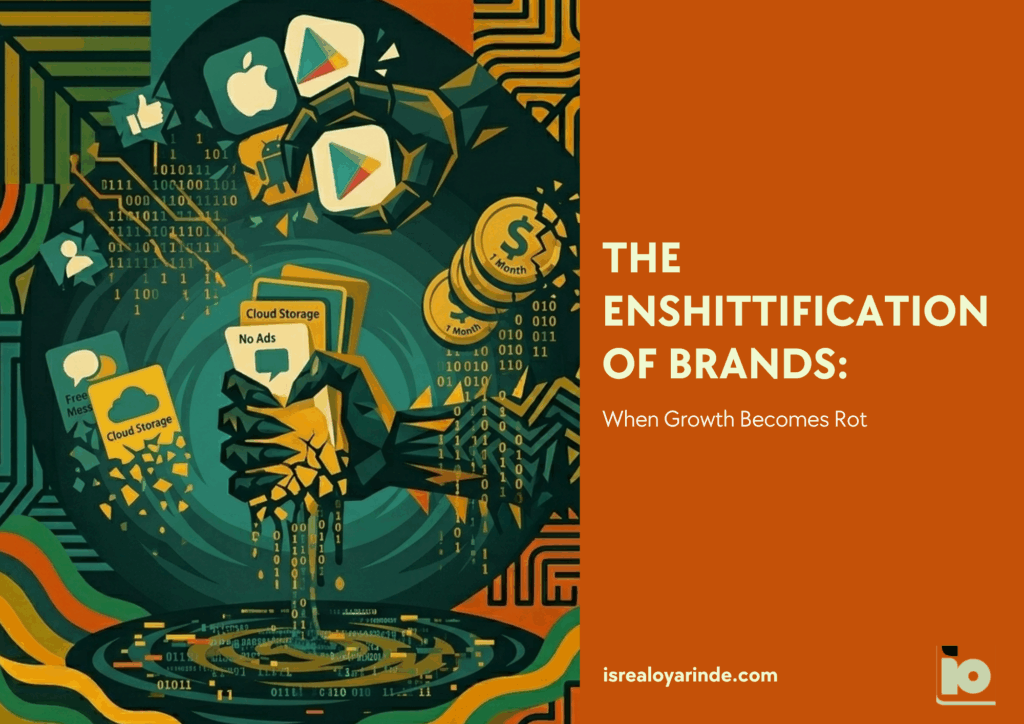
When Did This Start Tasting Different? You know that moment when you open a pack of something you have been buying for years and something feels… off? The biscuit is smaller. The flavour is thinner. The packaging looks the same, maybe even fancier, but the product itself has quietly, subtly, become worse. You ask yourself: “Did my taste change, or did they change the recipe?” The answer, almost always, is that they changed the recipe. And they are hoping you will not notice. There is something called “Enshittification” where sellers create more products, stuff in more features, add more flavours, and advertise, but then slowly erode the quality of those products to increase profit margins. The term was coined by Cory Doctorow, the Canadian-British writer and digital rights activist, in a 2023 essay. He originally used it to describe how technology platforms degrade over time: first they are good to users to attract them, then they are good to business customers at users’ expense, then they are good to nobody except shareholders. But the concept applies far beyond tech. It is a universal disease of capitalism, and Nigerian brands are not immune. The Lifecycle of Enshittification Every enshittified brand follows roughly the same trajectory: Phase 1 – The Honeymoon: The brand launches with genuine quality and value. They need customers, so they deliver their best. The product is excellent, the price is fair, the customer service is responsive. Think of Nigerian banks when they first launched mobile banking, zero charges, instant transfers, 24/7 customer support. Remember when GTBank was actually innovative? Phase 2 – The Squeeze Begins: Growth slows. Investors want returns. The CFO starts asking uncomfortable questions. So the brand starts making small changes. A little less product for the same price. A fee here. A surcharge there. Reduced customer service hours. They test how much they can take before customers notice. Phase 3 – The Extraction: Now the focus has fully shifted from “how do we make this better?” to “how do we make more from this?” Quality drops. Costs are cut. The brand coasts on its reputation while actively depleting it. Every decision is a spreadsheet exercise. The customer is no longer the priority; the shareholder is. Phase 4 – The Exodus: Customers start leaving, slowly at first, then all at once. The brand wonders what happened. But by this point, the damage is done. The trust account is overdrawn. Nigerian Case Studies in Enshittification The Indomie Debates: Ask any Nigerian over 25 and they will swear that Indomie used to taste better. The noodle strands were thicker, the seasoning was more potent, the portion was bigger. Is it nostalgia? Maybe partly. But the objective reality is that the product has been reformulated multiple times, portion sizes have been adjusted, and ingredient quality has shifted. The brand remains dominant because of its distribution power and brand loyalty, but the gap between what Indomie was and what it is now is a textbook example of incremental enshittification. Bank Service Degradation: Nigerian banks are a masterclass in enshittification. They once competed fiercely on service quality. Now they compete on who can charge the most fees while providing the least service. SMS alert charges. Card maintenance fees. Transfer charges. Stamp duty. USSD charges. Meanwhile, the apps crash during salary week, the customer care lines play hold music for 45 minutes, and branch visits feel like a punishment. They have monetized every touchpoint while degrading the experience at every touchpoint. Revenue is up. Customer satisfaction is in the gutter. Ribena and the Quiet Reformulation: When Suntory acquired Ribena from GlaxoSmithKline, the formula changed. Sugar was reduced (partly due to UK sugar taxes), and many consumers, including Nigerians who grew up on the brand, noticed the taste difference immediately. The brand kept the same packaging, the same marketing, the same price, but the product was fundamentally different. That is enshittification with a health-washing veneer. The Global Disease: Boeing, Twitter, and the Rest This is not just a Nigerian problem or a consumer goods issue. Some of the biggest brands including digital businesses and SAAS companies in the world have enshittified themselves into crisis: Boeing: Once the gold standard of aviation engineering, Boeing shifted from an engineering-first culture to a finance-first culture after the McDonnell Douglas merger. Cost-cutting, outsourcing critical engineering, and prioritizing shareholder returns over safety led to the 737 MAX disasters that killed 346 people. The stock price had been going up for years. On a spreadsheet, Boeing looked like a success. In reality, they were extracting from their most valuable asset: their engineering reputation. Twitter/X: The platform that once prided itself on being the “global town square” has been systematically stripped of the features and people that made it valuable. Verification became a paid product rather than a trust signal. Moderation was gutted. APIs were locked behind paywalls. The result? Advertisers fled, power users migrated, and the platform’s cultural relevance has eroded steadily. Amazon: Search for any product on Amazon today and the first page is dominated by ads and sponsored listings. The search experience has degraded so much that many users now add “reddit” to their Google searches to find genuine product recommendations. Amazon prioritized ad revenue over search quality, and users are finding workarounds. The Spreadsheet Illusion: When Metrics Mask Decline There are also some pricing innovations where brands try to make more from existing customers, increasing pricing bit by bit, more features. But the thing that comes to the fore is when the focus changes from “how do we make this better?” to “how do we make more from this?” And that is where the first sign of the quiet, subtle decline begins. On a spreadsheet, enshittification looks like success. Your margins look good. Revenue is up. Cost per unit is down. Efficiency ratios are improving. The quarterly report is beautiful. But here is where they move from value to tactics for some squeeze to extract. The issue is that you are extracting value from the
To Rent or To Buy a House: The Nigerian Housing Dilemma
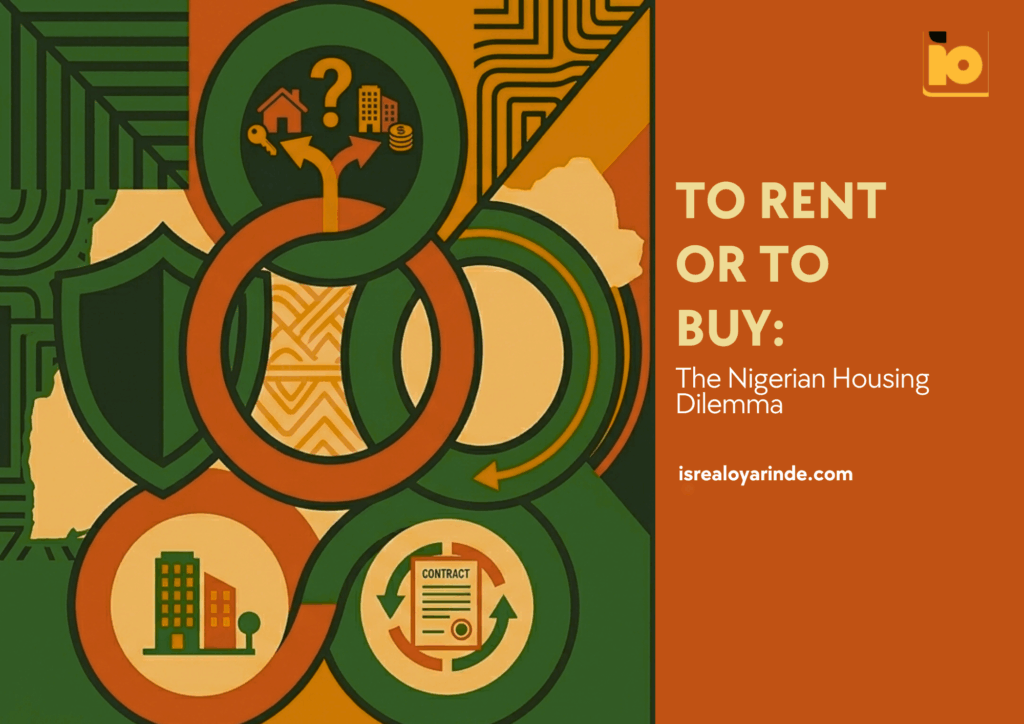
The first time someone told me I was “wasting money on rent,” I was sitting in a rented apartment in Ajah, eating jollof rice I could actually afford because I hadn’t sunk my entire net worth into a building. The person giving me the advice? A landlord who had been trying to sell a property in Lekki for eight months with zero offers. The irony was thicker than Lagos traffic on a Friday evening. The rent-versus-buy debate in Nigeria is one of those conversations that generates more heat than light. Everyone has an opinion, most of them inherited from parents who built houses in the 1980s when a plot of land in Ikeja cost less than a Toyota Corolla costs today. But the Nigeria of 2026 is not the Nigeria of 1985. Inflation is different. Interest rates are different. Urbanisation has changed our desires of what a good home is. The entire structure of how wealth is built and preserved has also shifted. So let us actually do the math, strip away the emotions, and figure out when renting wins, when buying wins, and when you should just mind your business and ignore your uncle’s WhatsApp forwards about “landed properties near Dangote refinery.” The Nigerian Dream of Owning a House Interesting topic because while the capitalist in me wants to make bank like Lagos and Abuja landlords, the socialist in me balks at the high price. As such, the realist in me definitely prefers the lower-priced rent and ample space of Arepo, or Magboro and Mowe. But of course, there’s always our parents’ voice in our head that says “Why are you paying rent? You’re making your landlord rich” “Buy your own land, start building your house” “This money you just paid as rent can build the foundation” It’s like the Nigerian dream, if one ever existed. In fact, many of our parents started with one or two rooms in an uncompleted building before building out the rest. But times have changed. You certainly can’t do that in most parts of Lagos, that is even if you can afford to buy a quarter plot and build, or buy a house that can see into your neighbour’s bedroom. To put it in perspective, the average price of a 3-bedroom flat in Lekki Phase 1 now sits between N80 million and N200 million depending on the estate. In Abuja’s Maitama or Asokoro, you are looking at N150 million to N400 million for a decent detached house. Meanwhile, the median income in Lagos is roughly N150,000 to N250,000 a month. The gap between what people earn and what houses cost is not a gap; it is the Grand Canyon. According to the Centre for Affordable Housing Finance in Africa, Nigeria’s housing deficit stands at approximately 17 to 28 million units, depending on who you ask. The National Bureau of Statistics puts home ownership at about 25% in urban areas. Compare that to South Africa at around 65%, Kenya at 26%, and even Ghana at about 47%. We are not just behind; we are running the race in the wrong direction. The Math Behind Renting To take another look at our parents’ advice, for most people in the building phase of wealth, buying a house is making a financial mistake, except, of course, it is for investment purposes. The main argument is always: “Rent is a waste. At the end of the year, you have nothing to show for it.” Let’s test that. Imagine you want to live in an apartment in Lekki/Ajah worth N200 million. The rent for that house, a Phase 2 apartment, likely costs 4 million to 5 million a year. That is a rental yield of 2% to 2.5% per year. If you buy the house and live in it, you’re locking down N200 million of capital to save N5 million in rent, but that means that N200 million is working for you at a 5% return. In an economy with almost 30% inflation (yeah, it’s going down), that is a CAPITAL DISASTER. If you took the same N200 million and put it in a safe instrument, even a simple Treasury Bill or a Eurobond fund doing 10%, you’ll make N20 million a year. You could pay your N5 million rent and still have N15 million leftover. In this scenario, renting is actually profitable. Also, if you’re a business owner, putting in N200 million into inventory or expansion should yield 20-30%. Turning your capital into concrete means you are killing your business growth to satisfy your ego. Let me put it even more starkly. Nigerian rental yields are among the lowest in Africa: This means that as a landlord in Lagos, the rent you collect barely covers 2-4% of the property value per year. As a tenant, you are getting an incredible deal relative to the asset value you are occupying. The math favours renting in Lagos more than almost any other major African city. The Math Behind Buying Now that I’ve badmouthed buying a house enough, that does not mean you should never buy. Buying is not always a bad deal. It depends entirely on your situation, your goals, and your capital structure. For example, a house can be a financial investment. Say you get a mortgage at 9.75%, and you buy a house in an area giving you at least 10%, even if you’ll still be adding some money. If you rent out the whole house and are able to use the rent to offset the mortgage cost for a period of 10 years, you essentially get a 100 million property for 10 million plus the returns for 10 years. Only a few asset classes can turn 10 million to 100 million in 10 years, possibly more because the house could appreciate as much as 150 million plus you’d still be collecting rent. Of course, maintenance costs apply too. The challenge, however, is that Nigerian mortgage rates are among the harshest in the world and they are
Solopreneur to CEO: A Lazy Founder’s Practical Guide to Building and Leading Teams
People close to me hold two ironic views of me. One is that I am lazy and I delegate too much. The other is that I am somehow hardworking. Both are true. And that contradiction is the entire philosophy of this essay. You Are the Problem (And That’s OK) I am probably a bonafide member of the hustle culture club —you know, the one that sleeps by 3am-4am, up by 8am at most, running on caffeine and persistent burnout. But I also believe it is madness to do the same thing by yourself over and over again. Here is the uncomfortable truth: if you are still the smartest person in the room, and if your business grinds to a halt when you leave, you are not a CEO. You are a glorified freelancer with overheads. To transition from solopreneur to CEO, you must embrace what I call the “Lazy Founder Methodology” which is really about finding the smartest, most leveraged way to set things up so they run without you. Leverage is the keyword here. And the first step? Admitting that you are the problem. If you have created a monopoly where you are the only provider of solutions, you probably have a founder-dependency disease. The good news? It is curable. The bad news? The cure requires you to let go. The SPOF Diagnosis: Are You a Single Point of Failure? I have spoken extensively about “Single Point of Failure” (SPOF) in engineering and business. In most businesses —including, at various points, my own — the founder is the SPOF. You are the Chief Marketing Officer, the Head of Sales, the Customer Support Lead, and the only person who can sign off on anything. You are the bottleneck disguised as a leader. Here is a quick self-diagnosis. Answer honestly: If you answered “no” to more than two of those, congratulations —you are a SPOF. Your business is not a business; it is a job that you created for yourself with extra steps. And the irony is that this job has no leave days, no pension, and the HR department (also you) is terrible. The Eisenhower Matrix is your friend here. Categorize every task you do into four quadrants: The fear of delegation is real. If a task requires your specific skill like strategy or closing high-value clients, you can keep it. But everything else? Start looking for what you can let go of. It is not about burning yourself out less. It is about building something that does not require your fire to stay warm. The next natural step after this is finding qualified and trustworthy people who can take up the things you are letting go of. So, to the next big question, how do you hire? Hiring in Nigeria: A Nightmare With Solutions Let me be honest: hiring in Nigeria is a nightmare. I have had bad hires that did the worst damage to projects precisely because the role was fully remote and unsupervised. In the early days of running Contentika, I found it really hard to find and retain talents. The good ones get entrepreneurial fast or get poached by international companies paying in dollars. The mediocre ones come with inflated CVs, fake experience, and LinkedIn profiles that read like fiction. And let me add, we do not have a robust system to verify credentials the way some countries do. There is no centralized background check database. Reference checks are often a formality where the “referee” is the candidate’s cousin using a different phone number. In short, I would not sugar coat what it takes by simply saying “hire the best people”. The truth is hiring the best people is very hard and keeping them is even harder. But it is not impossible. Here is what I have learned about finding and keeping them: Where to Find Talent How to Filter Do not hire cheaply. When I interview somebody, I run rigorous assessments regardless of their CV. I have seen first-class graduates who cannot write a coherent email and HND holders who can architect entire systems. The paper means less than the proof. Smart people do not come cheap. When you get them “cheap,” you get the enshittification of your product and service. It is a false economy. Budget for talent the way you budget for infrastructure —it is not optional. Documentification: The Ultimate Legacy This is the first thing I did when I started managing people instead of just managing myself: I wrote everything down. Everything. “Documentification” is my term for the obsessive documentation of every process, decision, and standard in your business. It is the single most important thing you can do to transition from solo operator to CEO. Here is why: if the knowledge of how your business operates lives only in your head, it dies when you step away. Every. Single. Time. When starting (or restructuring) a business, script everything: The tools for this are abundant and mostly affordable: This protects against the enshittification of your business. Everything about the decline of your service quality starts with undocumented processes. When the person who “knows how” leaves — and they will leave— the knowledge leaves with them. Documentation is your insurance policy against brain drain. Note that it is not just enough to document, draw data from what you have documented and apply them to improve your processes. No-Trust Architecture: Trust the System, Not the Person “No-Trust” is not about being paranoid or treating your employees like criminals. It is about building systems where consistency does not depend on any single person’s goodwill, competence, or presence. If the quality of your product or service is dependent on your physical presence or specific salespeople, that is a red flag. Build a quality culture instead. SOPs ensure consistency. Consistency builds trust. And trust is cumulative. Every time a customer has the same positive experience regardless of who serves them, your brand equity goes up. Theft is a silent killer, invisible when starting a business. Inventory
Employee Theft and Protection: The No-Trust Architecture
The Day I Caught My Own Cashier I remember the exact moment I knew something was wrong. It was a Thursday evening in 2019, and I was going through the day’s sales records at one of our retail outlets in Lagos. The numbers looked fine on paper. Actually, they looked a little too fine. Every transaction was perfectly rounded. No kobo balances, no odd figures. Just clean, whole numbers. And if you have ever sold anything in Nigeria, you know that is not how reality works. Reality is messy. Reality has N3,475 and N11,250 and change that nobody wants to carry. But this ledger? This ledger was fiction. I stayed back that night and told the team I had a meeting. Then I sat in the back office and tried to make sense of the accounting. What I discovered made my stomach turn. My cashier, a young man I had trained, personally vouched for, and even given a salary advance just two months earlier had developed a system. He would ring up items at a lower price, pocket the difference, and at the end of the day, adjust the books. He had been doing it for at least three months. The total? Over N800,000. That is not petty theft. That is a second salary. Although, I felt really betrayed, I did not shout. I did not fight. I sat with the pain for about two days before I acted. Because the truth is, it was not just about the money. It was the betrayal. You bring someone in, you trust them, you build something together and they are quietly bleeding you dry. That experience changed how I think about business security forever. It is what led me to what I now call the No-Trust Architecture. And no, it is not about being heartless. It is about being smart. As the Yoruba elders say, “Ẹni máa jẹ oyin inú àpáta, kì í wo ẹnu àáke” -the person who wants to eat honey embedded in a mountain will not be bothered about the effect on the axe. If you want to protect your business, you cannot be afraid to look closely at the people running it. This post is going to be long. It is going to be detailed. It is going to make some of you uncomfortable, because you will recognise your own businesses in this post. But I would rather you be uncomfortable now than bankrupt later. Let us get into it. Why Nigerian Businesses Are Bleeding Money Silently According to SMEDAN, over 80% of small and medium enterprises in Nigeria fail within their first five years. We like to blame the economy, the government, the exchange rate, NEPA sorry, PHCN or whatever they are calling themselves this week. But the truth that nobody wants to say out loud is this: a significant percentage of these businesses die because the owner’s own staff killed them from the inside. Employee theft in Nigeria is not an occasional problem. It is an epidemic. It is so normalized that some business owners have simply built it into their cost structure. I have heard people say, ‘just add 15% to your pricing to cover what staff will steal.’ Budgeting for robbery is not a business strategy. That is Stockholm syndrome. The EFCC deals with the big fraud cases, the million-naira corporate theft, the politicians, the Yahoo boys driving Benz. But who is dealing with the cashier that takes N5,000 a day? Who is tracking the warehouse manager that ‘damages’ three cartons of stock every week? Who is watching the procurement officer that inflates every invoice by 20% and splits the difference with the supplier? Nobody. Because we have accepted it as the cost of doing business in Nigeria. Here is what makes it worse, most business owners do not even know they are being stolen from. They see declining profits and blame the market. They see shrinking inventory and blame the supplier. They see rising costs and blame inflation. Meanwhile, the thief is sitting right there in the office, greeting them ‘Good morning, Oga’ every day with a smile that costs them millions. Here is what makes it worse, most business owners do not even know they are being stolen from. The people stealing from you will not look like thieves. They will look like your most loyal employees. The Seven Faces of Employee Theft Before we talk about solutions, we need to understand the problem. Employee theft in Nigerian businesses is not one thing, it is at least seven different things, and each one requires a different approach. Let me break them down. 1. The Classic Cash Theft – This is the most straightforward form. The cashier takes money directly from the register, the sales person underreports daily takings, or the accountant siphons funds through fake expenses. In a country where cash is still king, despite everything the Central Bank has tried to do with the cashless policy. I have seen cashiers develop systems so sophisticated that they could teach a masterclass on creative accounting. One woman I heard about would ring up every tenth transaction without recording it. Just skip it entirely. At the end of the day, she would reconcile by adjusting quantities on other transactions. Genius, honestly. Evil, but genius. 2. Inventory Theft (The Warehouse Ghost) – This is where products simply disappear. They walk out of the warehouse in staff bags, in delivery trucks making unauthorised stops, or they get ‘damaged’ with alarming frequency. A friend of mine who runs a provisions store in Surulere told me he was losing an average of N150,000 worth of stock every month to ‘breakage and spoilage.’ When he installed cameras, the breakage mysteriously dropped to almost zero. 3. Time Theft (The Invisible Drain) – This one does not show up on any ledger, but it costs you just as much. Staff who clock in and then disappear for hours. Drivers who take personal detours on company fuel. Employees who run their
An Experience In Nigeria’s Broken Housing Finance System
Recently, I was interested in the process of getting a mortgage facility, and I can say it’s out of reach for most people……